
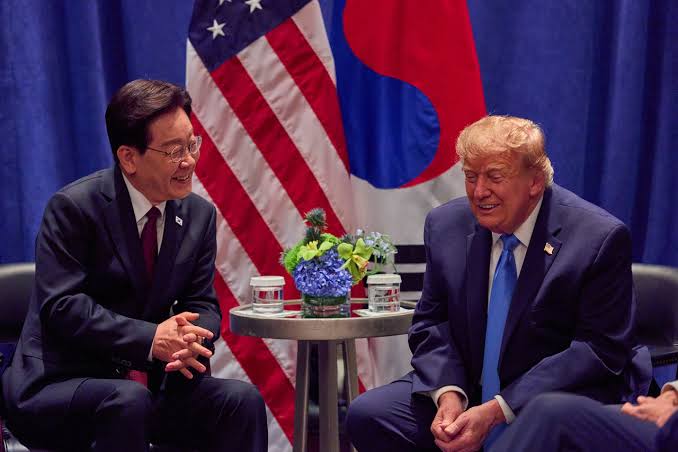
South Korean President Lee Jae Myung and U.S. President Donald Trump held a 30-minute summit on the sidelines of the 81st session of the United Nations General Assembly in New York, discussing several pending security and economic issues, a South Korean official said.
National Security Adviser Wi Sung-lac said the talks covered Seoul’s pursuit of nuclear-powered submarines, rights to enrich uranium and reprocess spent nuclear fuel, the transfer of wartime operational control (OPCON) of South Korean troops from Washington to Seoul, and bilateral shipbuilding cooperation, Yonhap reported.
The meeting marked the third summit between Lee and Trump and was reportedly the first time the envisioned wartime OPCON transfer had been discussed at the summit level. The two leaders agreed to hold follow-up consultations in Washington on the issues discussed.
During the meeting, Trump reaffirmed his commitment to dialogue with North Korea, while the two leaders welcomed progress in bilateral strategic projects. They agreed to maintain close communication in an effort to help restart dialogue between Washington and Pyongyang and establish lasting peace on the Korean Peninsula.
Lee specifically asked Trump to support efforts to resume North Korea-U.S. dialogue. Trump responded positively, saying he has a good relationship with North Korean leader Kim Jong-un, according to the South Korean official.
The summit followed progress on Seoul’s planned investment projects in the United States. South Korea has been working under a $350 billion investment package announced as part of a broader agreement aimed at reducing U.S. import tariffs. A large-scale gas-fired power plant in Texas has been identified as a potential first project under the package.
A South Korean presidential official said Trump repeatedly expressed interest in cooperation in shipbuilding, while Lee emphasized Seoul’s efforts to strengthen its independent defense capabilities, including increased defense spending and accelerated discussions on acquiring nuclear-powered submarines.
The two sides also agreed to continue consultations on nuclear fuel reprocessing, enrichment, shipbuilding and OPCON transfer, building on commitments made at their previous summit.
The meeting did not address the Strait of Hormuz, according to the South Korean official. The Lee administration has faced pressure from Washington over possible military contributions to operations aimed at maintaining freedom of navigation through the strategic waterway.
Lee has repeatedly expressed support for restarting dialogue between North and South Korea and between Pyongyang and Washington, with the longer-term goal of replacing the armistice that ended active fighting in the 1950-53 Korean War with a peace regime.