
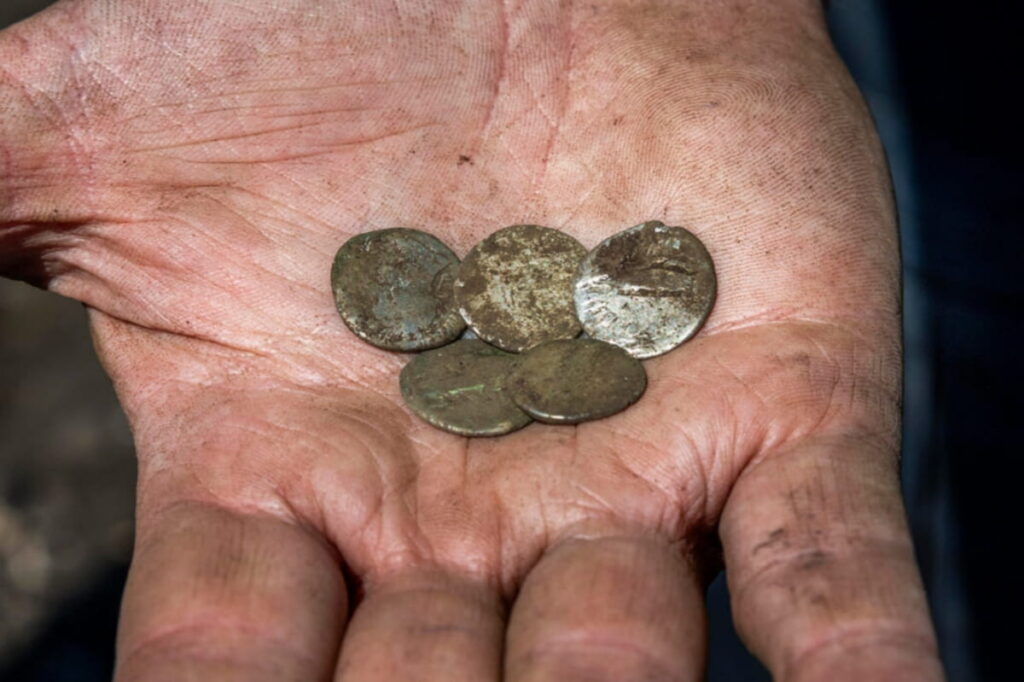
A Roman silver hoard with 45 coins and a gold ring has been found at an ancient farm site on Sweden’s Gotland island.
 Roman silver coins from the hoard. Credit: Daniel Klintholm, Swedish Armed Forces / Gotlands Museum
Archaeologists from Gotlands Museum and Arendus found the objects near Tofta shooting range during surveys linked to the expansion of the Gotland Regiment.
The site had already revealed four building remains from a former farm. Researchers believe the farm was known as Bars gård, with older forms including Bardhs or Bardhes.
Further military expansion led to new archaeological work during the spring. The latest survey uncovered remains from two more buildings within the same farm complex.
 The gold finger ring found alongside the Roman coins. Credit: Daniel Klintholm, Swedish Armed Forces / Gotlands Museum
Near the gable end of one building, archaeologists found a silver hoard. The find contained 45 Roman silver denarii and a gold finger ring.
The coins came from the Roman period rather than the Viking Age. They were struck for five emperors and four empresses over almost a century.
The earliest coins date to the reign of Emperor Trajan, who ruled from CE 98 to 117. Other coins came from the reigns of Hadrian, Antoninus Pius, Marcus Aurelius, and Commodus.
The hoard also included coins issued under Sabina, Faustina I, Faustina II, and Lucilla.
Roman coin expert Lennart Lind examined and identified the coins for Gotlands Museum. His assessment suggests the coins stayed in use long after their original minting dates.
Lind believes the coins reached Gotland during the fourth century. They then entered local trade and stayed in circulation into part of the fifth century.
 A Roman silver denarius struck during the reign of Antoninus Pius. Credit: Daniel Klintholm, Swedish Armed Forces / Gotlands Museum
The gold ring helps narrow down when the objects were buried. Its form appears to match rings dating from the middle of the fifth century.
Based on the coins and ring, researchers place the burial around CE 450. The find therefore reflects trade and the use of Roman money on Gotland centuries after the coins were struck.
The two buildings produced mostly pottery besides the metal finds. A first radiocarbon date also links one building with the fifth century.
Researchers obtained the date from animal bones found inside the building. The result supports the wider dating of activity at the farm during the fifth century.
The metal detector work played an important role in locating the hoard. Daniel Klintholm of the Swedish Armed Forces searched the survey area with a metal detector.
More information: Gotlands Museum