

- Introduction
- Iran: Trump threatens to «annihilate» the Islamic Republic while diplomacy advances at the UN
- Greenland: United States, Denmark, and Greenland sign accord aiming to resolve Arctic crisis
- Germany: successor to the SED wins in Berlin, far right triumphs in the north-east, and the centre collapses
- Canada and the EU: the Saint-Pierre and Miquelon summit
- Media review
- Editorial commentary
Introduction
Over the past twenty-four hours, the 81st Session of the General Assembly of the United Nations (UN) has turned New York into the focal point where nearly all the geopolitical fault lines monitored in these reports intersect. President Donald Trump took to the rostrum to present Tehran’s oligarchical-jihadist regime with a blunt ultimatum—agreement or annihilation—confirming merely hours later that his envoys had met with Iranian representatives on the sidelines of the Assembly. That same Tuesday, he signed a trilateral security accord with Denmark and Greenland aimed at resolving the Arctic crisis sparked in January, when Washington refused to rule out coercive measures to secure control over the island.
Concurrently, significant political shifts occurred on both sides of the Atlantic. In Germany, the regional elections on Sunday 20 September in Berlin and Mecklenburg-Western Pomerania revealed an electorate increasingly polarised by extremes: the legal successor to the party that built the Berlin Wall emerged as the leading political force in the federal capital, the far right secured victory in the north-east, and the Christian Democrats were excluded from a state parliament for the first time in the history of the Federal Republic. That same Sunday, on the French archipelago of Saint-Pierre and Miquelon, French President Emmanuel Macron and Canadian Prime Minister Mark Carney staged an institutional rapprochement between Canada and the European Union (EU), delivering an unmistakable signal to the White House.
This report examines these four developments using the established framework of facts, strategic implications, and outlooks, concluding with an extended editorial commentary addressing the unifying thread: the moral hemiplegia through which much of Europe views its political extremes, and the cartographic temptation with which Washington has approached sovereign allies.
Iran: Trump threatens to «annihilate» the Islamic Republic while diplomacy advances at the UN
Facts
In his address before the General Assembly on Tuesday 22 September, Trump questioned aloud whether he should conclude a pact with Iran allowing it to rebuild and become a great nation, or swiftly annihilate the Islamic Republic to prevent further bloodshed and destruction. He accused Tehran of deliberately stalling a comprehensive agreement regarding the full reopening of the Strait of Hormuz until after the US midterm elections on 3 November, asserting that the regime’s aggression stems not from strength but from weakness and desperation, and boasting that the US Navy has safely escorted over one billion barrels of crude through Hormuz. The majority of the Iranian delegation walked out of the hall during his remarks.
Hours later, the President revealed that his special envoys, Steve Witkoff and Jared Kushner, had met with Iranian representatives, describing the discussion as «very good». Several media outlets characterised this as the first confirmed direct contact since hostilities escalated in February, though Trump referred to a meeting «with the mediators», leaving the precise format ambiguous. Speaking before leaders of the Gulf Cooperation Council (GCC), he maintained that there is «significant momentum» for a settlement, while reiterating that the conflict will not conclude before the elections, expressing confidence in finalising a deal immediately thereafter.

US Vice President JD Vance addresses the press in Islamabad, Pakistan, alongside Jared Kushner and Special Envoy Steve Witkoff, 12 April 2026 – REUTERS/ JACQUELYN MARTIN
On the Iranian side, a senior official informed Reuters that Tehran could restore maritime transit through Hormuz for Gulf shipping within seven days if the United States lifts its naval blockade and eases military pressure. Framing the New York meetings as a «golden opportunity», he confirmed that President Masoud Pezeshkian’s delegation holds full plenipotentiary powers to resume negotiations, though he dismissed the prospect of a bilateral presidential summit. No face-to-face meetings have occurred since July, when the provisional understanding signed by Trump and Pezeshkian collapsed within weeks.
Iranian Parliament Speaker Mohammad Baqer Qalibaf, who led earlier rounds of talks, maintained that Iran will never surrender. Secretary of State Marco Rubio indicated openness to meeting Pezeshkian, while noting that the Iranian president remains strictly subordinate to Supreme Leader Mojtaba Khamenei. Mojtaba Khamenei has not appeared in public since the 28 February strike in which his father was killed and he himself was wounded; his directives are issued in writing or via couriers, leaving his operational health and command capability unverified.
The energy landscape remains highly precarious. Saudi Arabia shut down a strategic crude pipeline last week that bypassed the Gulf maritime bottleneck following strikes by pro-Iranian Iraqi paramilitary groups. Concurrently, the Houthi insurgent movement has expanded territorial control over the Bab el-Mandeb strait, rendering the Red Sea transit route perilous for commercial tankers under the monitoring of the International Maritime Organization (IMO) and the International Energy Agency (IEA).

Mohsen Rezaei, Abbas Araqchi, Gholamhossein Mohseni Ejei, Mohammad Baqer Qalibaf, and Masoud Pezeshkian at the Grand Mosque in Tehran, Iran, 3 July 2026 – REUTERS/ MOHAMMED SALEM
Strategic Implications
The dual messaging—apocalyptic threats in the morning paired with «very good» diplomatic meetings in the afternoon—reflects a recognised negotiating technique. H. R. Haldeman, Richard Nixon’s White House Chief of Staff, detailed in The Ends of Power (1978) how the president sought to convince adversaries he was capable of erratic, extreme measures to extract concessions: the «madman theory». It represents a tactical posture rather than a strategy, and its efficacy diminishes with repetition. Threatening the complete annihilation of a sovereign state from the UN rostrum compromises Washington’s diplomatic authority, particularly when it relies on Gulf partners hosting major US military installations targeted by Iranian strikes.
More significant than the rhetoric is the operational timetable Trump acknowledged. By confirming that an agreement will materialise «after the elections», Trump acknowledged that the military campaign is subordinated to the domestic electoral calendar. In doing so, he validated Tehran’s delaying strategy, which wagers that Republican setbacks on 3 November will weaken the negotiating posture of the White House. Republican anxiety ahead of midterm elections held amid combat operations and high energy prices is increasingly evident.

Iranian President Masoud Pezeshkian – WANA/MAJID ASGARIPOUR via REUTERS
The structural impediment extends beyond the institutional subordination Rubio highlighted. The challenge is not merely Pezeshkian’s subservience to the Supreme Leader, but that the Supreme Leader is incapacitated or absent, leaving a power vacuum occupied by the regime’s hardline commanders: Mohsen Rezaei, Secretary of the Supreme National Security Council, and General Ahmad Vahidi, Commander-in-Chief of the Islamic Revolutionary Guard Corps (IRGC). Both figures are subject to Interpol Red Notices for their direct involvement in the 1994 AMIA community centre bombing in Buenos Aires, which killed 85 people.
Rezaei and Vahidi have systematically obstructed attempts by moderate factions around Pezeshkian to negotiate an off-ramp from the war. Sustained confrontation justifies the militarisation of state power, suppresses internal reformist voices, and cements IRGC control over state resources. The plenipotentiary authority claimed by Pezeshkian’s delegation in New York collides with this internal power balance, and the July agreement’s rapid collapse demonstrates where operational power resides in Tehran.

The commercial vessel Epaminondas following its interdiction by the IRGC in the Strait of Hormuz, Iran – WANA via REUTERS
Finally, the strategic balance validates our baseline assessment: tactical military successes (the neutralisation of Iranian naval and aerial assets, the targeting of regime command structures, and severe economic contraction under the blockade) stand contrasted against an unmitigated geopolitical setback, with two vital global straits compromised simultaneously (Hormuz and Bab el-Mandeb), a critical Saudi export pipeline disabled, and energy markets under persistent structural strain.
Perspectives and Scenarios
- Scenario A (Most Probable): Phased Negotiations. Mediated consultations proceed during and after the General Assembly, yielding reciprocal de-escalatory steps in Hormuz in exchange for eased naval restrictions enforced by the Pentagon and US CENTCOM, leading to a broader framework after 3 November. Iran gains time, Trump claims a diplomatic breakthrough, and oil prices soften moderately while Bab el-Mandeb remains contested.
- Scenario B: Protracted Low-Intensity War. Diplomatic talks stall, skirmishes persist around Hormuz, Iranian-backed militias sustain strikes against Saudi infrastructure, and Brent crude remains elevated past the midterms. This represents the preferred environment for Rezaei and Vahidi.
- Scenario C (High-Impact Outlier): Total Escalation. A major kinetic incident prompts Washington to execute extensive strikes targeting Iranian civil and energy infrastructure. The regime faces collapse without post-conflict stabilization planning, risking territorial fragmentation, power vacuums, and regional refugee flows.

Satellite imagery of Qeshm Island following oil discharge off the Iranian coast, 10 August 2026 – European Union/Copernicus Sentinel-2 via REUTERS
Greenland: United States, Denmark, and Greenland sign accord aiming to resolve Arctic crisis
Facts
On Tuesday, Trump, Danish Prime Minister Mette Frederiksen, and Greenlandic Prime Minister Jens-Frederik Nielsen signed the trilateral security agreement announced the previous Friday on the margins of the General Assembly. The text, published by the Danish Ministry of Foreign Affairs, amends the 1951 bilateral defence treaty between the United States and Denmark—which remains the legal basis for the US military presence on the island and to which Greenland was not an original signatory. The accord permits the United States to upgrade and expand Pituffik Space Base, its northernmost installation dedicated to ballistic missile early warning and space surveillance, while establishing new forward defence zones in Narsarsuaq (the Bluie West One airfield closed in the 1950s) and Mestersvig on the eastern coast, currently operated by the Danish Sirius Dog Sled Patrol. The two sites are separated by roughly 1,500 kilometres.

Demonstrators gather outside the US Consulate in Nuuk, Greenland, protesting for self-determination – PHOTO/ Christian Klindt Soelbeck/Ritzau Scanpix via REUTERS
The treaty grants US forces unimpeded transit between designated defence zones by land, sea, and air, including sovereign territorial waters, permitting military aircraft to overfly and land across the territory. It authorizes the integration of the «Golden Dome» missile defence system. According to CBS News, the agreement lacks an expiration date, remains binding should Greenland achieve full independence, and prohibits non-NATO nations from establishing military infrastructure without trilateral consensus. It also incorporates an investment screening mechanism that, according to the State Department, permanently restricts sensitive infrastructure investments to the US and its allies. In return, the accord reaffirms the sovereignty and territorial integrity of the Kingdom of Denmark while formally recognizing Greenland’s right to self-determination. Technical specifications for the new bases remain subject to mutual agreement.
Trump announced that Washington will promptly initiate construction of «two very important military bases», asserting that the US has assumed «permanent control» over the island’s security. Frederiksen and Nielsen welcomed the resolution, and Macron praised the treaty for respecting Danish sovereignty and international law. During the Cold War, the United States maintained 17 facilities and over 10,000 personnel in Greenland, compared to a single operational base today. In early September, European Commission President Ursula von der Leyen had announced a €200 million European investment package for the island.
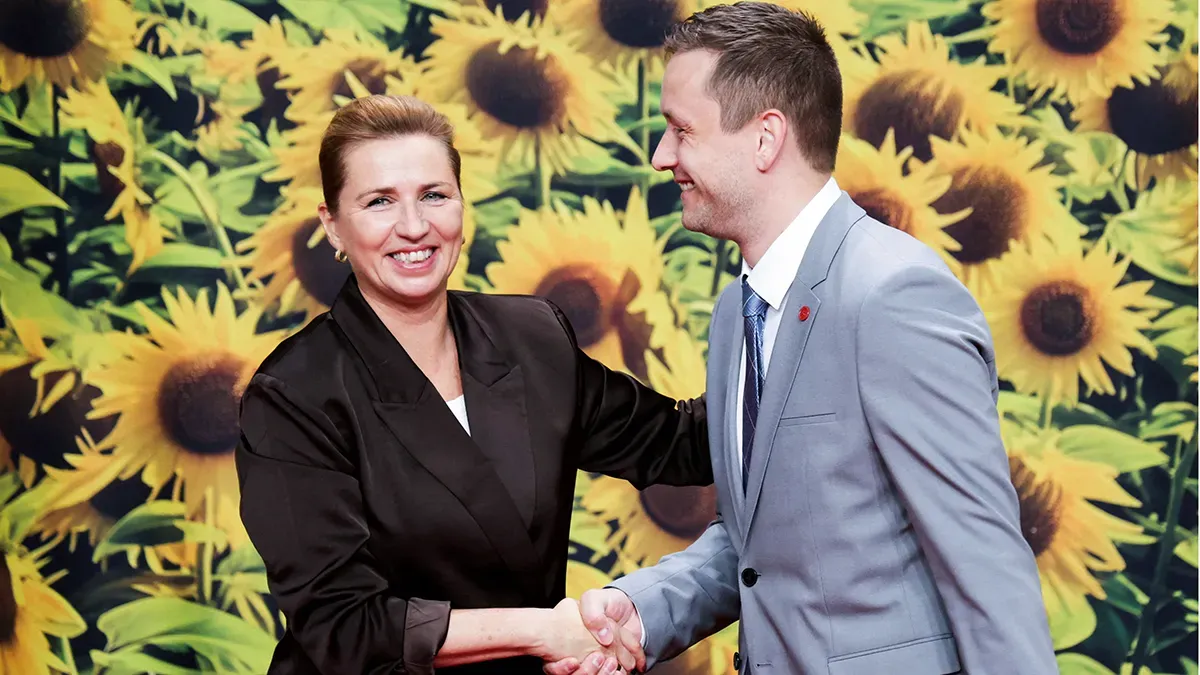
Danish Prime Minister Mette Frederiksen welcomes Greenland Prime Minister Jens-Frederik Nielsen in Copenhagen, Denmark – REUTERS/ LEONHARD FOEGER
Strategic Implications
This development exemplifies the strategy of the calculated outburst: advancing disruptive, seemingly non-negotiable demands—such as the territorial acquisition of a sovereign ally—to force concessions, subsequently stepping down the escalation ladder to conclude an agreement yielding far greater operational gains than standard diplomacy would have secured. The United States successfully secured broader terms from Denmark and Nuuk (indefinite duration, survival past sovereign independence, a veto over non-NATO basing, and exclusive investment screening) than traditional negotiations would have achieved.
While Trump’s rhetoric generated friction among European NATO allies and damaged the predictability of American foreign policy, European capitals frequently misinterpret his tactical methodology. As former Utah Congressman Chris Stewart, a retired Air Force colonel and colleague in our policy forum, observes, Trump must be taken seriously, but not literally; Europe persistently does the reverse, taking him literally while failing to treat the underlying strategic imperatives seriously. This dynamic, formulated by journalist Salena Zito in The Atlantic in September 2016, remains central to understanding his foreign policy execution.

US President Donald Trump addresses the UN General Assembly in New York, US – REUTERS/ MIKE SEGAR
Substantively, the treaty represents a major gain for Western collective defence. It was strategically unsustainable for an independence movement representing an island of 60,000 residents to hold the security architecture of the United States, Canada, and Europe in limbo. Greenland anchors the GIUK Gap (Greenland-Iceland-UK), the strategic maritime gateway between the Arctic and the North Atlantic through which opening polar sea lanes pass. Crucially, it serves as the maritime transit corridor for the Russian Northern Fleet’s nuclear submarines based on the Kola Peninsula, monitored via Pituffik. The territory was subject to persistent Chinese and Russian influence operations. The investment screening mechanism directly counters Beijing’s ambitions regarding Greenland’s rare-earth mineral deposits—among the largest reserves outside China—while the treaty’s permanence neutralizes efforts by foreign adversaries to court pro-independence factions.
The counterweight is institutional asymmetry: Washington secures effective veto power over sensitive foreign direct investments on European soil, while the EU’s €200 million financial package contrasts sharply with US military basing, missile defence architecture, and regulatory control, exposing the gap between European strategic autonomy rhetoric and practical capability.

Greenlandic Prime Minister Jens-Frederik Nielsen addresses a press conference in Copenhagen, Denmark – REUTERS/ TOM LITTLE
Perspectives and Scenarios
The agreement requires parliamentary ratification by the Danish Folketing and the Greenlandic Inatsisartut, where independence advocates may challenge the post-independence continuity clause. While ratification is anticipated, domestic debate will be contentious. Russian counter-posturing will likely manifest through Northern Fleet maritime maneuvers, alongside diplomatic objections from Beijing under World Trade Organization (WTO) trade frameworks. The primary question is whether this accord satisfies White House territorial ambitions or emboldens them: Trump’s 7 September social media map, depicting Iceland and French Atlantic territories under the American flag, suggests these dynamics will continue to resurface.
Germany: successor to the SED wins in Berlin, far right triumphs in the north-east, and the centre collapses
Facts
In Berlin, provisional results show Die Linke (The Left) doubling its electoral support to emerge as the leading political party in the capital for the first time, securing 25.7% of the vote (up from 12.2% in 2023). The CDU (Christian Democratic Union) dropped to 18.8% from 28.2%; the AfD (Alternative for Germany) climbed to 16.3% from 9.1%; Bündnis 90/Die Grünen (The Greens) declined to 14.3%; and the SPD (Social Democratic Party), which historically governed the city under mayors such as Willy Brandt, fell to 12.1%. The BSW (Sahra Wagenknecht Alliance) fell short of the parliamentary threshold at 4.7%. Voter turnout reached 74.2%. Die Linke candidate Elif Eralp and Christian Democrat Stefan Evers both claim the governing mandate, with each theoretically able to command a parliamentary majority alongside the Greens and the SPD.

Ulrich Siegmund, lead candidate of the AfD, gestures at an election event in Magdeburg, Germany – REUTERS/ FABRIZIO BENSCH
Outgoing CDU Mayor Kai Wegner declined to stand in July following widespread criticism over his handling of the 3 January arson attack on Berlin’s electrical grid, which cut power and heating to roughly 45,000 households and 2,200 businesses in mid-winter—the longest blackout in Berlin since 1945. The attack was claimed by a far-left «Vulkangruppe», prompting the Federal Prosecutor’s Office to lead a counter-terrorism investigation. On election night, Josef Schuster, President of the Central Council of Jews in Germany, accused Die Linke of tolerating recurring antisemitic incidents during the campaign without internal disciplinary measures. Left-leaning daily taz documented that members of the party’s Neukölln district branch maintain open ideological proximity to the Popular Front for the Liberation of Palestine (PFLP).
In Mecklenburg-Western Pomerania, the AfD won the state election with 38.2% (up from 16.7% in 2021), ahead of Minister-President Manuela Schwesig’s SPD (35.5%, down four points). Die Linke secured 6.5% and the Greens 5.7%. The CDU obtained 4.9%, failing to meet the 5% electoral threshold and losing parliamentary representation in a state legislature for the first time in Federal Republic history; the BSW (4.8%) and the FDP (1.0%) also failed to secure seats. Of the 71 seats, the AfD secured 32, the SPD 29, and Die Linke and the Greens 5 each. The outgoing SPD-Linke coalition lost its majority, leaving Schwesig likely to form a tripartite government with the Greens, as all parties reject governing with the AfD. Chancellor Friedrich Merz termed the outcome a «disaster», while confirming he will remain at the helm of the party and government. These results follow the AfD securing 43.8% in Saxony-Anhalt two weeks earlier, more than doubling the CDU (17.2%).

German Chancellor Friedrich Merz – REUTERS/ CHRISTIAN MANG
Strategic Implications
These regional elections represent a profound structural crisis for Germany’s traditional parties of government. The SPD faces a prolonged decline that mirrors the historical marginalisation of other European centre-left parties, such as the Italian Socialist Party (dissolved in 1994) or the French Socialists, whose presidential candidate failed to clear 2% in 2022. The CDU has lost its parliamentary presence in a federal state while shedding ten points in the capital.
Mainstream European media coverage has appropriately focused on the AfD’s advance, yet largely minimized the surge of the far left. The victor in Berlin was not moderate democratic socialism, but the most radical, uncompromising left: the direct legal successor to the totalitarian apparatus that subjugated East Berliners for over four decades. Die Linke is the legal successor to the SED (Socialist Unity Party of Germany), the ruling communist party of the GDR (German Democratic Republic), formed in April 1946 through the forced merger of the KPD and SPD under Soviet military occupation. Renamed SED-PDS in December 1989, then PDS, it merged with the western-based WASG in 2007 to establish Die Linke.

Leif-Erik Holm, AfD candidate for state premier, reacts on television following regional election exit polls in Schwerin, Germany – Marcus Brandt/Pool via REUTERS
This is the political entity that erected the Berlin Wall in 1961 and issued the orders to shoot citizens attempting to cross: at least 140 individuals were killed at the Wall, and hundreds more along the inner-German border. It directed the Stasi, which by 1989 deployed 91,000 full-time operatives and nearly 189,000 informants to surveil sixteen million citizens, detaining and interrogating tens of thousands in prisons like Hohenschönhausen, with historical estimates numbering roughly 200,000 political prisoners over the GDR’s existence.
That this successor movement now commands the largest vote share in the city that symbolized Western resistance to communist totalitarianism represents a profound political realignment that cannot be dismissed as progressive urban voting. Western democracies face the rise of radical extremes across both flanks; far-left extremism warrants the same rigorous democratic scrutiny applied to the far right.

AfD co-leader Alice Weidel speaks during a campaign rally in Neubrandenburg, Germany – REUTERS/ LISI NIESNER
The results in Mecklenburg-Western Pomerania also demonstrate the migration of working-class electorates from the far left to the far right in eastern Germany: Die Linke, historically entrenched as the PDS in the region, fell over a decade from 13.2% to 6.5%, while the AfD expanded from 16.7% to 38.2%, echoing historical voting realignments seen with the French Communist Party (PCF) electorate.
The principal casualty is the democratic centre. Chancellor Merz, who entered office carrying expectations of political revival, has struggled to stabilise the federal administration, leaving the governing coalition increasingly vulnerable. Both extremes share destabilising foreign policy positions: hostility toward NATO, political ambiguity regarding Vladimir Putin’s Russia, and opposition to Western military assistance for Ukraine.
Perspectives and Scenarios
In Berlin, a left-wing governing coalition led by Eralp alongside the Greens and SPD remains the most probable outcome, though an alternate centre-left administration headed by Evers is mathematically viable if antisemitism controversies constrain negotiations. In Mecklenburg-Western Pomerania, Schwesig will likely lead an expanded coalition, while the AfD consolidates its position as the excluded parliamentary plurality. Federally, internal party pressure on Merz will intensify, while upcoming government formation talks in Saxony-Anhalt will test the viability of established cordon sanitaire practices.

Ulrich Siegmund alongside party co-leaders Alice Weidel and Tino Chrupalla react after the close of polls in Magdeburg, Germany – REUTERS/ FABRIZIO BENSCH
Canada and the EU: the Saint-Pierre and Miquelon summit
Facts
On Sunday 20 September, Macron received Carney on Saint-Pierre and Miquelon, a French overseas territory of 5,800 residents situated off the coast of Newfoundland, marking the first official visit by a Canadian prime minister to the archipelago and the first by a French president in over ten years. Carney observed that while only kilometres separate Canada and France physically, their shared values are closer still. The two governments instructed their space agencies and defence ministries to co-develop and share dual-use infrastructure—including satellite launch systems and ground stations—while expanding bilateral cooperation across energy, telecommunications, climate adaptation, critical raw materials, quantum computing, and advanced supercomputing. Macron prioritized securing long-term contracts to import Canadian liquefied natural gas (LNG) into Western Europe amid disruptions linked to the Middle East conflict.

Canadian Prime Minister Mark Carney attends the World Economic Forum in Davos, Switzerland – REUTERS/ DENIS BALIBOUSE
Macron formally endorsed the proposal outlined by Von der Leyen in her State of the Union address to establish Canada as the EU’s first «associate member state», an initiative Carney embraced following his address to the European Parliament on 17 September. Last year, Canada became the sole non-European nation integrated into the EU’s joint defence procurement framework, while the CETA trade agreement has operated provisionally since 2017, despite awaiting full ratification in several member states, including France. Canada has not requested EU accession, as Article 49 of the Treaty on European Union restricts membership to European states; associate membership currently lacks statutory codification. Canadian Conservative opposition leader Pierre Poilievre warned that Canada will never become an EU member state.
The diplomatic summit carried an explicit geopolitical message. On 7 September, Trump posted a map on Truth Social showing the American flag covering Canada, Mexico, Greenland, Iceland, the French West Indies, and Saint-Pierre and Miquelon, prompting Reykjavik to summon the US ambassador. Arriving on the archipelago, Macron affirmed that its French sovereignty is indisputable, dismissing foreign territorial claims, and declaring that France and Canada remain sovereign independent nations committed to preserving that status.

US President Donald Trump welcomes Canadian Prime Minister Mark Carney to the White House in Washington, DC – REUTERS/ EVELYN HOCKSTEIN
Strategic Implications
The summit is consequential for three structural reasons. First, it accelerates institutional alignment between Canada and the EU toward the highest level of integration accessible to a non-European state, building on existing defence, research, and trade agreements, with expansion into energy and critical minerals. Second, it delivers a direct diplomatic signal to Washington: Canada is diversifying its transatlantic partnerships via Europe, undertaking a strategic rebalancing to reduce exposure to unilateral American economic coercion.
The third reason is territorial: Saint-Pierre and Miquelon sits roughly twenty kilometres off Newfoundland’s Burin Peninsula. France retained the archipelago under the 1763 Treaty of Paris when ceding New France, and Canada has never contested French sovereignty; their sole bilateral maritime dispute was resolved in international law through the 1992 arbitral tribunal award. Ottawa has never advanced the geography-based argument that proximity within the Western Hemisphere transfers sovereignty.

European Commission President Ursula von der Leyen, European Council President António Costa, and Canadian Prime Minister Mark Carney during the EU-Canada Summit – PHOTO/CANADIAN PRESIDENCY
International borders frequently diverge from strict continental geography: Eastern Thrace forms part of European Turkey; Dutch, British, and French overseas territories exist across the Caribbean; Greek islands such as Samos and Kastellorizo sit within kilometres of the Turkish Anatolian coast; and Equatorial Guinea’s island of Bioko lies closer to Cameroon than to its mainland territory of Río Muni. Sovereignty is established through legal title, democratic consent, and international treaties rather than physical proximity.
Perspectives and Scenarios
Structuring associate membership for Canada will require creating a novel legal status between the European Economic Area and standard association treaties, necessitating unanimous European Council approval. This exposes the proposal to the same domestic agricultural lobbies that have stalled CETA’s ratification in France and elsewhere. In Canada, while broader engagement with Europe enjoys cross-party support, accession rhetoric could generate domestic political friction if framed by the opposition as an erosion of sovereignty. US economic counter-measures remain possible: France Info reported that the White House has moved to restrict imports of selected Canadian goods, including alcoholic beverages, effective 29 September, while raising tariffs on other product categories.

Canadian Prime Minister Mark Carney and British Prime Minister Andy Burnham hold bilateral discussions in Merseyside, UK – PHOTO/ PAUL COOPER via REUTERS
Reuters: Framed Trump’s UN address as dual signalling—combining threats of annihilation with diplomatic outreach—while reporting the Iranian offer to reopen Hormuz within seven days upon the suspension of the naval blockade. Arctic reporting highlighted that the Greenland agreement permits the deployment of the Golden Dome missile shield without granting territorial annexation.
Associated Press (AP): Emphasized Macron’s endorsement of Canada as the EU’s inaugural associate member, underlining the symbolism of convening in a French territory off the Canadian coast amid shifting Canadian foreign policy alignments toward Europe.
CBS News: Focused on key clauses of the Greenland treaty: indefinite operational duration, survival post-independence, and the explicit prohibition of non-NATO military installations.
Time: Analyzed the State Department’s framing of the accord, noting that it establishes permanent mechanisms ensuring only the US and its allies can execute strategic investments in Greenland, contextualising it within debates over Danish sovereignty.
Fox News: Broadcast an interview with Rubio in which the Secretary of State kept diplomatic channels open with Pezeshkian while reiterating that Iranian executive leadership remains subordinated to Mojtaba Khamenei and asserting that Iran will never be permitted nuclear weapons capability.
Le Figaro: Highlighted Carney’s deployment of the Saint-Pierre summit to advocate for the final ratification of the CETA trade pact in France, which has operated under provisional application since 2017.
Libération and BFM TV: Addressed the historical nature of the visit as the first by a Canadian head of government to the archipelago, emphasizing joint affirmations of sovereignty against US pressure.
France Info: Reported on Trump’s 7 September social media map depicting the French Antilles, Saint-Pierre and Miquelon, Greenland, and Iceland under the US flag, detailing Iceland’s diplomatic protest.
Additional sources consulted: Euronews (Trump’s address and the Greenland accord), ZDF and Germany’s Federal Agency for Civic Education (bpb, election data), taz (antisemitism within Die Linke’s Berlin branch), Le Devoir, and Europe 1 (Carney’s bilateral tour).
Moral hemiplegia and the map: Europe confronts its extremes, Washington confronts its allies
In his 1937 prologue written for the French edition of The Revolt of the Masses, Spanish philosopher José Ortega y Gasset formulated a timeless critique of political dogmatism: «To be of the left or to be of the right is but one of the endless ways open to man to become an imbecile: both are forms of moral hemiplegia». Ortega was not condemning political philosophy, but the paralysis of those who view political reality through only one ideological lens. That critique holds profound relevance this week, as significant portions of the European commentary space evaluated the German regional elections with only one hemisphere of the political brain.
Headlines correctly examined the AfD’s 38.2% result in Mecklenburg-Western Pomerania, following its 43.8% performance in Saxony-Anhalt two weeks prior. This represents an acute democratic challenge that warrants rigorous scrutiny. Yet that same Sunday, in the federal capital, Die Linke emerged as the leading political party. Die Linke is the direct legal successor to the SED, the totalitarian apparatus that ruled the GDR for over forty years. It oversaw one of the most oppressive police states in the Soviet bloc, backed by the Stasi, the most pervasive internal security service behind the Iron Curtain, matched only by Bulgaria’s State Security (DS). This was the party that constructed the Berlin Wall in August 1961 and issued orders to shoot citizens fleeing toward freedom. In numerous media accounts, its electoral victory was treated as progressive urban politics or a benign counterweight to the radical right. That reading collapses under historical scrutiny.
Berlin is not merely another municipality. It is the city where Mayor Ernst Reuter stood before the ruins of the Reichstag on 9 September 1948, during the Soviet blockade, appealing to the world to look upon Berlin. It is where John F. Kennedy affirmed democratic solidarity in 1963, and where Ronald Reagan demanded at the Brandenburg Gate in 1987 that Mikhail Gorbachev tear down the Wall. That the institutional successor to the regime that constructed the Wall now leads the vote in that same city, while the party of Reuter and Brandt fell to 12.1%, should provoke serious reflection across Europe.
While many voters backing Die Linke are younger urban citizens focused on housing affordability, and mayoral candidate Elif Eralp has sought to navigate past controversies, democratic standards must remain consistent. The same investigative rigor applied to the AfD must apply when the President of the Central Council of Jews in Germany documents antisemitic infractions within Die Linke during the campaign, or when left-wing publications like taz report links between local party branches and radical Palestinian factions. Antisemitism does not cease to be antisemitism because it emerges from the left, just as xenophobia cannot be rationalised when it emerges from the right. Moral hemiplegia disables this objective standard.
Jean-François Revel examined this selective memory in La Grande Parade (2000), observing that communist totalitarianism has frequently benefited from historical amnesia that democratic societies rightly deny to national socialism, ensuring that the human cost of real-existing socialism failed to fully discredit the ideology in certain intellectual spaces.
This dynamic was visible in Berlin, where the campaign followed the 3 January arson attack on the electrical grid, claimed by a militant far-left group, which cut power to nearly 100,000 residents in sub-zero temperatures and remains under federal counter-terrorism investigation. That attack cost the incumbent Christian Democratic mayor his position over crisis mismanagement, while the extremist ideology behind the sabotage received minimal European coverage.
This scrutiny does not diminish the political challenge posed by the AfD, whose surge in eastern Germany reflects deep socioeconomic grievances that require policy solutions rather than dismissal. The data from Mecklenburg-Western Pomerania is clear: as Die Linke dropped from 13.2% to 6.5% over a decade, the AfD advanced to 38.2%. Working-class electorates historically aligned with the far left have transitioned toward the radical right, mirroring realignments seen in France with the historic Communist Party (PCF) electorate.
Political extremes operate dialectically: they reinforce one another, share common foreign policy positions including hostility toward NATO and accommodation of the Kremlin, and expand into the vacuum left by a democratic centre unable to resolve core challenges in housing, public safety, migration, and energy costs. The CDU’s loss of regional representation and the SPD’s collapse in Berlin represent the electoral arithmetic of that vacuum. Chancellor Merz has not yet established the stable leadership Germany and Europe require. The remedy cannot rely on one-sided cordon sanitaires; it requires an effective democratic centre capable of confronting both extremes with equal resolve.
A parallel hemiplegia affects transatlantic relations. On 7 September, the US President posted a map online, without comment, depicting Canada, Mexico, Greenland, Iceland, the French West Indies, and Saint-Pierre and Miquelon under the American flag. Iceland, a founding NATO member, formally summoned the US ambassador.
While this reflects the disruptive rhetoric of the administration and should not be taken literally as an operational war plan, symbols carry diplomatic weight, and erratic posturing degrades American credibility among allies. In Thucydides’ Melian Dialogue, the Athenian envoys asserted that the strong do what they can and the weak suffer what they must. The post-1945 rules-based international order constructed by the United States was established specifically to replace that doctrine of coercion, particularly among democratic allies.
The premise underlying that map—that sovereign territories situated within the Western Hemisphere belong by geography to an American sphere of dominion—is legally unfounded, and the reality of Saint-Pierre and Miquelon refutes it. France retained the archipelago in 1763, and Canada has never claimed it; their maritime boundary was resolved amicably under international law in 1992.
Global borders consistently demonstrate that territorial sovereignty is not governed by proximity: Turkish Thrace sits in Europe; Dutch, British, and French territories exist in the Caribbean; Greek Aegean islands sit off the Anatolian coast; and Equatorial Guinea’s capital operates on Bioko, closer to Cameroon than to its continental territory. If physical proximity dictated borders, the international system would exist in permanent conflict. Sovereignty rests upon legal title, democratic consent, and international law; abandoning those principles creates precedents that revisionist powers in Moscow and Beijing will exploit.
The resolution in Greenland demonstrates the practical dimension of Trump’s negotiating method. By initially advancing an unacceptable demand—territorial annexation—the White House stepped down to conclude an agreement updating the 1951 defence treaty that respects Danish sovereignty and Greenlandic self-determination, while securing significant operational gains: expanded basing rights, missile defence integration, control over the GIUK Gap against Russian submarines, investment screening barring Chinese capital from rare-earth mining, and indefinite treaty duration.
This is a textbook application of opening with maximum leverage, leaving European governments, which reacted literally to early rhetoric without addressing structural Arctic security, reacting defensively. While the diplomatic friction with allies was real, the strategic outcome strengthens Western defence, achieved because professional diplomats like Marco Rubio translated disruptive posturing into a robust institutional accord. The lesson for Europe is to assess policy outcomes rather than rhetoric; the lesson for Washington is that coercive diplomatic methods carry diminishing returns.
Canada recognized this strategic reality early. In 1949, Canadian leaders Louis St. Laurent and Lester Pearson successfully embedded Article 2 into the North Atlantic Treaty—the «Canadian Article»—committing allies to strengthening free democratic institutions and promoting economic collaboration. For Ottawa, NATO was never merely a military pact, but a community of values. Prime Minister Carney’s engagement with Europe does not represent a retreat from transatlanticism, but an effort to reinforce its pillars when bilateral relations with Washington encounter strain. Europe, however, must match its commitments: it cannot credibly offer associate status to Canada while key member states, including France, delay final ratification of the CETA trade agreement nine years after its provisional entry into force.
A similar dynamic governs the Middle Eastern theatre. The binary choice Trump presented at the UN—greatness or total annihilation—represents a false dilemma. The ideological nature of the Iranian regime as a sponsor of regional terrorism and the imperative to prevent it from acquiring nuclear weapons are established realities. However, tactical military successes have coincided with structural geopolitical vulnerabilities: Hormuz partially contested, Bab el-Mandeb controlled by the Houthis, Saudi infrastructure vulnerable to Iraqi proxies, and energy markets strained.
Authoritarian regimes that fracture without post-conflict stabilization do not yield stable democracies; they create vacuums exploited by radical forces. Furthermore, acknowledging that formal negotiations will await the conclusion of the US midterms provides Tehran with strategic breathing room, allowing hardliners like Rezaei and Vahidi to leverage the electoral calendar to maintain operational control.
The developments evaluated in this report converge on a singular conclusion: Europe must overcome its moral hemiplegia by confronting political radicalism across both extremes with consistent standards while governing effectively. Washington must remember that its enduring influence rests upon alliances founded on the rule of law rather than unilateral maps. The transatlantic alliance, from Nuuk to Saint-Pierre, and from Berlin to Ottawa, will endure as a community grounded in law or fracture under division. Nearly nine decades after Ortega warned against viewing political reality with a single eye, that insight remains essential across both shores of the Atlantic.