
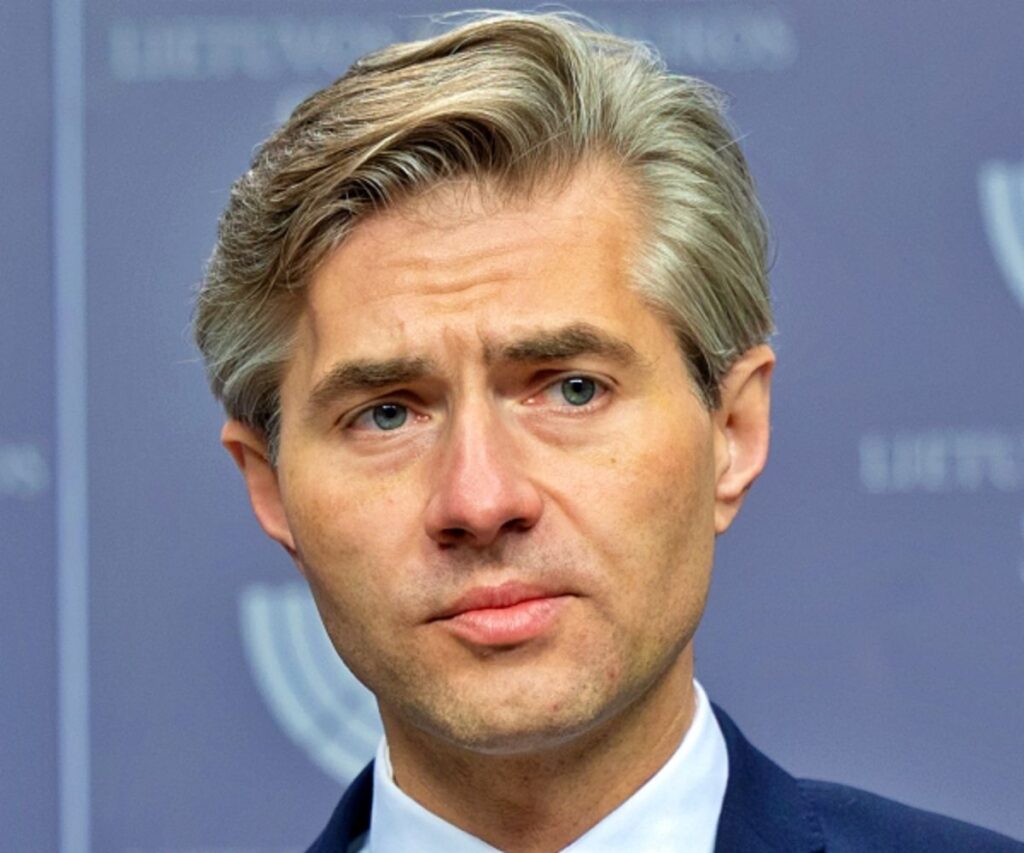

Lithuanian Foreign Minister Kęstutis Budrys (Dreamstime)
Lithuania, Costa Rica, and the United States have launched an international initiative aimed at supporting democratic change in Cuba, bringing government representatives together with Cuban dissidents and civil society leaders on the sidelines of the United Nations General Assembly in New York, Breitbart reported Thursday.
The initiative, dubbed “Nations for a Free Cuba,” emerged from a Tuesday meeting hosted by Lithuania and led by Lithuanian Foreign Minister Kęstutis Budrys.
Participants discussed building international support for Cuban civil society and democracy advocates. Lithuania’s Foreign Ministry confirmed Budrys met representatives of the Cuban diaspora to discuss human rights, democracy, and international support for civil society.
“Lithuania’s position on Cuba remains strong and we support the aspirations of the Cuban people to live in a free and democratic state, respecting human rights and fundamental freedoms,” Budrys said.
“We condemn the Cuban regime’s repression of its people and its support for Russia’s aggression against Ukraine,” he added.
Budrys said Lithuania would continue supporting Cuban human rights defenders and democratic movements while seeking broader international backing.
The issue also figured in Budrys’ talks with Secretary of State Marco Rubio in Washington last week, when the two discussed “the importance of opposing the abuses of the Cuban regime,” according to a State Department readout.
The Assembly of the Cuban Resistance, a coalition of Cuban opposition groups, characterized Tuesday’s gathering as a significant step toward coordinated international action.
“For the first time, a group of democratic nations have sat down to discuss how to support the Cuban people,” the group said, according to Breitbart.
Orlando Gutierrez-Boronat, the coalition’s coordinator, said the initiative could provide Cuba’s opposition with a new multilateral platform.
“When this takes its next step, for the first time the Cuban people will have a group of nations at the international level who defend its right to be free,” Gutierrez-Boronat said.
“This means that for the first time, we are multilateralizing the backing for freedom for the Cuban people,” he added.
Pushing reforms in Cuba has been a prominent element of the second Trump administration’s foreign policy.
The issue has long been a focus for Rubio, the son of Cuban immigrants who arrived in the United States in 1956, before Fidel Castro took power in 1959. Rubio discussed his family background during his 2025 Senate confirmation hearing.
Throughout his political career, Rubio has advocated sustained U.S. pressure on Havana and support for Cubans seeking greater political freedom, making democratic change on the island a long-standing focus of his approach to the Western Hemisphere.
That position places Cuba within Rubio’s broader emphasis on confronting authoritarian governments in the region and supporting democratic institutions and civil society.
The effort to enlist other governments behind Cuban dissidents also reflects a longstanding element of U.S. policy, seeking cooperation from democratic allies to encourage a peaceful transition toward representative government and greater respect for human rights in Cuba.
© 2026 Newsmax. All rights reserved.