
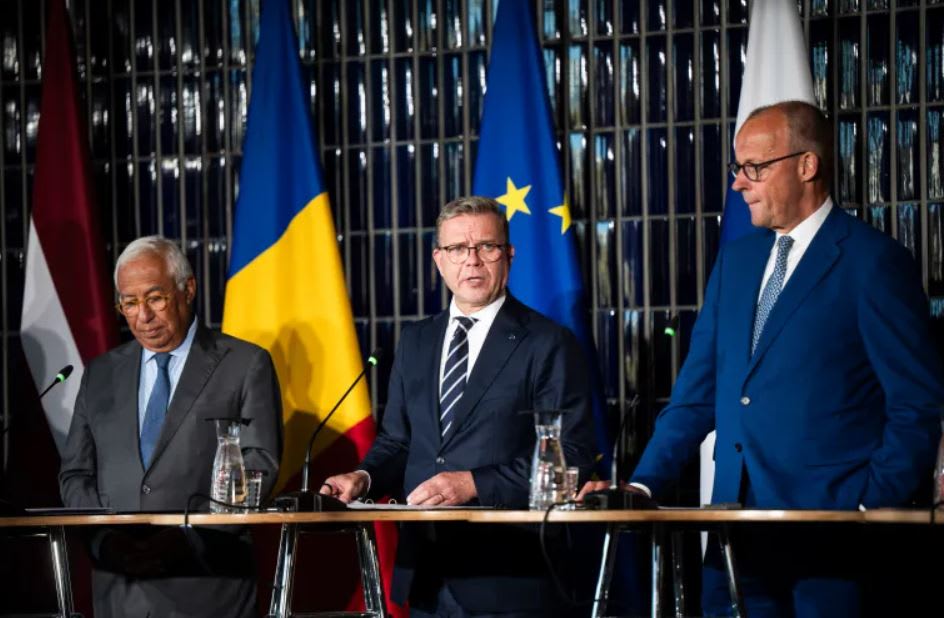
In a joint statement issued after a high-level meeting on Monday, leaders from Finland, Denmark, Estonia, France, Greece, Germany, Latvia, Lithuania, the Netherlands, Poland, Romania, and Sweden labeled the Arctic a “geopolitical hotspot.” The group called for the European Union to assume a “more strategic and proactive role” in the region, signaling a major shift in European security policy.
German Chancellor Friedrich Merz, whose country is not an Arctic nation, emphasized the broader implications for continental security. “Let me put it this way: High north and low attention is over,” Merz told reporters, underscoring that the Arctic can no longer be viewed as a remote periphery but as a central front in Europe’s defense architecture.
The Russian Threat and Great Power Competition
The primary driver of this renewed focus is Russia, which participants identified as the “most significant and long-term threat to Arctic security and stability.” Moscow has spent the last decade modernizing its military infrastructure in the region, reopening Soviet-era bases and expanding its nuclear and conventional capabilities along its northern coast. Finnish Prime Minister Petteri Orpo stated that the EU must treat the Arctic as a “strategic frontier” to counter this threat.
However, the scramble for influence extends beyond Moscow. The retreat of polar ice, accelerated by climate change, has unlocked vast economic opportunities, including new shipping routes, fishing grounds, and access to untapped reserves of oil, gas, and rare earth minerals. This has drawn the attention of China, which has explicitly declared itself a “Near-Arctic State” and is investing heavily in infrastructure and research in the region.
The presence of the United States further complicates the landscape. While Washington is a key NATO ally, its approach to the Arctic has become increasingly transactional and unilateral under President Donald Trump, creating friction with European partners.
The Greenland Flashpoint
Nowhere is this tension more evident than in Greenland, the autonomous territory of Denmark. Greenland’s strategic location and resource wealth have made it a target for both Chinese investment and American interest. President Trump has repeatedly claimed that Denmark is unable to protect the island from Russian and Chinese encroachment, going so far as to suggest annexation or purchase of the territory, a notion that has caused deep anxiety in Copenhagen and Nuuk.
Danish Prime Minister Mette Frederiksen acknowledged the pressure, stating, “I think everybody recognised that Greenland has been under a big pressure.” In a move to stabilize the situation and reinforce European ties, the EU signed a declaration with Greenland last week, promising a stronger partnership and announcing a €200 million ($232 million) investment package. This initiative is designed to bolster Greenland’s economy and infrastructure, reducing its reliance on external powers and soothing fears of American overreach.
A New Strategic Frontier
The meeting included both Arctic states (Finland, Sweden, Denmark) and non-Arctic EU members, reflecting the understanding that security in the North is indivisible from security in the rest of Europe. The participants noted that while Russia, Canada, Iceland, Norway, and the US are the traditional Arctic powers, the EU has a vital stake in ensuring the region remains stable, secure, and governed by international law.
The agreement calls for increased investment in dual-use infrastructure, ports, communications, and surveillance systems that can support both economic development and defense needs. It also emphasizes the need for closer coordination among NATO allies and EU institutions to present a unified front against coercive actions by rival powers.
As the ice melts, the Arctic is transforming from a frozen wasteland into a contested arena of global power politics. For Europe, the message from this summit is clear: ignoring the North is no longer an option. The race for resources and security advantages has begun, and the EU intends to be a major player in determining the future of the High North.