
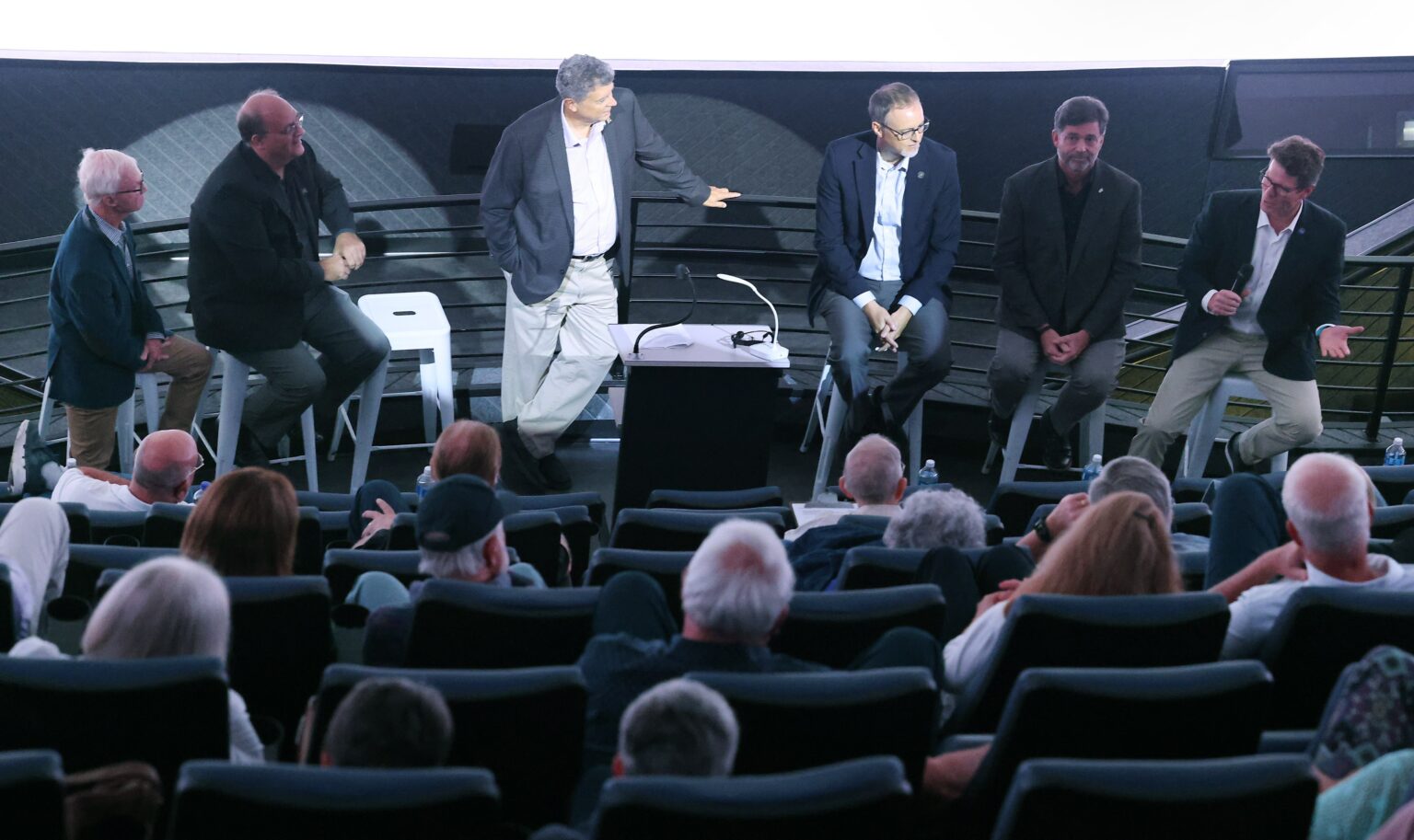
As part of the Orlando Sentinel’s series of special events celebrating the paper’s 150th anniversary, the Orlando Science Center hosted a panel about space on Wednesday night.
The event brought together representatives from Kennedy Space Center, the Space Force and UCF as well as current and former journalists to talk about Central Florida’s vital role in the nation’s space endeavors.
One of the highlights of the panel was the displays of former Sentinel photographer Red Huber’s photo retrospective of his 37-year career with the paper, which he titled, “The Cape Chronicles.”
“I think my commitment to document history, that’s my job as a photojournalist, but I want to give our readers something different, and tell NASA’s story in a different visual way,” Huber said.
He was able to earn the trust of NASA officials over the years, a relationship that led to access not seen from other venues over the years.
“I had a commitment, a work ethic,” he said. “I couldn’t believe I was getting paid to do it.”
The images were projected on the science center’s newly refurbished 8-story Dome theater.
Jeff Stanford, vice president of marketing at the science center pointed out the venue has its roots in the space program as well, and was even once named the John Young Museum and Planetarium after the local astronaut.
“We started out in 1955 as a volunteer effort by a passionate group of engineers, teachers, community leaders. They knew that the next generation was going to journey to space and beyond, and to walk on planets beyond our own — that an entrance in science was its first step, and that cause took shape in a small museum in Lock Haven Park, just around the corner,” he said. “From there, the momentum continued to what we know now as Orlando Science Center.”
-

A dazzling projection show is shown during the Orlando Sentinel presentation of “Space: Past, Present & Future in Central Florida” at the Orlando Science Center on Wednesday, September 23, 2026. This was one of several events celebrating the 150th anniversary of the Orlando Sentinel. (Stephen M. Dowell/Orlando Sentinel)


1 of 17
A dazzling projection show is shown during the Orlando Sentinel presentation of “Space: Past, Present & Future in Central Florida” at the Orlando Science Center on Wednesday, September 23, 2026. This was one of several events celebrating the 150th anniversary of the Orlando Sentinel. (Stephen M. Dowell/Orlando Sentinel)
The venue treated the more than 100 attendees to a sampling of the new Dome theater experience being offered at the center before moving onto the main panel discussion.
Derrol Nail with NASA’s Office of Communications talked about his role as the voice accompanying the agency’s coverage of major launches from Kennedy Space Center.
“I’d rather be an astronaut,” he said. “That’s the coolest job that’s ever been in my opinion.”
He said he enjoys diving into the nitty-gritty of the details for each launch, but the most remarkable mission he’s covered came this year he said when Artemis II launched the Orion capsule with crew for the first time for their historic trip around the moon.
“That moment when those engines lit, those RS-25s, at minus 7 seconds. Voom, that thing came to life, and then 6, 5, 4, 3, 2, 1 and off we go,” he said. “It is the most incredible experience I think, besides the birth of my son.”
Dr. Philip Metzger, now at UCF and director of the Stephen W. Hawking Center for Microgravity Research & Education was formerly with NASA and cofounder of KSC’s Swamp Works innovation program.
He weighed in on the Orlando university’s role in the space program, first started to support NASA’s efforts.
“UCF, we were created to support the space program. We call ourselves SpaceU, Space University. … Six years in a row we’ve put more graduates into aerospace than any other university,” he said.
He was excited about two faculty serving as principle investigators for the first time for a NASA mission, a rover headed to the moon. He’s particularly keen on lunar mining and touted UCF’s patents for moon base missions plans.
Perhaps the person with the most insight on the history of space in Florida was James Draper, director of the Cape Canaveral Space Force Museum at Cape Canaveral Space Force Station.
“We focus heavily on origin stories and milestones. And there’s a lot this history that people just don’t realize,” he said.
Florida’s first rocket launch came in 1950 and has been host to thousands of rockets ever since. But that was almost not the case, Draper explained, noting that originally the nation wanted to make a site in southern California the home to the rocket proving ground.
But an errant V2 rocket went off course out of White Sands, New Mexico, and landed near Juarez, Mexico.
“The Mexican government didn’t take kindly to being accidentally bombed,” he said. “So they settled for Cape Canaveral.”
He said that decision was enshrined by President Harry S. Truman after congressional approval with a document called Public Law 60.
“Public Law 60 is like the charter document for the Space Coast and for Central Florida at large. It’s like the Declaration of Independence, Constitution, Federalist papers, all tucked into this little public law signed by the president, establishing the Joint Range Proving Grounds at Cape Canaveral,” he said.
Of course Florida allowed for year-round launches over open ocean and had a series of tracking stations 10,000 miles out into the Atlantic.
“That’s how all of this started. Without Public Law 60, there’s no Cape Canaveral Space Force Station today. There’s not Patrick Space Force Base. There’s no Kennedy Space Center and there’s no multibillion dollar aerospace industry in Central Florida,” he said.
More stories and features from the Orlando Sentinel’s 150 years of covering Central Florida can be found at OrlandoSentinel.com/150. Sign up for our free history newsletter at OrlandoSentinel.com/newsletters
***
Want more Orlando history? Buy a copy of the Orlando Sentinel’s 150th anniversary book with 150 front pages from our 150 years. Get it OrlandoSentinel.com/150yearsbook and see more anniversary merchandise at OrlandoSentinel.com/150yearsmerch