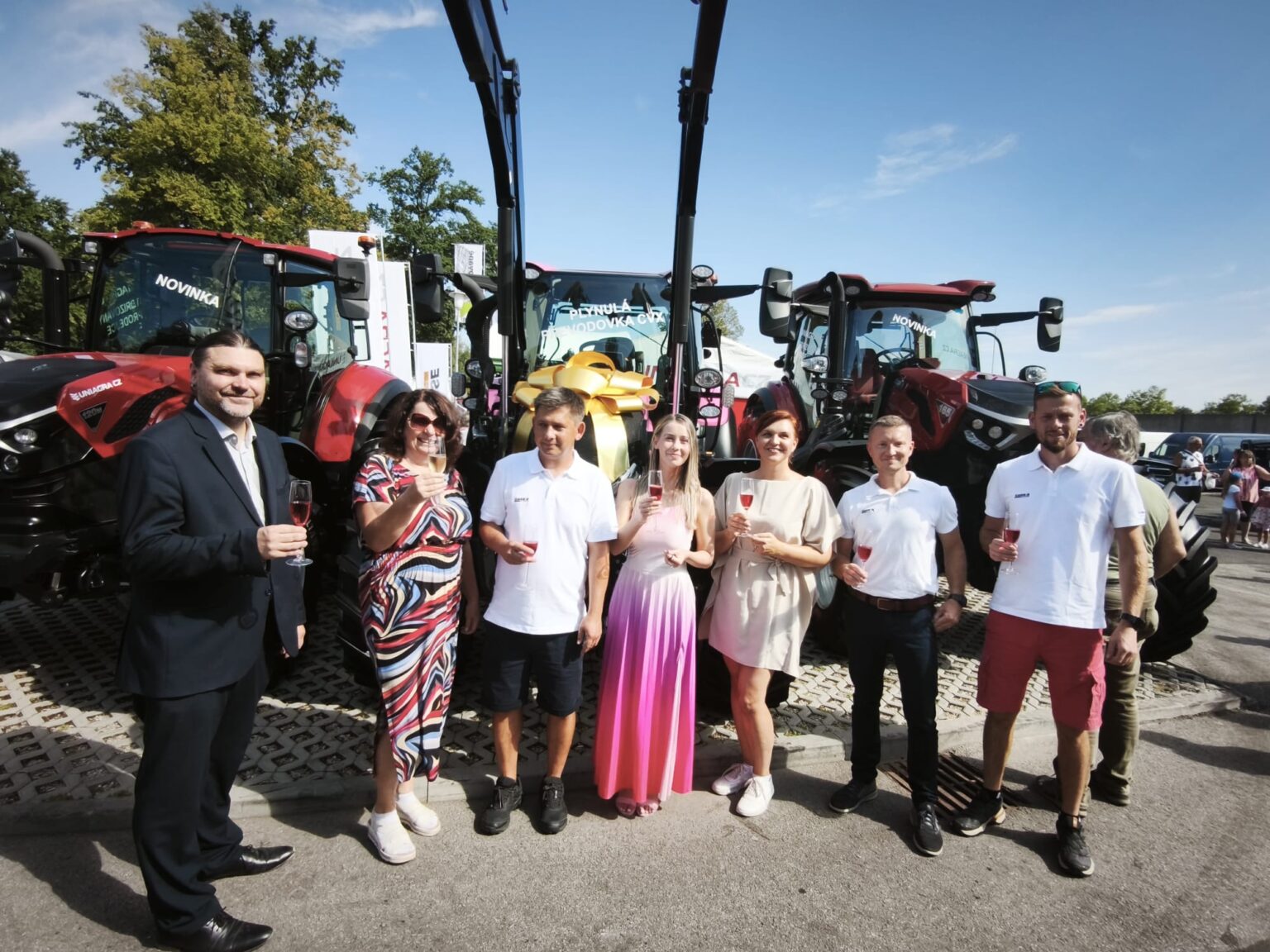
 Young farmer Barbora [centre] drinks a toast to her new pink tractor with her mother Terezie [second from left] and wellwishersWe’re back on Hoslovice ranch in South Bohemia, where mother and daughter team Terezie Daňková and Barbora Halová have been pushing against structural barriers to generational renewal – as well as physical barriers for women in farming. In their closing letter from the farm, Terezie and Barbora look back on their journey and reflect on the policy tweaks and cultural shifts that could attract more young women into farming. As well as access to land, young farmers need the flexibility to adapt to a changing climate in a way that’s right for their farm.

Growing pains
Terezie:
A lot has changed since our first interview with ARC2020. At that time my daughter Barbora had just returned from a year in London. After her studies, she started working on the farm and applied for start-up aid for young farmers.
Going through this process, which isn’t over yet, we have learned a lot. Czech farming enterprises have different legal forms: there are many agricultural cooperatives, as well as limited liability companies and joint stock companies. When you’re a shareholder in an agricultural company and your child wants to take over your share, this transfer isn’t supported in any way. Because our company is so small, we were able to start another limited liability company and Barbora applied that way.
But it’s difficult with larger companies – which make up the majority of agricultural enterprises in the Czech Republic. We see this play out in real time: in larger companies, instead of bringing young people into the ownership structure, the shareholders prefer to sell the whole company. And young people who want to work in agriculture enter as managers for multinational companies or through some other form of big capital. It’s great that there are still people who want to work in agriculture and who become experts, but their decision-making and ownership ties to the sector aren’t what the goals of a common agricultural policy should be.

Throwing her weight around?
Barbora:
It used to be that much of farming was physically demanding work. In some ways it still is. It’s not easy for a woman. With 21st century technology, we’re reaching a point where a lot of this work is mechanised. However, personally I still struggle with physical barriers to certain tasks. For example, connecting hydraulic attachments to a front loader or to towed machinery. Mechanics will say to me, “Well, just push harder.” Sure, thanks, but I weigh 50 kilos, and can generate a lot less force than most male tractor drivers. It’s a shame farm machinery manufacturers can’t come up with some sort of gadget to make this task physically possible for a woman my size, because I think with today’s technology, it is possible.
As this series comes to a close I have finally bought my tractor with the help of a young farmer grant that covered about 40% of the cost. I wanted a pink tractor. Pink is my favourite colour. I expected a strong reaction; I underestimated just how overwhelming the response would be. But the positive feedback has definitely outweighed the negative. All in all, I’m absolutely delighted with my pink tractor.

What we need to do for the land
Terezie:
Drought is a huge problem in certain regions of the Czech Republic, and typically here in South Bohemia. What scares us the most isn’t the current drought itself, but the possibility that drought could become a trend. We would have enjoyed this summer a lot more if we’d had a bit more rain. We really hope that if it does become a trend, European policy will quickly adapt accordingly, so that we can do everything we need to do for the land – techniques like regenerative grazing, for example, would allow us to adapt to the current situation.
As we have described over the years, in the Czech Republic, a big problem is the fragmentation of land ownership, which makes it very difficult to introduce wetland ecosystems and similar systems that would help retain water in the landscape. We hope that the new CAP will take this into account too.
A heartfelt thanks to Terezie and Barbora, and to all of our letter-writers over the years for sharing their stories. Without your thoughtful insights, poetry and generosity of spirit, this very special series would not have been possible ♥
Read more from Terezie and Barbora’s farm