

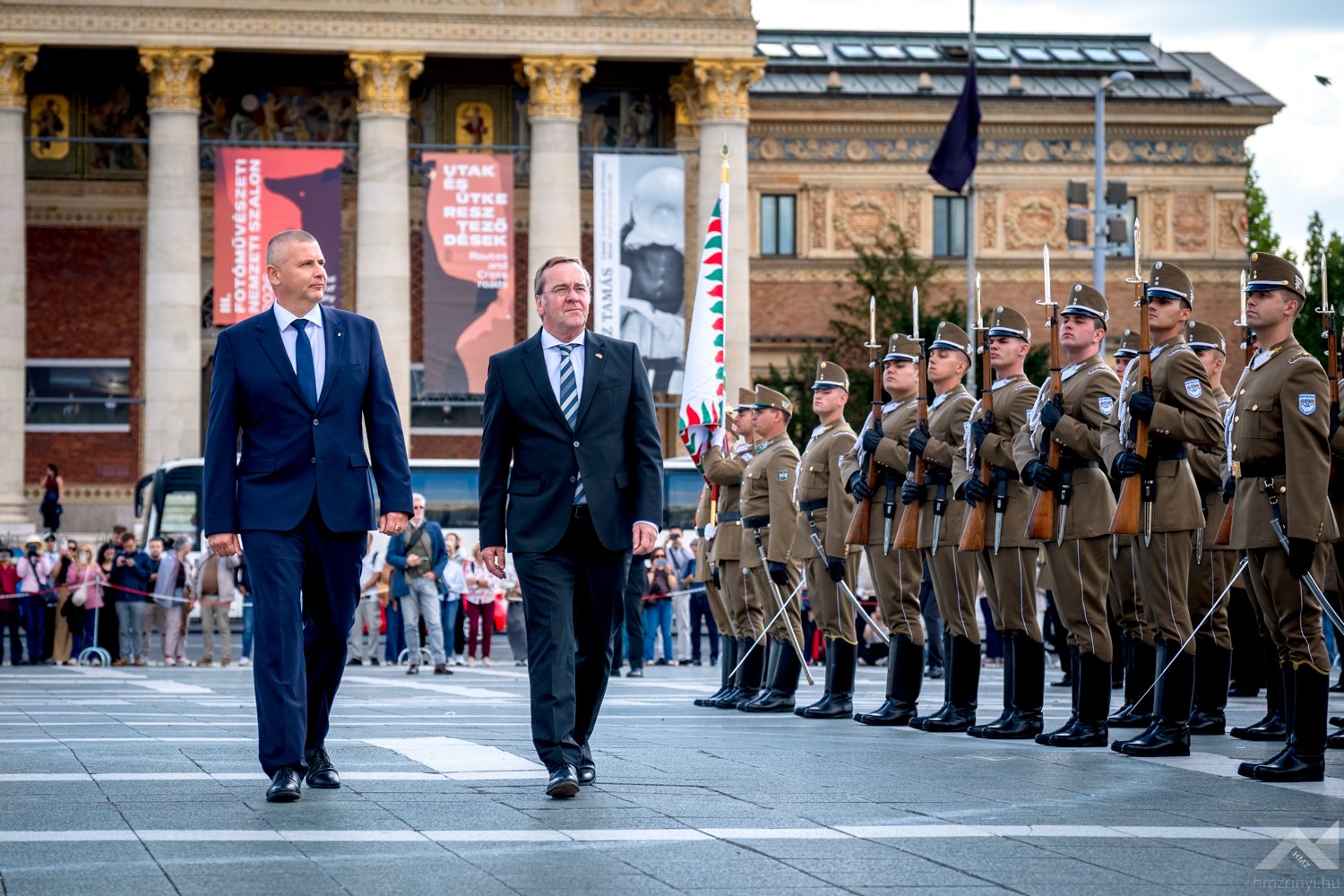
Romulusz Ruszin-Szendi (L) with his German Counterpart, Boris Pistorius, in Budapest
Apart from offering an uncalled-for political commentary concerning Hungary’s internal affairs, now commonplace with German left-wing politicians, Boris Pistorius’ Friday visit to Budapest has contained bellicose rhetoric that was politely deflected even by Hungary’s new pro-EU government.
Discussions focused on strengthening German-Hungarian military cooperation, military mobility, the space industry, and strategic issues concerning the future of the European Union and the North Atlantic Treaty Organization with German Defense Minister Boris Pistorius, who was visiting Hungary, at the Stefánia Palace-Honvéd Cultural Center on September 25, reported honvedelem.hu. However, the German politician has also diverted his message into political rhetoric, in which he attacked both the Russian government, as well as the former government of Viktor Orbán. In his words, “No matter what they say in Moscow, Putin shows no willingness to end the war.”
Hungary inspires courage in many people, because here the people have shown that democracy can flourish even within an authoritarian system,”
the German politician remarked in a all-too-obvious jibe against the former Orbán government, one of Germany’s largest defense and trading-partners in the region.
“Hungary has returned to both NATO and the European Union,” he continued without elaborating on why he thought the country has departed from the aforementioned alliances in the past. This type of politically charged messaging goes well beyond the usual international protocol of respecting EU and NATO partner’s national sovereignty and keeping diplomatic decorum during official visits. The anti-Russian and anti-Orbán message though is thought to have been directed towards his domestic audiences via the German media present. It is most likely designed to divert attention from his governments’ recent electoral woes, when during three of the most recent local state elections Pistorius’ SPD had suffered humiliating defeat from its arch-enemies, the center-right Alternative for Germany (AfD), but also from the communist-Islamist alliance (Die Linke) in Berlin. The German Defense Minister is also one of the most vocal advocates of banning the now most popular party in Germany, the AfD.
Boris Pistorius went on to explained that the threat posed by Russia is allegedly becoming increasingly significant to the peace order that Europe has built up over decades. “Today, it is particularly important that we stand together: we must respond to provocations calmly, in coordination with one another, and without contributing to escalation. Together, we have the resources, capabilities, and commitment to defend the alliance and ensure deterrence,” the defense minister added. At the end of his statement, he reminded the audience: “Neither peace nor democracy is guaranteed or self-evident; 72 percent of the world’s population lives under authoritarian regimes. However, as the example of Hungary shows, democracy can be rebuilt and strengthened.”

Romulusz Ruszin-Szendi (R), Boris Pistorius on Heroe’s Square in the capital. Photo: honvedelem.hu
“Military cooperation has never suffered any setbacks, as our soldiers have served side by side throughout the years in various parts of the world, including our country’s training grounds. We began the development of the Hungarian armed forces together. Our German equipment serves as a testament to the excellence of German industry, and the development of our heavy brigade capability—which we have offered to NATO—could not have gotten off the ground without German assistance,” reminded his German counterpart Romulusz Ruszin-Szendi, Minister of Defense.
The Hungarian Defense Minister’s words, who was Chief of Staff during the Viktor Orbán government, were a reflection of the fact that defense industry and military cooperation between Germany and Hungary was exceptionally high in the previous decade, despite the fact that Berlin and Budapest did not see eye-to-eye in a number of political issues. German defense industry, however, voted with their feet and have brought significant investment to Hungary, such as the Rheinmetall factory in Zalaegerszeg, where state-of-the-art infantry fighting vehicles are currently manufactured.
Featured Image: honvedelem.hu