
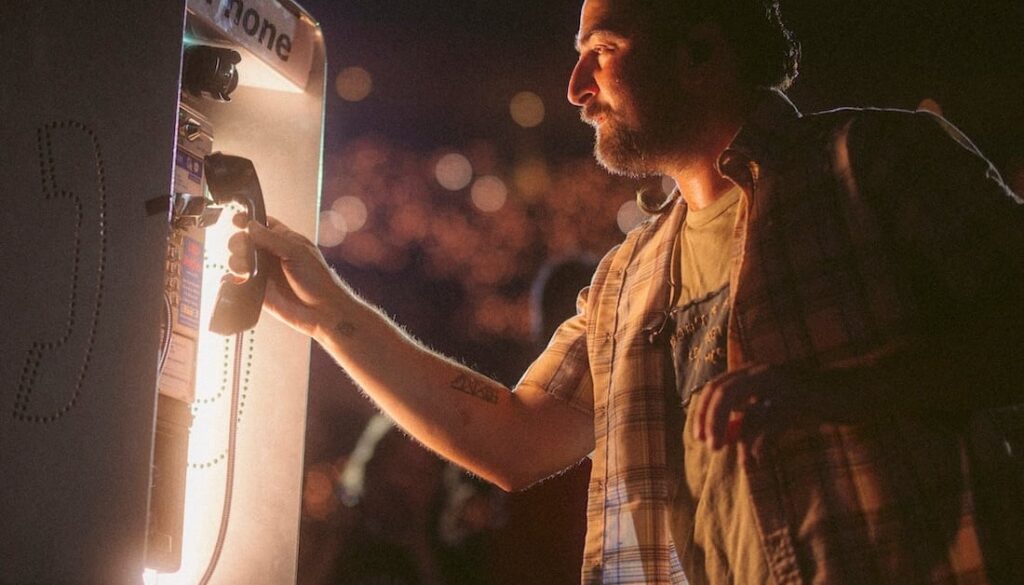
Noah Kahan has officially kicked off his Australia and New Zealand tour this past weekend with two massive shows in Melbourne.
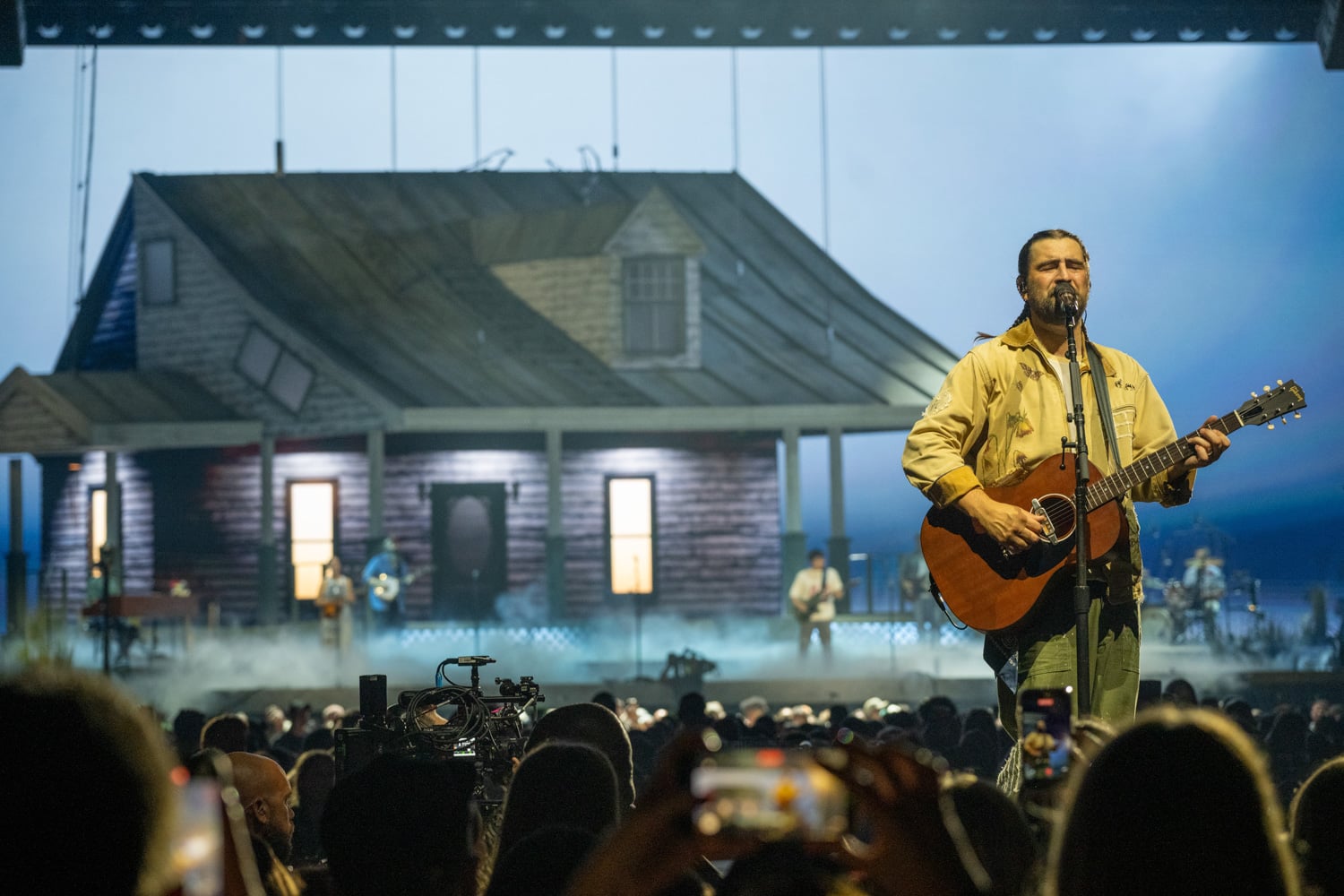
While thousands have and will continue to flock to the US songwriter’s shows, one standout feature of ‘The Great Divide’ tour is the stage design. As it was described when the run kicked off this past June: “The whole show is built around one idea: the house from his songs, brought to life at stadium scale. Noah sings from the porch, climbs onto the roof as it lowers to become a stage, and watches it transform around him. From a family home one moment, a roadside gas station the next, ageing through the seasons and from night to day as the lighting and video shift. The creative concept behind the show reads as thresholds, the idea that life happens in the fringes: on porches, doorsteps and the edges of town.”
To celebrate the tour’s arrival in Australia and New Zealand, we sat down with STUFISH Entertainment Architects’ Senior Designer, Rachel Duncan, and The Playground’s Creative Director, Benny Or and Production and Lighting Designer Sooner Routhier, to talk about how they brought Kahan’s Vermont house to life on stage.
Rachel Duncan, STUFISH Entertainment Architects
Rolling Stone AU/NZ: How did your involvement in ‘The Great Divide’ tour come about?
Duncan: We were approached by the management team, Foundations (DrewSimmons, Ryan Langlois, Nate Futral and Joel Eriksson), who we have enjoyed working collaboratively with on other artists such as Laufey and Chappell Roan. We swiftly set up a call with the production team (Sam Savile and Andrew Dobbins from 24/7), Lighting Designer (Sooner Routhier) and Creative Director (Benny Or).
From the get-go, it was clear this was going to be a great team and an incredibly fun project for us to collaborate on. We also had the advantage of being connected directly with the musical director, Zubin Thakkar, from a very early stage, who helped shape the flow of the show to the music. It’s really a dream to have all departments working together in parallel right at the start of a project.
Get your daily dose of everything happening in Australian/New Zealand music and globally.

Did you get to work directly with Noah on this? What was his own vision of what it would look like?
The creative team had an initial moodboard for the album campaign creative direction, created by Mikey Laviolette and discussed with Drew, Ryan and the management team.
At its heart, The Great Divide is about the complexity of the human experience and how contradictory life can sometimes feel. Paradoxical themes such as feeling homesick only to find that home is a place you no longer belong, achieving incredible success while also feeling self-doubt, and the simultaneous existence of love and conflict within families are beautifully woven into the album.
Noah and his team were very generous with material they shared with us. We had access to the new music, sneak peeks of documentaries and photographs of the artist and his hometown in Strafford, Vermont. This resulted in a very rich and clear picture about the artist’s background and sentiment of the album, which gave us an amazing starting point to work from together with Benny and Sooner. We then presented a concept to Noah, which we developed together with him.

What stood out to you in the brief? Was there any one part that you needed to nail in order to achieve the overall goal?
We worked closely with the creative team, Benny Or and Sooner Routhier, to develop the staging concept. One idea that kept coming back to us was the concept of ‘home’ and what happens when that becomes somewhere you no longer feel you belong.
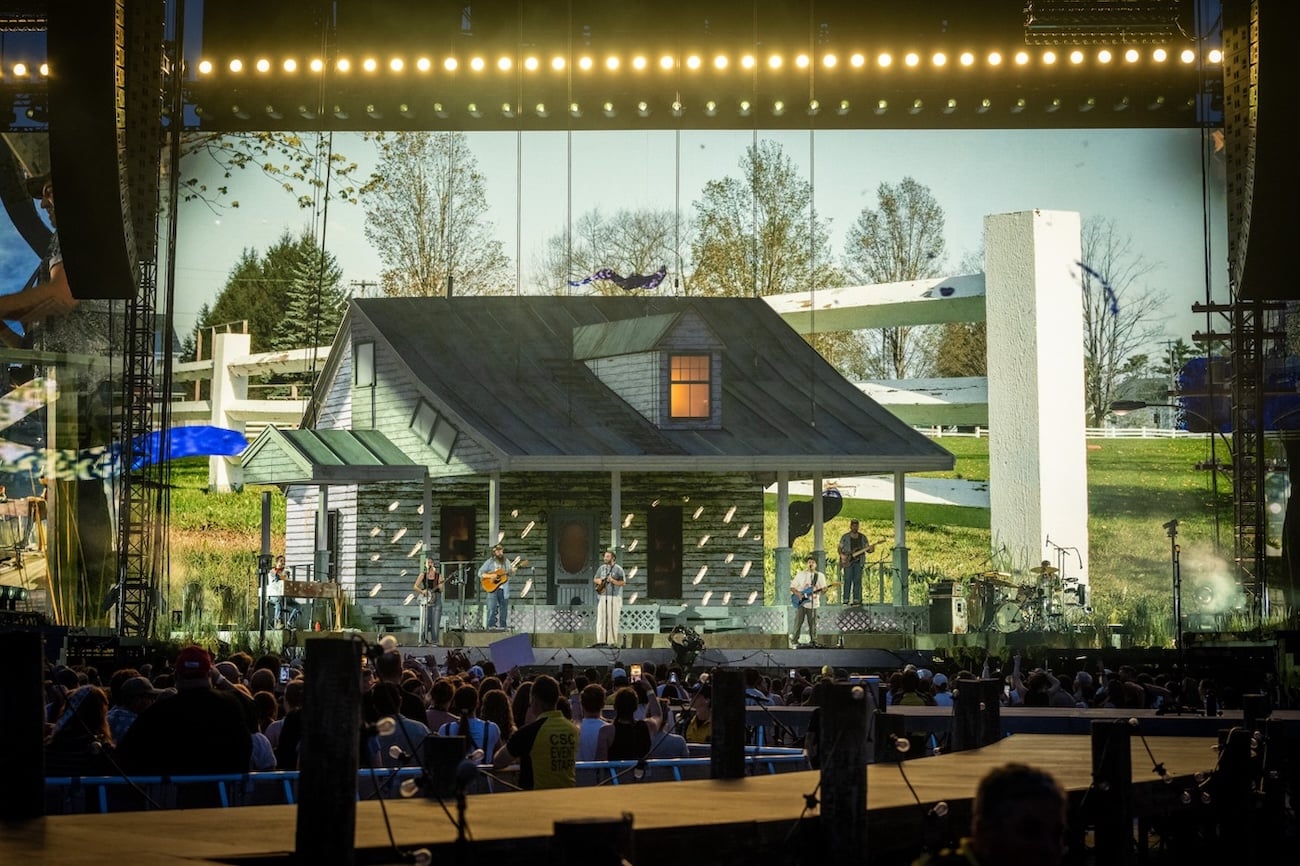
We explored the idea of a set piece that could create the illusion of ‘home’ but could also morph and distort to reveal that it is not quite what it seems. This led to the idea of the perspective house, consisting of a physical scenic perspective roof, a physical scenic porch and a digital façade. A hybrid set piece combining traditional scenery and digital content that straddles both the physical and digital environment.
At certain points in the show, the house appears tangible, but then the image breaks away, the perspective shifts, and it no longer feels recognisable. The digital façade enables the house to dissolve and transform throughout the show. The perspective roof can lower, adjusting the audience’s vantage point, or even fly out altogether, revealing a clear panoramic canvas of the video screen behind.
Once this element was in place, we were able to flesh out the rest of the design around it. We wanted to reference the artist’s hometown without it being too literal, so we added some scenic elements for context using a lot of foliage to ground the house in rural Vermont. Two catwalks, each with a different scenic treatment, extend off the sides of the stage: one is paved with concrete, while the other represents a forest floor. These pathways wind and undulate through the audience, enabling Noah to travel right through the crowd to reach the centre on a B-stage that resembles a dock.

What was the biggest challenge?
The biggest challenge was finding a way to seamlessly merge the digital and physical components of the house, so that they would appear as a single, coherent object.
We worked closely with Raw Cereal’s brilliant content team to develop a digital façade that could coexist alongside the physical scenic elements. Sooner and Raw Cereal worked together to carefully match the digital lighting, colour and texture to the physical set, creating a seamless relationship between what was real and what was digital content.
The result was an object that began as a familiar and recognisable house but possessed the ability to continually evolve throughout the show, adapting to different conceptual locations and narrative moments.
Has the set changed at all since ‘The Great Divide’ tour began?
The show has been designed to expand and contract to different scales of venues, from arenas to baseball and soccer stadiums. The stage and catwalk length is adaptable while maintaining the core essence of the show.
What does working on Noah’s set and other big names you worked with say about human creation and design in a world where some people believe AI is coming for the creative industry?
It’s certainly an interesting time to be doing this kind of work. I think there are some fascinating AI-based tools that are great fun to experiment with, but I also believe that there is beauty in the imperfections and rawness of human work, which I think is still highly valued in our industry. It’s also interesting that, in this digital age, there’s a growing appetite for traditional physical scenery. There also seem to be trends for nature, where you might have expected more digital and abstract themes.
The other key element of what we do is making real-life moments where our real-life experience is dealing with show-making in person, in rehearsals and between a collaboration of artists, creative, production, technical, and vendors come together into a magic mix of show creation.

Sooner Routhier and Benny Or, The Playground
Rolling Stone AU/NZ: How did your involvement in ‘The Great Divide’ tour come about?
Routhier: Corinne Merolla of The Playground and I, creative directed, designed, and produced the previous ‘We’ll All Be Here Forever’ tour for Noah Kahan and management in 2024. Our relationship with their team led to a festival iteration in the summer of 2025. We developed a great creative shorthand between the project managers and designers at The Playground, and the very creative humans on Noah’s management team at Foundations over time.
Or: I came into the project through The Playground, building on the relationship Sooner and Corinne had built with Noah’s team over the years. Management asked for a pitch for this tour, and that’s when Sooner brought me in. My role was to shape the creative narrative and to expand on the existing visual direction, developing a language for this tour that was uniquely Noah’s.
Did you speak to Noah directly about this – what was his own vision of what it would look like?
Routhier: The process starts with management. They are amazing at discerning what Noah would like to see in his live production. As far as management goes, they are one of the better teams that we’ve collaborated with that can interpret Noah’s thoughts, music, and visual identity into tangible creative for the tour design. As we work with management, STUFISH and Playground collaborate to create a creative deck that includes a narrative outlined by Benny and a production design created by the entire team in a collaborative manner. Once we’re in a good spot, we take it to Noah for feedback.
Or: The creative direction of the show was driven by Noah’s request that everything go back to the music and the feeling behind it.
What stood out to you in the brief?
Routhier: The brief in Noah’s visual identity always contains a feel of “maker” or “craft” and is centred around life in New England. More importantly, the state of Vermont. Luckily, I’m also a native Vermonster! The themes and emotions in Noah’s music speak heavily to my childhood and young adult life living in multiple states in New England – mainly Vermont. We’re able to create a love letter to my and Noah’s upbringing every time we create a new show for Noah, and it’s an incredibly emotional process for me.
I think the combined creative team of The Playground and StuFish helped carry that emotion through every aspect of the production we created together. The multiple viewpoints from both inside and outside that geographical area create a multifaceted production that you couldn’t get without the natives of New England AND the outsider’s points of view combining into a singular vision.
Or: Responding to Noah’s brief, I listened almost exclusively to his music throughout the creative process. Each song became its own act of soul searching: dissecting the lyrics and their meanings, then imagining a world where that song could live. Noah’s brand creative director, Mikey Lavi, set a cinematic yet tactile direction for The Great Divide’s visual identity. The challenge was to root the show in Noah’s world, his hometown of Strafford, Vermont, while making it feel universal. That balance was what we needed to nail.
What was the biggest challenge?
Routhier: The routing of the beginning of the tour posed the biggest challenge for us in the pre-production stages. In about a month and a half, we had to prep and perform an arena, festival, and stadium version of the show. In this instance, we had to adjust lighting design and lighting programming, video content and video programming, stage movement and direction for three different production designs in a fairly short amount of time. As always, we’re up for a challenge, and we had the team to set us up for success.
Or: The video wall was a huge canvas that had to scale for both arenas and stadiums, reconfiguring throughout the show as the massive roof moved in and out of place. We worked with Raw Cereal to create bespoke content that pushed in two directions at once. On one side, we developed new ways of using video game engines and built virtual time-lapse sequences. On the other hand, we painstakingly hand-painted and composited visuals. Between scenic, lighting and content, many moving pieces had to work as one. The key challenge was deciding when and where to let each element lead, so that every moment served the emotion of the song.
What does working on Noah’s set and other big names you worked with say about human creation and design in a world where some people believe AI is coming for the creative industry?
Routhier: AI can certainly be a tool in the process of creative direction and production design for a tour. I often use it for reference images, research, and early renders for proposals and creative decks. However, designs for Noah Kahan’s tours need a bit of craft work or makership in order to feel like they fit into his world. There is a very human component to his visual identity that’s expressed through lyrics and music. It permeates the set, lighting, wardrobe, and even the digital content on the LED video surfaces. Those surfaces are painted with canvases that are animated *actual* pieces of hand-made art in the form of collage, paint, and hand-made illustration. There is a tactile connection to the art on stage and on screen that isn’t easily achieved with AI at this point in time.
Or: As a creative director, much of my time goes into building decks, sourcing references and creating renders. New tools have streamlined that work, freeing me to focus on the ideas themselves, explore quickly and communicate clearly. While none of what the audience sees on Noah’s stage was generated by AI, to me, art is about what it means to be human, and AI is now part of the human experience. To reject its influence completely would be inauthentic in its own way. The value lies in knowing what you’re after. With a clear vision, AI becomes a way to get there faster. Without one, it ends up deciding for you.
For complete tour and ticket information, see here.