
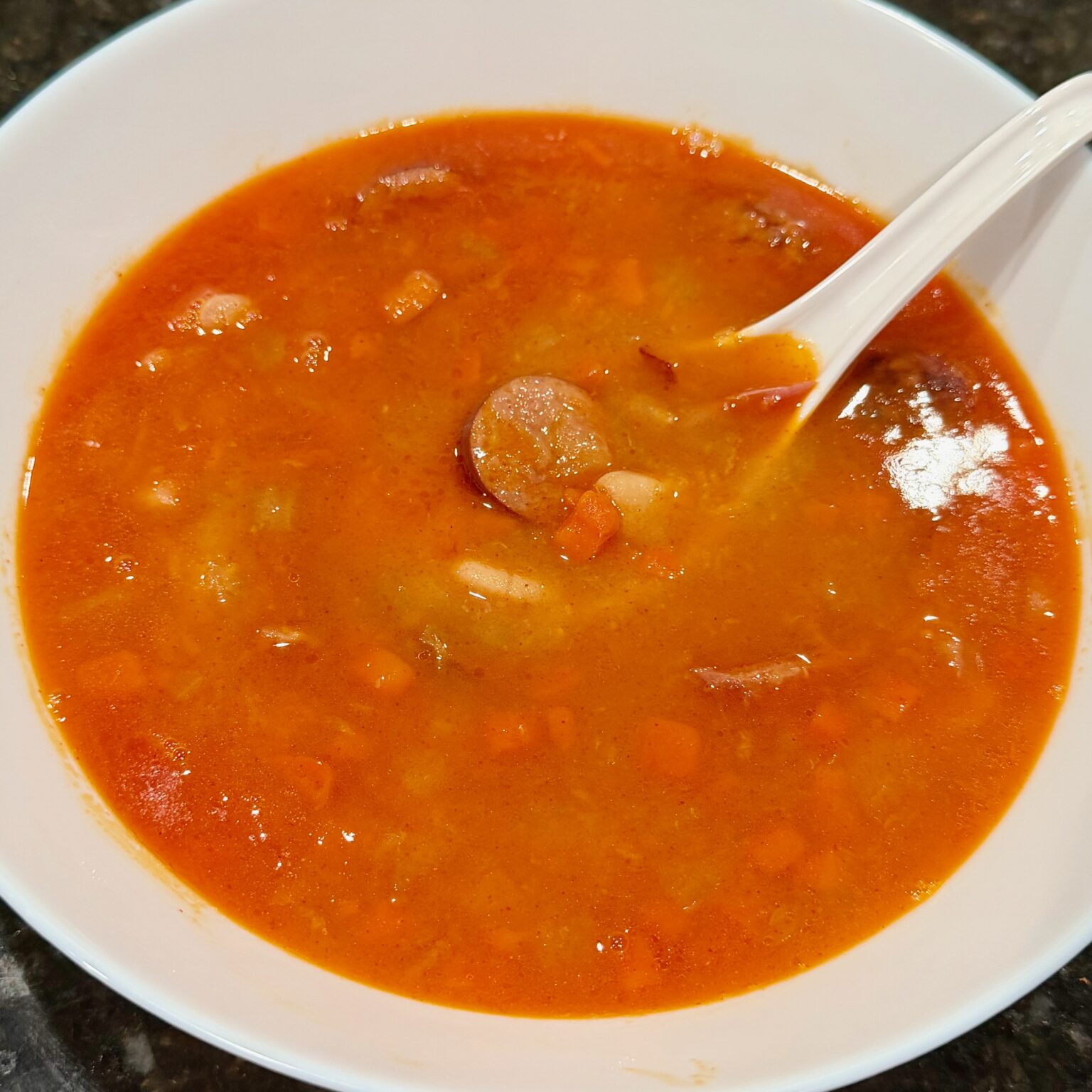
Good evening, Kibitzers! Well, after posting a surprisingly popular (and controversial) borderline-satirical rant on Costco for New Day Cafe yesterday, I thought I’d better post something less divisive for KTK tonight. So, naturally, the Balkans came to mind. Nobody’s ever fought over that.
(In all seriousness, I hope I don’t accidentally start an ethnic conflict or something. I just want to share a bean recipe, folks. Let’s try not to balkanize over this.)
As all of you at KTK know, I’ve been on what you could call a bean journey for the past several months. It’s partly an attempt at frugality and partly an attempt at improving my health. There are a few favorite bean recipes I keep coming back to, but I’ve also really been pushing myself to expand my horizons and try beans in different ways. Lately, I’ve been interested in discovering how beans are eaten in other parts of the world, since they’re so commonly eating all around the globe. Tonight’s dish (pasulj) is Serbian in origin, but I might start posting more of these “international” bean recipes in future diaries. We’ll see!
Why Serbia? I have no connection to Serbia or any of the other Balkan countries. To be perfectly honest, until fairly recently, I would have probably struggled to point out Serbia on the map. My education is very American-centric, and my knowledge of that part of Europe (or any part of Europe, for that matter) was/is pretty sparse. Of course, being a historian by training, I was at least vaguely knowledgeable of the conflicts in that region, but I knew very little of the geography or culture.
Then, I started trucking. Virtual trucking, that is. As many of you know, I spend quite a bit of time playing both American Truck Simulator and Euro Truck Simulator 2. I have a whole trucking setup with a 48-inch monitor in my office, and I spend much of my evening trucking around different parts of the U.S. and Europe. I play the American simulator much more than the Euro simulator, but on most weekends, I’m gallivanting around Europe in my Scania. It might seem silly, but it’s therapeutic for me, much like real-life driving is (but this doesn’t cost anything for fuel!). Now that I have several hundred hours of Euro trucking under my belt, I also have a much better grasp on European geography. When somebody brings up a European country, I now have mental images of topography and landmarks to go along with it. And, inevitably, when I visit a new country that I really enjoy in the game, I find myself wanting to learn more about its people, culture, and even food.
The Balkans are probably my favorite place to drive through, which (based on what I’ve seen online) is not the opinion of actual European truckers. But it’s a game, so I get to just enjoy all the scenery while not having to worry about corruption at the borders, bad road conditions, etc. Here are some screenshots of my Scania in various parts of Serbia:
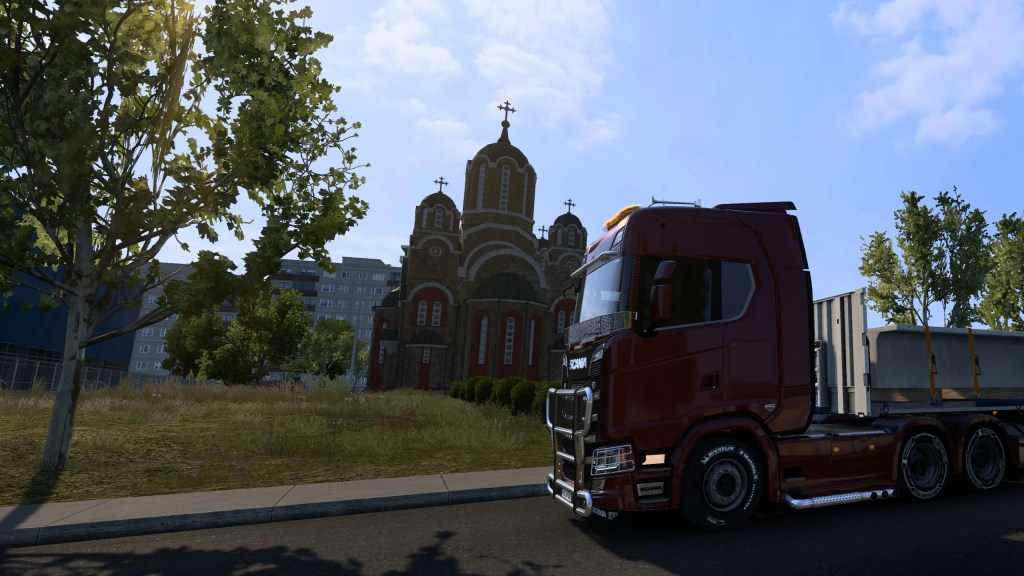 A Serbian Orthodox church in KragujevacChrislove
 Somewhere near the border between Serbia and Bosnia and HerzegovinaChrislove
 Somewhere between Niš and SarajevoChrislove
 In Prokuplje, one of my favorite little cities to drive throughChrislove
 In BelgradeChrislove
To bring it back to beans (lol): When seeking out new “international” bean recipes, my virtual travels through the Balkans made me wonder what bean dishes I could find from that region. That’s how I landed on pasulj.
In researching this dish, I came to realize that it’s not very fussy. It’s not like some, say, Italian recipes, where you’ll have the whole Internet hunting you down because you put cream in the carbonara. There seems to be quite a bit of variation, and some of the things available in that part of the world are not things I can find here, so I just used the recipes as a general guide and made adjustments as I saw fit. The recipe I most closely followed, though, is this one, mainly because the pictures looked so good (although mine didn’t turn out to look much like that at all). I do have to insist, however, that (if you have time) you watch this video of a guy helping his mother make pasulj (as well as another Serbian bean dish I might try sometime, prebranac). I think you’ll enjoy it as much as I did. This lady is a hoot!
Anyway, on to the cooking! For this recipe, I decided to use a pound of Rancho Gordo cassoulet beans. Since I intended to cook the beans in the soup, I did soak these for several hours before using them.
 Chrislove
I started by browning sliced kielbasa in some cooking oil. Smoked sausage is commonly found in this dish, and while I’m sure there are different types of sausage available in the Balkans, I figured kielbasa would do the job. I just used a standard 14-ounce kielbasa sausage that I sliced. Animal fat is often used for this dish, but I’m trying to watch my saturated fat consumption, so I used avocado oil. Once browned, the kielbasa slices were removed and set aside.
 Chrislove
Then, in the same Dutch oven with the same oil, I cooked two onions (chopped) and two carrots (somewhat finely chopped) until tender.
 Chrislove
There’s really not that much more to it. I added in the beans, browned kielbasa, a couple of bay leaves, and about 10 cups of water. Note: If I did this over again (and I probably will), I would use less water, because it turned out a bit too soupy for my tastes. Oh, and I also added in some smoked turkey legs. Various smoked meats are used for this dish, and while I haven’t come across a recipe that uses smoked turkey, I figured it would be fine. From what I’ve gathered, people kind of just use what they have. I brought it all to a simmer and transferred to a 300 degree (F) oven.
 Chrislove
Another note: The recipe I linked above says to boil the soaked beans for 20 minutes before adding them to the pot. I opted not to do that, and I wish I had. It all worked out in the end, but it just took longer than I’d planned. In total, this took about two hours in the oven, at which point I took out the turkey legs and stripped off as much meat as I could to return to the pot.
The last step is interesting, and it’s something a lot of the recipes have in common. The thickener is made by heating fat (usually animal fat) and adding flour and paprika to it, which you then add to the soup. This recipe also called for grated garlic. I used four tablespoons of butter, and once that heated in a pan, I added four grated cloves of garlic and cooked for a minute or two, then two tablespoons of flour and one tablespoon of smoked paprika. The next time I make this, I’m going to double the flour, because I’d like the final product to be thicker.
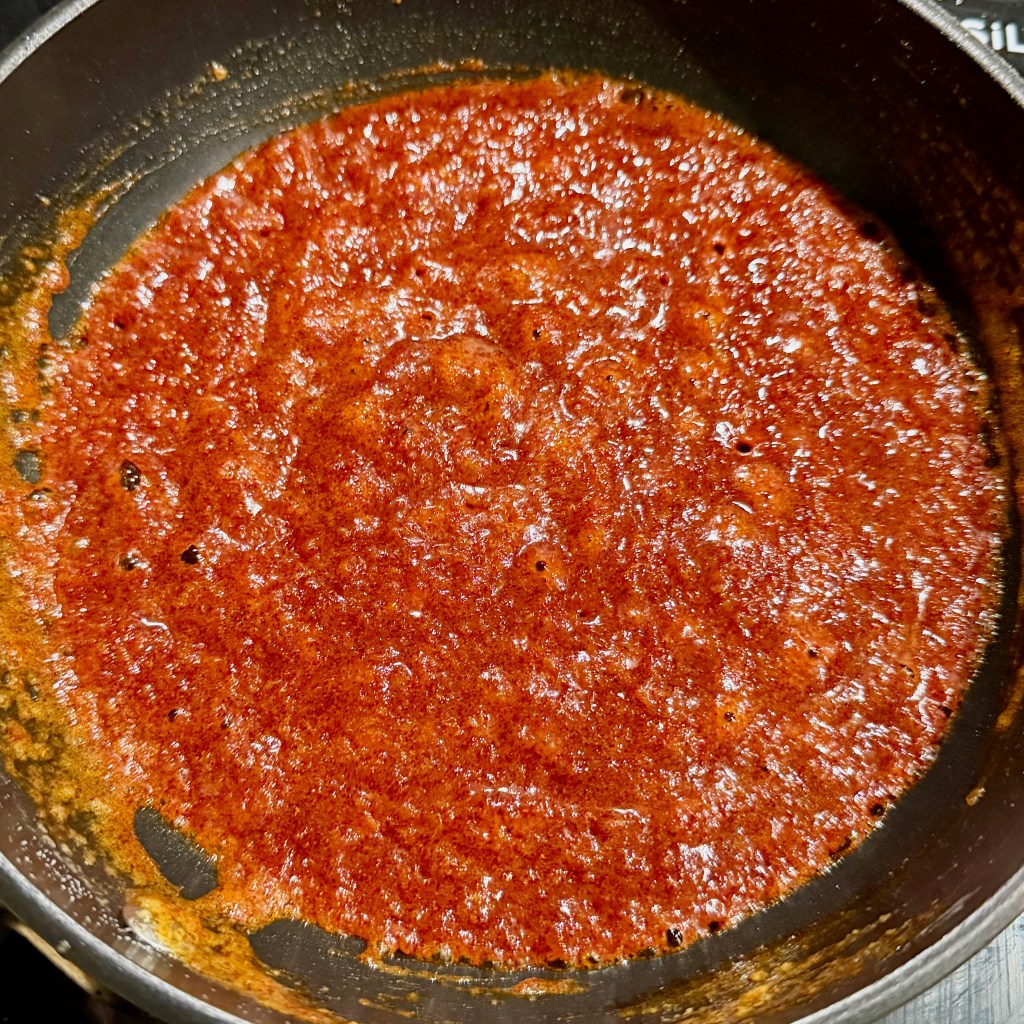 Chrislove
Once that is added to the soup and it simmers a few more minutes to thicken, it’s done! Well, other than the seasoning. This needed plenty of salt. Many recipes use Vegeta, which is a Croatian-produced all-purpose vegetable seasoning. I’m pretty sure I can’t get that here, but I used some Better Than Bouillon vegetable base, which I figured would be fine as a substitute.
 Chrislove
Again, too much liquid for my liking, so next time I’ll add less. I had to spoon the beans and sausage out just to prove they were there! And, just to make it multicultural, I ate mine with an Asian soup spoon.
 Chrislove
The first thing that hit me was the garlic. If garlic is a turnoff for you, leave it out. In fact, I wasn’t sure I liked that garlic flavor at first. But, after the first couple of slurps, I really started to enjoy it. It’s a very comforting soup, and the smoked meats really carry it. It’s economical, pretty easy to make, high in protein and fiber, and is like getting a warm hug (from somebody with garlic breath). What’s not to love?
Let me know if you’d like more international bean dishes. Hey, maybe I could even let my virtual truck guide me to the next bean destination!
What’s on your mind (or plate) this evening?
🫖 💭 🥂 🍽️ ☕
 belinda ridgewood