
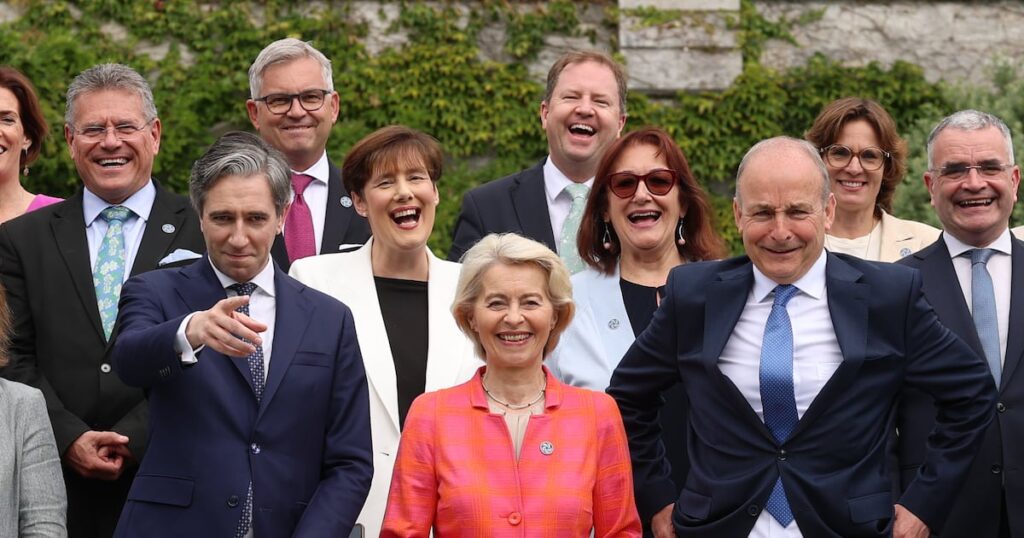
Ireland’s EU presidency has gone without a hitch, but could that be about to change?
European energy ministers are assembling in Dublin Castle for informal talks on energy affordability and security.
Speaking in advance of the meeting, Ireland’s Minister for Climate and Energy, Darragh O’Brien, said: “The ongoing conflict in the Middle East underlines why Europe must accelerate the deployment of renewables across all sectors.”
He said that during Ireland’s presidency of the Council of the European Union he was “emphasising the need for the accelerated deployment of clean energy” to “deliver affordable and sustainable power”.
The meeting comes – the August break notwithstanding – halfway through Ireland’s EU presidency, which, so far at least, has progressed smoothly.
However, as Europe Correspondent Jack Power reports in our lead today, there may be trouble ahead.
Senior Government officials have warned Ministers that a planned work-to-rule across the Civil Service starting this week has the potential to cause serious disruption to Ireland’s EU presidency.
Against the backdrop of the battle over public-sector pay there are fears a prolonged industrial dispute will cause a slowdown in the Government’s attempts to conclude political deals on a wide range of European legislation and reforms during its six-month presidency.
The work-to-rule, whereby staff are restricted to working within the letter of their contracts, will be in place from Wednesday onward.
The industrial action follows ballots passed by Fórsa, Siptu and other unions representing public-sector workers.
A one-day strike by public-sector workers is planned for October 14th, to raise pressure on the Government in advance of expected pay talks.
There are concerns the work-to-rule restrictions will disrupt Irish efforts to guide EU policy negotiations in Brussels, work that can regularly run late into the evenings and take place over weekends.
Guidance about how civil servants should approach the work-to-rule action differs between unions.
The Association of Higher Civil and Public Servants, which represents higher-ranked staff, has instructed its members not to carry out additional duties.
Any travel – including to EU meetings in Brussels, or ministerial “informals” organised in the Republic – should be undertaken only during working hours, according to the guidance.
It is understood Ministers have been privately briefed by senior officials that this could create challenges for civil servants based in Dublin, who had been expected to accompany Ministers to meetings and discussions in Brussels and Luxembourg.
Today’s meeting in Dublin Castle will be unaffected by any industrial action but waters could turn more choppy soon.
Crisis in the North
The events in Northern Ireland over recent days offer a deeply worrying and unwelcome reminder that tensions from the past can quickly resurface and escalate into political crisis.
As Freya McClements and Mark Hennessy report, the Irish and British governments have stressed the need to safeguard the North’s powersharing institutions amid the row over a controversial Orange Order parade at Drumcree.
The stand-off in Portadown, Co Armagh, continued on Monday night, with hundreds of residents and supporters remaining on watch in case members of the Orange Order tried to force the march through.
During Monday, the order made a number of attempts to parade from the Church of Ireland church at the centre of the dispute. However, they did not try to breach the barrier of Police Service of Northern Ireland Land Rovers blocking their route.
At Stormont, there were heated exchanges in the Northern Assembly, with the Democratic Unionist Party accusing the First Minister, Sinn Féin’s Michelle O’Neill, of breaking the law and a “total abdication of leadership”. Sinn Féin told the DUP the Drumcree parade was “steeped in a history of murder, violence, intimidation and supremacy”.
“It’s very important the institutions are protected,” Taoiseach Micheál Martin told reporters in Cork. In Hillsborough, Northern Secretary Chris Bryant said the “most important thing is we have to have powersharing”.
Bryant on Monday met members of the Orange Order, the Garvaghy Road Residents’ Coalition and political parties in an attempt to find a solution to the stalemate. He admitted to reporters afterwards that “it’s not quite clear what that will look like yet”.
Ireland and Britain Editor Mark Hennessy spoke to residents on the Garvaghy Road.
In her analysis, our Northern Editor Freya McClements writes that although Stormont staggers on, this is a dangerous moment for Northern Ireland.
Best Reads
On the Opinion pages, Fintan O’Toole writes that Ireland stood up to Israel – then left it to 26 footballers to follow through.
It is not fully clear whether the Central Bank will no longer have the role of approving Israeli bonds for sale in the European Union, according to the chair of the Oireachtas finance committee Sinn Féin TD Mairéad Farrell. Harry McGee has the story.
Health Correspondent Shauna Bowers reports on how the contractor behind the new national children’s hospital has submitted claims for an additional €983 million over disputed costs incurred during the project.
Work Correspondent Emmet Malone has a feature on the cybersecurity implications of artificial intelligence agents hacking government agencies.
Playbook
The Cabinet meets this morning. Our tee-up story – which includes details of how a rule that limits workers from outside the European Economic Area to 50 per cent of an organisation’s workforce is being relaxed to address critical healthcare staff shortages – can be found here.
Dáil proceedings begin with Leaders’ Questions at 2pm.
Legislation proposed by Fianna Fáil TD Malcolm Byrne aimed at protecting children from AI companion chat bots is to be introduced at 3:04pm.
Government Business later in the afternoon – from 3:55pm – is a second stage debate on the Strategic Lawsuits Against Public Participation Bill 2026.
Next up is a debate on a Sinn Féin motion on the recently announced public transport fare increases.
Tánaiste and Minister for Finance Simon Harris is due to take Parliamentary Questions at 9:29pm.
There will be an opportunity for TDs to raise Topical Issues at 11:05pm.
A Government motion on the Defective Concrete Blocks Social Homes Scheme 2026 will be before the Seanad at 3:30pm.
Artificial intelligence and the environment will be the topic for discussion at the Committee on Artificial Intelligence from 11am. Representatives from ESB Networks, EirGrid and the Commission for Regulation of Utilities will be in attendance to take questions.
European Union climate commissioner Wopke Hoekstra will be before the Committee on Climate from 11am.
The Committee on Foreign Affairs will be looking at diaspora engagement from 3pm.
There will be pre-legislative scrutiny of the heads of the Legacy of the Troubles Bill at the Committee on Justice from 3pm. Organisations due to attend include Amnesty International Ireland, Relatives for Justice, The Pat Finucane Centre and the Irish Council for Civil Liberties.