
The increase in the ability to collect and analyse sports data has undeniably increased in recent years, spurred on by the evolution of increasingly powerful data-specific systems. Now, with the advent of AI, the capabilities of these platforms are set to expand dramatically once again.
At the present time, however, there is much evidence to suggest that a not insignificant percentage of sports federations and broadcasters have yet to optimise their data infrastructures. So why does it pay to take a closer look at the way data is aggregated and utilised?
Centralised system value
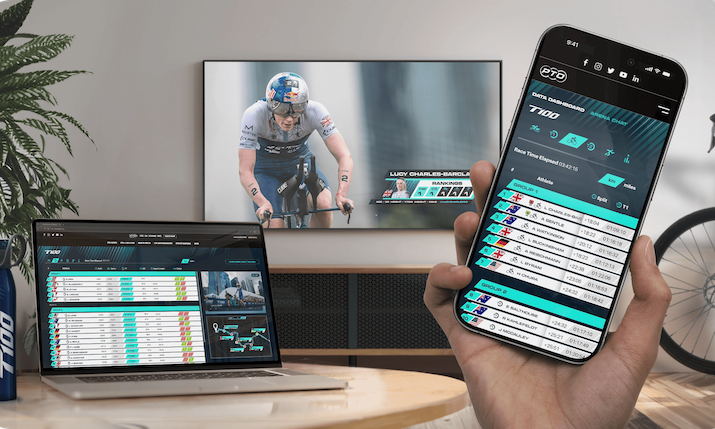
James Haigh has a long history of working with sports federations to maximise their management of utilisation data, having co-established sports technology agency We Are Sweet in 2011. During that time, a project with the Professional Triathletes Organisation (PTO) prompted a deep exploration into “everything from their website through to the way they deal with stats for their athletes, as well as the use of different stats in a second screen interface”. Consequently, they learned “a great deal about the challenges of ingesting data in real-time, validating, caching it, and so on”.
One of the primary observations was that there was an unnecessary duplication of data pipelines occurring between the sensor provider and the broadcast graphics supplier. It quickly seemed that it would make far more sense, says Haigh, to “process everything in one place and then feed both the website and the broadcast graphics provider”.
 James Haigh, Dataworks
The gradual realisation that there were plenty of “other endurance sports and even stadium sports that were still trying to sort this data thing out, and who had probably got lots of different parties trying to do different integrations” was the impetus for the incorporation of Dataworks, with PTO as one of the investors, in January 2025. Its primary offer to clients is a “centralised system that takes in all the data – it doesn’t matter where it comes from – and that can then be sent to TV graphics, an app, a website, social media and betting integrations. The sky’s the limit on where the data can then add value,” he adds.
Nonetheless, while Dataworks has garnered plenty of interest over the past 18 months, Haigh feels that the adoption of a unified data strategy is some distance from becoming a default position. “I’m not sure that everyone is yet thinking that data is more than just a feed I send from a stadium to TV graphics,” he says. “I hope that over time everyone will realise they can centralise their use of data sources. They can employ AI to generate some stories, but also develop more substantial storytelling that underlines the emotions of an event, as well as being able to personalise data for certain athletes to go to broadcasters in specific territories. There are a huge number of opportunities if you go down this route.”
Structured data store
Spicy Mango is another company for whom the optimisation of data infrastructure has often been integral to the projects it delivers for sports, media and entertainment brands that are aimed at driving ‘transformation to accelerate growth’. Chief technology officer Chris Wood is not alone in suggesting that, in many parts of the industry, “there is still a bit of catching up to do. Everybody talks about data and its importance, but how many people are actually doing it properly?”
He observes that it remains common practice for a sports organisation or broadcaster to be “taking something from a data provider, passing it through the system, and then placing it on their front-ends, which are in effect purely ephemeral. They’ve got scoreboards, leaderboards, and bits and pieces while games are going on, but when those things are finished those items disappear.”
“Everybody talks about data and its importance, but how many people are actually doing it properly?”
With the rise of AI – and its many attendant complex and logistical challenges – it’s become increasingly clear over the last “36 months that to do anything in terms of analysis, trending and predictions, you require a structured, persistent data store”, adds Wood. Asked whether this means that many sports organisations still fail to have a clearly delineated data strategy, he confirms: “100%. They will have customer data, data for sites and apps, sports data and video content, but it’s rare that those things are linked or brought together.”
This is certainly not by design; instead, it’s likely the result of a tendency to develop capabilities piecemeal over time, and with different configurations of people. “Companies who build these data teams tend to do it very organically, so they might hire a CRM team then a platform or architecture team at a later date, followed by separate teams to do encoding, operations and so on,” he explains. “This means they remain very siloed things, and the links and relationships between those data sources are not put in place.”
A unified architecture makes much more sense, then – especially as the volumes of data being amassed and managed continue to surge. Asked for advice to offer companies planning a new approach to data, Wood urges them to “think about points of departure. In the case of sports, generally everything can hang around the sports information architecture, so you would [typically have criteria such as] competitions, stages, events, clubs, teams, players, venues and key moments.”
 Chris Wood, Spicy Mango
What Spicy Mango has done with its Gameday platform – which facilitates the ingest, control and monetisation of real-time sports data through a fully managed service – is provide the ability to “pull in and link all of these different things. What you can do with data is incredible. One example is to take data from some of the leading ticket providers and then think about the two or three aspects that are most closely associated with the ticket, which might be a specific club, team or event. What you might do at the ingest point is to take all that information and develop it inside of the sports information architecture in order to present extensive lists of competitions and venues – meaning you end up with a whole relationship model for ticketing data.”
The managed service structure of Gameday, and therefore its capacity to lighten the internal load of sports organisations and broadcasters, has led to considerable interest from federations, tournament and event organisers. “It’s been well-received and we’re currently involved in a lot of digital transformation projects,” he says.
Variable data strategies
Niall Hendry, VP of AI applications and solutions at sports AI company Stats Perform, agrees that “more unified things like data lakes” – which are centralised stores able to contain raw, native structured, semi-structured and unstructured data – and “structured data sets” can be of significant benefit. However, he also acknowledges that the data needs and progress status of broadcasters and federations can vary.
“Some are more advanced than others,” he says. “Some will just integrate direct data sources to where they need them. So it does depend on the size and scope of the broadcaster, as well as their data strategy.”
 Niall Hendry, Stats Perform
Nonetheless, when there is an involvement of real-time data feeds – “which are vast in terms of advanced analytics, fan data and subscriber data” – structured sets are very useful. Consequently, on the Stats Perform front-end, “all of our data is formatted the same way, so basically throughout our data feeds, irrespective of sport, we have a unified data structure”. The company also tends to “work with broadcasters across multiple sports so they don’t have to replicate their systems time and time again for new vendors”.
As to the future impact of AI, Hendry underlines the fact that the “veracity of the data” will have to be guaranteed, adding: “Our perspective is that to maintain the authenticity, accuracy and quality of the data if you’re going to integrate with more large language model-based services, then you need to actually put an agentic structure and intelligence layer on top of our data versus just allowing it to be accessed freehold.”
He implies that the next year will be highly instructive as to how AI is going to play out in sports data long-term. “The next 6 to 12 months will be very exciting in terms of using AI tooling on top of data feeds that are both being ingested and redistributed, and [as to what AI] can give you as an easier way of understanding the health of what’s in your ecosystem.”