
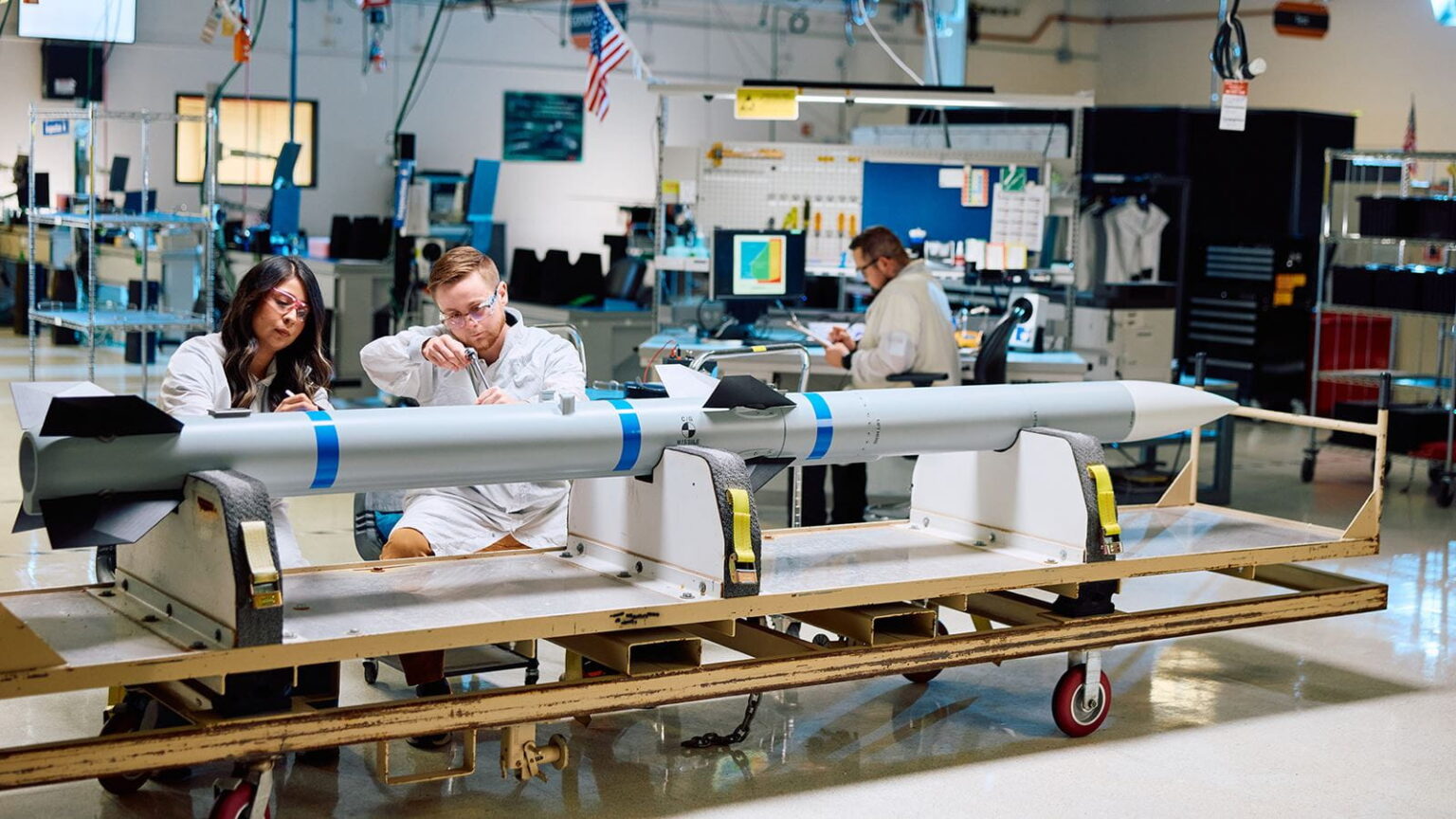
A $20.7 billion Raytheon contract will push AMRAAM production to record levels. With the missile in service across 19 European nations, stocks could decide how hard NATO can contest the air against Russia, and how well it can blunt Moscow’s opening strategic operations.
By Sam Cranny-Evans, editor of Calibre Defence, published on September 29, 2026.
In an all-out war between NATO and Russia, missile stocks would quickly have a decisive impact on the shape of the war. That impact would be most keenly felt in the air.
The reason for this is potentially somewhat binary; either NATO airpower succeeds in writing down the Russian Aerospace Forces (the VKS) – including its air defence network and air superiority fighter fleet – allowing the Alliance’s combat airpower to contribute to the war on the ground. Or NATO fails in securing some form of air superiority, and the resultant war becomes protracted and very difficult for NATO’s land forces.
There are, of course a range of scenarios between these two extremes, and a host of others that would present themselves if NATO did achieve air superiority. But the core aspect here is that NATO must try to achieve air superiority whilst balancing demands for defensive counter air (DCA) operations.
DCA is the term used to describe the strategy of using active and passive measures to detect, identify, intercept, and destroy or negate enemy air and missile forces trying to attack or penetrate friendly airspace. For NATO, it would involve its ground-based air defences, as well as fighter jets like the Eurofighter Typhoon and F-35 taking to the skies to intercept Russian cruise missiles and aircraft, perhaps with some special attention on the VKS’s strategic bomber fleet because it is responsible for air-launched cruise missiles.
Russia and the Initial Period of War

UAC has delivered multiple batches of Su-35S fighters to the Russian MoD since 2022. Equipped with their own long-range air-to-air missiles, they would be a credible threat to NATO airpower without systems like the AMRAAM. Credit: UAC
This DCA mission is vital for NATO because of how it relates to Russia’s perception of the Initial Period of War (IPW). According to research by Roger McDermott and Charles Bartles, the IPW is supposed to be shaped by strategic military operations that aim to disrupt an opponent’s attempt to mass combat power and prepare for a conflict. The aim, broadly, is to either prevent an escalation by conveying the credible risk of nuclear release or deny an adversary enough of their advantages that Russia has the upper hand.
They explain that there are four types of strategic operation, which means they are seen by Russia’s senior officers as the highest form of military operation (hence “strategic”). They are defined by the fact that they combine a series of operations in space and time to achieve a single goal. The four types of strategic operation are as follows, according to a separate report from CNA:
- SOTMO (strategic operation in a theatre of military operations): The broadest of the four, this is a set of coordinated operations within a defined theatre carried out by the Ground Forces and VKS, with Navy and special forces and part of the RVSN in a nuclear war. Its aim is to achieve military-political goals in the theatre by repelling aggression, defeating enemy groupings and, where needed, taking the fight into the enemy’s territory.
- SAO (strategic aerospace operation): An integrated defensive and offensive operation designed to counter a massed NATO or US air-missile strike, chiefly in the initial period of war. It is run by the Aerospace Forces (VKS), combining air defence, missile defence, early warning and space forces with tactical and long-range aviation. Its aim is to deflect the strike, win air and space dominance, and hit the opponent’s aerospace forces and bases.
- SODCIT (strategic operation for the destruction of critically important targets): A scalable, iterative conventional and partly non-kinetic strike campaign against military, economic and political-administrative targets, most likely early in a regional war and before any nuclear use. It relies on long-range precision weapons from long-range aviation, surface ships, submarines and ground force missile brigades, plus EW, cyber and some directed-energy means. Its aim is to inflict deterrent damage, with the psychological effect exceeding the material damage, so that the adversary or coalition halts escalation on terms favourable to Russia.
- SONF (strategic operation of nuclear forces): The operation governing nuclear warfighting and retaliation, on a global or theatre scale, though its scope for limited or demonstrative use remains ambiguous. Its aim is to halt aggression and destroy an aggressor that has used, or is ready to use, WMD.
The SODCIT and SAO are two operations of primary concern here because they would focus Russia’s airpower on NATO in both cases, albeit in an offensive manner in the case of a SODCIT, and a defensive manner for the SAO.
Where does the Raytheon AMRAAM order come in?

An RAF Typhoon with two AMRAAMs under its wings at RAF Akrotiri. Credit: SAC PHIL DYE/UK MOD © Crown copyright 2020.
Raytheon was awarded a $20.7 billion contract by the US Department of War on September 28, 2026. According to Raytheon, it “will accelerate production of AMRAAM® missiles to record-setting levels…as part of the Department of War’s Arsenal of Freedom.”
Already the company has increased production of the air-to-air missile to at least 1,900 missiles per year, and this contract is set to increase it in line with a similar uplift to other US missiles.
AMRAAM is already in service with 19 European nations, 20 if you include Turkey within the NATO remit, and will climb to 22 with deliveries to Bulgaria and to Slovakia’s air force. This means AMRAAM is the most widely used beyond visual range air-to-air missile in Europe and a vital component of NATO’s DCA capabilities as a result.
Its availability and production rate would therefore be likely to dictate how aggressively NATO could employ its airpower in the pursuit of air superiority. Large stockpiles could enable a rapid campaign to reduce the VKS’s fighter jet fleet, which includes a growing number of Su-35s, Su-34s, and the fifth-generation Su-57. They may also enable NATO’s air forces to engage cruise missiles, reducing the numbers that make it through to critical targets like airbases, munitions stockpiles, and command centres.
In effect, healthy stocks of AMRAAM could potentially blunt an attempted SODCIT or SAO, preventing further escalation or at least shaping the battlefield so that NATO’s airpower can support whatever ground campaign occurs.
More limited stocks, however, could force NATO to make more difficult decisions about what to defend and how to defend it. As well as giving the VKS more breathing room to conduct and support a strategic operation.
Calibre comment: European alternatives to AMRAAM

A JAS 39 Gripen on display with the Meteor air-to-air missile in 2019. Credit: By wallycacsabre – 20190719160000_1P4A8363_1, CC BY 2.0, https://commons.wikimedia.org/w/index.php?curid=80749567
There are of course European alternatives like Meteor and its eventual replacement, IRIS-T to some extent, and Mica. However, the core question is missile stockpiles. NATO would hopefully respond to any Russian strategic operation in a coordinated manner, with mixed fleets engaging targets and responding to centrally decided goals, which should help to make the most of the available resources, whether they are produced in the US or in Europe. But the deciding factor will be initial availability of the AMRAAM, as well as the production capacity to replenish spent missiles.
With the US investing heavily in the missile, it is reasonable to conclude that Europe could stand to benefit from that increased capacity. The contract also hopefully goes to show the level of investment that would be needed for European alternatives to the AMRAAM to be produced in similar quantities. It is not unimaginable that European NATO could achieve those levels of investment, but there does appear to be a lack of political will to do so. So, Europe will likely continue to rely on the US for its air-to-air capabilities, which are critical as the above hopefully helps to illustrate.
The lead image shows an AMRAAM on the Raytheon production line in Tucson. Credit: Raytheon.