
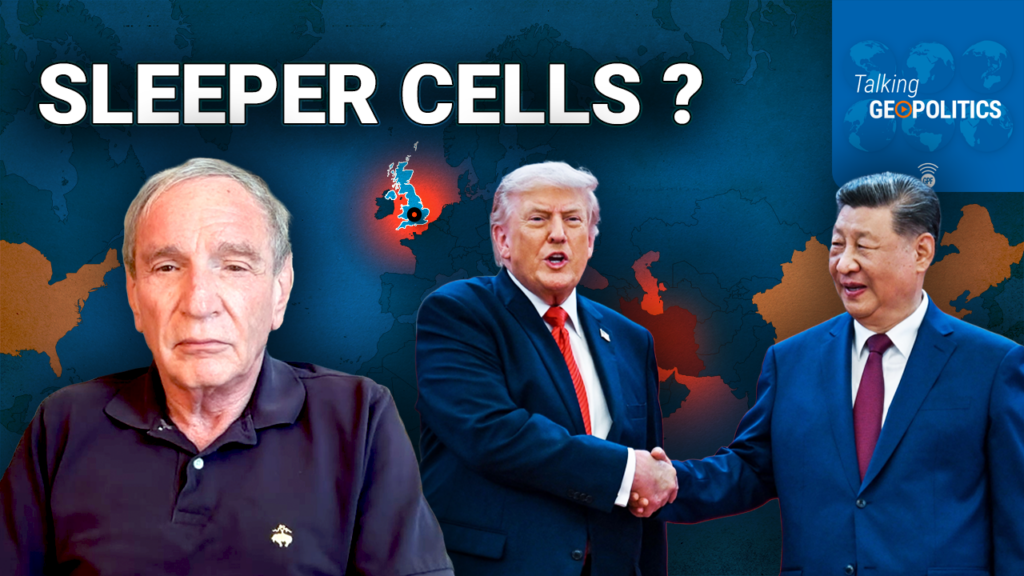
Christian Smith: On Sunday in the UK, the police declared a major incident after a potential attack on an RAF base was apparently foiled. The police investigation is ongoing, but they have said that they’re not ruling out the involvement of a foreign state. And reports have suggested that that this could include Iran. Iranian plots in Britain are increasingly common. Last October, MI5 said that it had foiled more than 20 potentially lethal Iranian plots in the UK in the preceding 12 months. But while a huge amount is still unknown about this incident, it feels like it could be a new stage in the clash between Iran and America and its allies. Hello. Welcome to this podcast from Geopolitical Futures. I’m Christian Smith and I’m joined by Geopolitical Futures chairman and founder George Friedman. Now, last week, we promised you an assessment on the podcast of the US China Summit, and we will be bringing you that in just a bit to start off with, though. First of all, remember, you can go to geopoliticalfutures.com to find out all our analysis and forecasting on the world of geopolitics. But we start with this situation in Gloucestershire in the UK, which is somewhere in the middle, not too far from Oxford, not too far from Bristol. And what we know about this incident so far is that five men suspected of plotting a bomb attack on RAF Fairford were arrested on Sunday morning. RAF Fairford, perhaps most importantly here, is used by the US Air Force for bombing missions against Iran. George, we start with that. Now, the police have said, as I said at the top, that they’re not ruling out, that proxies are working on behalf of a foreign state. That, of course, could be Iran. What do you make of that?
George Friedman: I’m having real trouble understanding this. Okay, yesterday, what they said was that five men driving a vehicle loaded with explosives tried to enter an RAF base from which American aircraft flew. Now, they’re not sure of it. Now, given the fact that they had already arrested them, had the car in possession, it’s not clear what happened to the explosives and why they said there were explosives on the car. So I’m baffled, and I’m also appalled that I took them seriously and wrote an analysis based on the Iranian capability of sending in sleeper cells into countries and acting on that. And they’ve done that with Iraq, the United States, some points, it’s been there. So I wrote this based on assuming that they would not be saying that there were explosives on board, nor that they were trying to enter the base. So I’m kind of chagrined that I believe them. Now, I respect all the British Profoundly. But sometimes they’re very strange. Stranger than us. They think we’re strange. Oh man, they’re really strange.
Christian Smith: Maybe everyone’s strange. Look, the police have said their investigations ongoing, they’ve basically said that this still could turn into what you’re describing there, George. They did send in bomb squads and that sort of thing into these, these vans that were discovered with, with these men. I mean, given the analysis of this, given the sort of presentation that it has had in the media here and, and what it was on Sunday, we were recording this on Monday, it’s very plausible, I suppose, that this was an attempted attack. And as the police have said, perhaps by proxies used by Iran. Would you categorize this, George, as a terrorist attack? Or would you say it’s actually more of an attack by an enemy in war?
George Friedman: I have no idea what it is. They release these men on their own recognizances, it seems, on bail, you know, or whatever it is. So obviously they don’t fear these men and obviously they don’t think they’ve done anything as heinous as attempt to penetrate a British base and destroy American aircraft. So what I’m saying is that between what they were releasing officially yesterday, okay. And what they’re saying today, I suspect what they’re saying today is more valid. On the other hand, I don’t know what process inside of Britain caused them to say that five men carrying explosives or suspected of carrying explosives that would be known try to enter a British air base, okay? And they held onto that until today. And so it’s very hard to figure out what they saw initially, why they made it public and now withdrew it. So it seems to me that someone made either a very bad mistake or far fetched, they’re playing with the Iranians heads somehow trying to say they didn’t know it for some reason. This is an absurd explanation, but it’s the only rational one I can find. And I don’t think that’s what’s happening. I’m just really shocked because given that, the way they framed it, okay, it seemed to me that there had been a penetration by an Iranian group, you know, who else would be trying to blow up air bases? Okay. And so on. So my chagrin is I believe them and wrote something wrong. I don’t like doing that. But this is far more important than me. But the important thing here is are the Iranians engaging in planting cells inside of enemy countries? Britain being, I assume, an enemy, United certainly being an enemy, and are we possibly looking forward to Penetrations of this sort in many ways. So we have to really wait a bit for the British to explain themselves. They backed off, they haven’t dropped it. So something has to be organized here.
Christian Smith: And what could well be going on? I suppose that they arrested these people, but then didn’t have enough to bring charges against them, but are still investigating and it may proceed from there. I mean, as I said at the top, MI5 has said that it has foiled many Iranian plots in the UK. I’m sure that’s not dissimilar in the US and other countries in the West. In fact, we know that’s the case. What’s the significance of this? So, for example, here in Britain in the last few years, we know a number of these incidents, sometimes they engage, by proxies, we mean, petty criminals even to carry out certain attacks or attempted attacks. What’s the significance of Iran doing this? And I suppose if we are going to say, look, this is, this is. If it turns out that this was an attack on an airbase or an attempted one, is that raising the stakes here very much.
George Friedman: Remember, Iran does not have the military capability of striking the United States directly or seemingly to strike Britain. Why they would prefer striking Britain than the United States is one question. So if they were to try to counter the attacks the Americans are making on them, the Israelis and so on, one way to do it would be to send in covert operations of believers who would be prepared to take the risks in their lives. Guys who knew how to assemble explosives based on training and set out to enter the Air Force base. What made it so credible was that they were saying that they were suspecting that they had on board explosives after they had already arrested them. Okay, still saying that. And at the same time saying very clearly that they were attacking an RAF base, hence a military action. So when you think about the Iranians, how they would carry out a counterattack against the United States as allies, they don’t have the capability of launching missiles at that range and so on, okay? But they do have a covert operative capability, kind of to penetrate and destroy. Okay? So the assumption I drew from what they said was this was a logical action to be taken by the Iranians putting in people to carry this out. Now, did they or did they not? Okay, so this is a fundamental military issue. Is Britain under attack by covert operatives able to secure explosives, attacking bases, or did they make a mistake? I wonder how they could make the mistake. Or if somebody who released the news released it too soon and they didn’t expect to, or Sudden something happened. But what we do know is that one, the Iranians want the counter. Two, this is about the only counter they have militarily at home. Three, it seemed by what the British said underway, and then they back off. So I don’t understand what the British saw, but it seemed to me very likely that this would be the kind of action that Iran would want to try to take.
Christian Smith: And of course, President Trump as well said that. He said that they’d been investigating these guys for a while and that they wanted to do massive damage in this potential attack. So there’s that confusion there, as well as to whether or not there was a confusion around what he was saying there. I mean, speaking of Trump, is this sort of thing, I assume this is sort of thing that in America that they are particularly on the lookout for. I mean, Perhaps ever since 9, 11, it’s been the sort of thing that people are on the lookout for.
George Friedman: And indeed, and MI5 and the CIA are very close. I have no doubt that they immediately notified CIA that we got something here, trying to see what the CIA was seeing, if they could check records that something about these people. So I doubt very much that they were doing this on their own, that we backed off from them from this. Any theories I have at this point are insane. So I won’t give them out.
Christian Smith: Click the link in the description for access to our free newsletter and for a limited time, you’ll receive an instant download of our special report on NATO’s eastern line by senior analyst Antonia Colibasanu. All right, then we’ll look. Let’s turn to this conference, this summit between President Xi and Trump that happened at the end of last week. We have a bit of a preview about what was at stake there and we have a bit more concrete in terms of what came out of that. A bit of the assess. A lot of the assessments that have been going so far is that not much came out of this. Do you think that’s fair, George?
George Friedman: No, I think a great deal came out of it. The most important thing was a letter that Xi wrote to Trump and was published in the United States and was published widely in China. That letter said that the United States and China, China in particular, has a very strong interest in reaching accommodation with the United States on economic, military matters. That if we do that, we are going to be very powerful allies in this world and we have to do it. That this would have been sent or said to the American public was one thing, that he sent that letter widely to all the newspapers inside of China indicated a fundamental change in, in how he, the government and others presented the United States inside of China. So I think there was something very much there. I think there is something very much there. And it doesn’t surprise me that after two discussions, such a massive issue would still have issues hanging out. And remember, there are two further summits planned already in the next couple of months. So this is a process. These are the two major economic powers in the world. A major regional power, China dominating many of these areas. The American global empire, if you will, trying to reach an accommodation on a range of issues ranging from tariffs to AI to military actions in the Philippines to Taiwan. This is a very complex thing that is constantly being under negotiation by lesser people than the presidents of the two countries. But it’d be shocking that after one or two meetings they would put behind kind of a 70 year history of hostility to each other and just leave it. What I saw at that meeting was extensive affirmations of the agreements that others, lesser had made. I don’t think they discussed detailed instruction under these terms this short time. What’s going on is that the most important discussions, not the decisions this morning discussions are going on at lower levels and they’re constantly being held almost continually and they have to finally be approved of by the leaders. And blessed. What was indicated to me by that letter that Xi released, as well as the way that Trump spoke, although he frequently talks about adversaries as dear Fellows, so I’m a little less convinced by that. But the fact that they released that very almost loving letter inside of China, breaking years, decades of hostility to the United States, I think that was the most significant thing. The that they have things to work out from. How do they reduce military tensions between each other, what they do with Taiwan, exactly how much access will the Chinese have to the American economy and so on, that’s inevitable. But that the Chinese need a deal because they produce more products than they can consume and they must have access to the American market. And that the US also has an economic need lowering prices in the United States, the affordability crisis, and that both want to end the oil embargo and the United States asked the Chinese, I think, to block any Iranian access to the banking system of China, which they used for international trade. Now, China said in this vaguely that no, they wouldn’t do it, but will they? Because these talks are going on. So don’t look at the summit as a place where they make decisions. Look at the lower level talks going on. Okay? And the job of the presidents is to Bless the various things that are out there. They’re clearly not at that point yet. But given the amount of time that’s been spent on these negotiations, far less than a year, it’d be surprising if they could reach an understanding and they’re not under the gun, time wise to do it. Okay, so when you take a look at it, I find the most important thing being that letter released in China.
Christian Smith: What time frame are we looking at here, George? I mean, just to give it a bit of wider context, I suppose. Trump’s got two years or so left on his presidency, as you say. You point out a few issues there that are somewhat medium term issues in terms of economic difficulties and priorities. As much as they perhaps don’t need to make a deal right now, they do need to get on with it, in certain words.
George Friedman: Well, in a way, you take a look at what happened in 1945 when Allies sat down trying to negotiate the economic system of the world. It took many months, many years, many disagreements, and these were allies. These are very complex issues. And one thing that each side wants to do is confirm for sure that the other side is going to do what they say they’re going to do. Okay, so when you take a look at how long it takes you to buy a house, how many houses, you’re going to look at, how many times you get a bargain and everything like that, put it in that context and realize they talk about historical moment in history, they can’t get it wrong.
Christian Smith: Talking about AI is all the rage at the moment. Its risks and how it’s going to end humanity and all those sorts of things. AI was one of the things that was produced by the Chinese media in one of its readouts of the summit and agreements to work together on AI. What role do you think AI has? Well, I suppose two questions here, George. What role do you think AI has in the relationship between the US and China as the world’s two really leading tech powers? And then what role do you think AI has for geopolitics more generally? But maybe go with the first one first.
George Friedman: Well, looking at that, AI is a new technology. It’s like the telegraph, the telephone, the automobile. It fundamentally changes life and there are very great myths attached to it. I always love to take the example that at one point they people thought that the railroad could be run across the Atlantic Ocean, allowing people to cross. So there is a point, what I call the reductio ad absurdum, that you push a technology beyond what it could be. So we’re talking about AI Agents attacking each other. Okay? No, this is a misdesign of a machine. A computer is a machine. It is a machine. It does not think, it is not intelligent. It carries out the functions that are programmed into it. So it’s a programming issue. It can’t be solved by AI. Hence, we see the fundamental problem of AI. It’s a machine that does what it’s trained to do. The programmers themselves have to take a very close look. One of the fundamental problems of this is that it’s called intelligence, okay? The person who invented the term artificial intelligence guy called John McCarthy, near his death, regretted profoundly using the term intelligence or artificial intelligence as if it mimicked the human sort. He wanted to call it at that point, which didn’t happen, machine intelligence or computing intelligence, but not artificial intelligence. So we have people talking about super intelligence, the idea that a human being can create an intelligence vastly beyond that of a human. Okay. That’s quite a trick to do that. Okay? But it’s a great marketing tool, and it certainly will help IPOs all over the world. Okay? The point is every major technology is first embraced. Television was going to give a new sense of reality to children, to adults, tied them together. Then it realized the children aren’t going to school, they’re not learning to read, they’re sitting there watching television. So there’s a process. When you look at all these technologies, they emerge, they’re useful. The expectations built on their success is vastly beyond what’s going to happen, okay? And then there’s a crisis, and then it goes away. So we’re at the moment where the various ideas that this was anything like human intelligence, that the agents had choices, you know, these agents were attacking each other. No, somebody had designed a faulty program or a faulty machine or something like that. This is a machine and it’s a design feature, not a something the computers are doing. Now, we’re talking about this as if the computers attacked each other, having made a decision to do so and so on and so forth. They simply followed the programs that were in there using the tools that were built for them, and did whatever they did. They’re not conscious. So one of the things that I think is the most important thing coming out of this is that we are now going to, as with previous technologies, all the telegraphs and everything, put this in the context of a human creation for which humans are responsible and which humans must control. Okay? So we, because of the name, we went to the point where it was not considered just advanced computing. It was artificial intelligence that was basically a Language Lisp, a particular computing language that emerged decades ago. And John McCarthy had given it the name artificial intelligence. So it’s a marketing ploy by him because he couldn’t get anybody to work with him, other professors to work with him on developing this. So he called it that, he admitted that. So I think we have to really, at this point have the opportunity to put artificial intelligence in the context of advanced computing systems and that understanding they’re not conscious, they do not attack others, they were poorly programmed. Okay, so if it’s a creation of human beings, the idea that a super intelligence can be designed by me, you or others. Well, what does super intelligence look like? What do we mean? So I’m passionate on this because I’ve been involved long, long ago in a little bit of AI. Okay. Came away from it, seeing it. Yeah, it’s a great, great language going on and seeing it evolve into a metaphysical concept. And this is the point, the reductio ad absurdum that we’ve get to reality. The answer is the emissions. The machines did not attack each other. What happened was that somebody screwed up and programmed them incorrectly.
Christian Smith: So would you say that then concluding from that, that its role in geopolitics. Well, there isn’t really one for it and that it’s not going to be influential.
George Friedman: It’s superb. I use AI to look up facts. When I started in this career, I would go to the Library of Congress and spend two hours trying to find out what year the Battle of Britain started. Okay, because I have to go through the books and everything else. I can now get that in a few seconds just by typing it in. So it’s massive. Just like television, the railroad, the auto, these are massive transformations. But we are expecting, as in all those other cases, much more from them than they can deliver. Okay, so this is how AI matures. It remains a fundamental part of human life, as the railroad did, the automobile, everything did. But the extraordinary claims made for it, which by the way, are mostly made by marketing people and people trying to raise funds for an investment, not by the people who are writing the code and stuff like that, although many of them probably do. So I think this is the normal cycle. We are suddenly hit by the fact this really has big downsides, the way it’s designed and it’ll mature into something that’s normal, but it’s valuable. It can do many things very well. Just like the computer could, television, could telegraph, did radio. All of these were there and fundamental and all these were overestimated at the time.
Christian Smith: Take a moment to Follow and rate us on your preferred podcast platform. If you’re already watching on YouTube, don’t forget to like and subscribe. George Bringing it back to the US And China, Trump and Xi have said they’re going to meet again twice this year at the APEC summit and at the G20. What do you expect to come out of that? Or is this more about continuing that conversation towards a deal?
George Friedman: What’s happening here? Is that not noticed by many people? There are intense negotiations taking place at many levels over many issues. Okay. When this summits are held, each side has come to the table either blessing what was done or saying, no, we’re gonna have to do more work on this. I don’t want it this way. The summits are not where decisions are made, they’re where they’re blessed. And in many cases they’ll some they won’t bless it, okay? But pretty much when they come to that table, they know what they’re going to be talking about. They’ve been fully briefed on all the complexities. They have already blessed it with their own staff. Sometimes saying to the staff member, how could you be so stupid to agree that I’m never going to do that? So I see the most important conversations taking place not between the Americans and the Chinese meeting the President and his aides as they try to come to terms. So look at the summits taking place at a point where we might say that they’re pretty close to an agreement. Now, there are things that we know are outstanding. The Taiwan issue, most importantly, the actual amounts of tariffs and the amount of trade that will take place, relations with other nations and all sorts of things that were probably coming up. Okay. But all of these have channels that are constantly or continuously, shall we say, talking to each other, coming back to the table. President looks at that and says, okay, I can live with that. You go on, I have a problem with that. So they’re discussing it through these people. And then the symbol of the summit, which is really a conversation, okay. Is more getting to know each other, getting comfortable with each other, trusting each other and so on and so forth. Because many of the basic issues are way beyond them needing to work on. Okay,
Christian Smith: George, last week I asked you whether or not the Chinese might just make the decision, as sometimes countries do, to wait out a US Presidency to kick the can down the road and go, well, you’ve only got two years left here. We don’t want to give in to what you want, so we’ll wait. Let me ask you the opposite question. Is there A pressure on China to want to do a deal with Trump before he goes and with this administration more generally, because they don’t know what they’re going to get next time. And they may be able to do a deal with Trump that they want to get done.
George Friedman: I think they have a need to do this not because of Trump or anybody else, but because their growth rate now is at 4% where it used to be in this in past 15% a year and 5% a year because they don’t have access to the American market. Among other things. The Chinese economy is in trouble. There’s unemployment, there’s bank failures. The real estate market, in which many of them invest, is in decline. So they have to stabilize their economy. Okay? Now, the United States, one can’t be dependent on exports from a country with which it can face war, can’t do that. So the Americans want a settlement on the military. I think in this meeting, from what I saw, much more was discussed on the military side than on the economic side. What was discussed there was what really Trump wanted to talk about, which is, how do we make sure we don’t mistake what you’re doing as an attack on something we care about and get into war? One of the ways you normally do it is agreeing to inform the other side of any exercises you’ll be carrying out, you know, naval exercises, air exercises, and you keep them noticed because you don’t go to war announcing that you’re doing it. So that was one of the things that came out of there, an element of agreement, not only on AI, but as importantly, on not quite yet agreeing to, but in principle informing each other on the military side. So we have to remember that while the world is looking at this basically as an economic accommodation, and for the Chinese, that is what it is. For the Americans, it’s two spheres. And what I believe I saw coming out of the meeting was an agreement on informing each other on exercises, or very close to it. So this is something the Americans very badly want. Still sitting there to be settled is Taiwan. The problem is, politically, neither Trump nor Xi can give on this because the Chinese regard this as a fundamental part of China, which it was and must be returned. And the public feels that way. The American public doesn’t want, or most of the publics doesn’t want to abandon an ally, don’t just abandon terrible things. So both presidents have problems here. I don’t think Xi personally cares that much about Taiwan that he’d not want to have a settlement, but he’s got to care about Taiwan. I’m not sure Trump gives much of a damn about Taiwan, but he doesn’t want to be accused again of abandoning allies. So we have all of these issues that are now evolving into how do you present this to the public? And that’s, again, why I look at that letter and what it presented to the Chinese public as, in a way, much more important than what they agreed on or didn’t agree on in the meeting itself. It was a breakthrough in that sense.
Christian Smith: George, let’s leave it there. As always, thanks so much. Thanks out there for listening. We’ll be back again soon with another podcast, but for now, go to geopoliticalfutures.com for all of our analysis and forecasting. Thanks very much. Bye bye. Find all of our expert geopolitical analysis at Geopolitical Futures.