
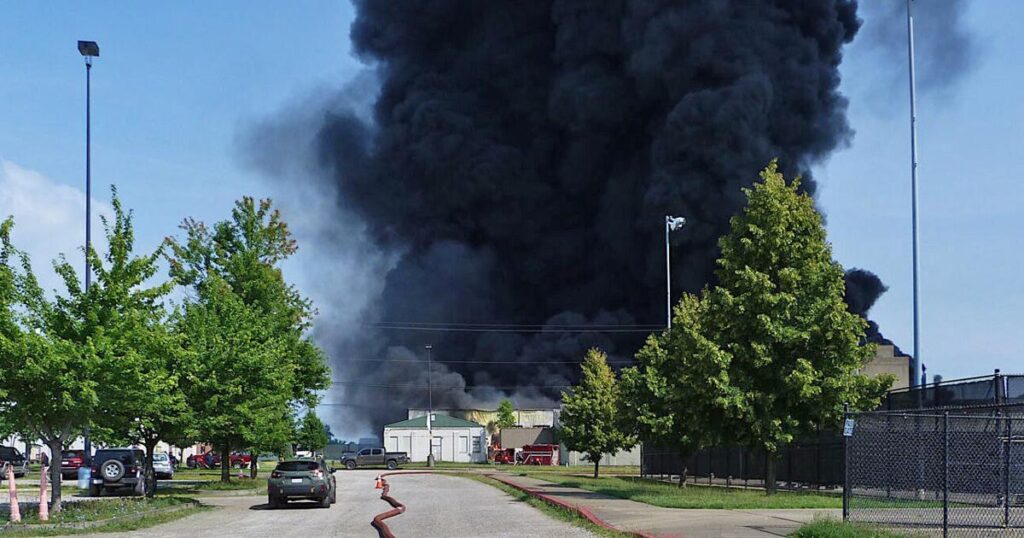

Water lines lead to a fire at a Peoples Cartage warehouse near Parkersburg on July 5, 2026.
JESS MANCINI | Parkersburg News-Sentinel
The potential for environmental contamination is vast from a massive industrial fire just outside Parkersburg that caused Gov. Patrick Morrisey to declare a State of Emergency on July 5, according to a new site assessment plan obtained by the Gazette-Mail via a Freedom of Information Act request.
The plan, a preliminary site characterization strategy document, was prepared on behalf of Peoples Cartage Inc. for its 4301 Camden Ave. facility near Parkersburg and the Little Kanawha River, and approved by the West Virginia Department of Environmental Protection in a Sept. 17 letter to the company.
Peoples Cartage submitted the plan to comply with a DEP order issued four days after the State of Emergency declaration mandating that Canton, Ohio-based Peoples Cartage affiliate Publix, Inc. provide a site characterization plan including methods and a schedule for conducting a site assessment that would allow for “delineating the extent of soil contamination that originated from the aforementioned fire.”
The DEP order had required the site characterization plan to be submitted within 20 days of Publix and Peoples Cartage receiving the agency’s order, but the plan approved by the DEP on Sept. 17 was only submitted by the companies two days earlier, according to the DEP’s plan approval letter.
The plan authored by Cranberry Township, Pennsylvania-based Groundwater & Environmental Services, Inc. and dated Sept. 15, details a long list of potential contaminants stemming from the fire, noting that the fire and subsequent response and cleanup activities exposed fire-damaged materials and debris to stormwater and fire-suppression water. The water may have transported ash, soot and other fire-related materials into surrounding soils, according to the site characterization plan.
State and local officials were tight-lipped about the chemical composition of the fire while reporting that the building stored plastic materials and that there were no injuries from the fire.
Wood County residents reported black ash and debris from the fire in their yards and pools while contending with a nearly 24-hour shelter-in-place advisory issued by Wood County 911 for a roughly half-mile stretch of the Staunton Turnpike corridor along the Little Kanawha River. The agency attributed the shelter-in-place to “air monitoring particulate levels hav[ing] recently exceeded minimum threshold levels.”
A July 5 DEP emergency response document states the fire was fueled by cardboard and oil-based thermal plastic resins.
A July 9 U.S. Environmental Protection Agency air quality monitoring report on the fire states that an EPA environmental response team conducted air monitoring from the afternoon of July 5 to the morning of July 8, initially deploying air-monitoring equipment at five perimeter locations and, the next day, a sixth. The EPA said it demobilized the air monitoring systems on July 8 after air monitoring throughout the impacted area consistently showed no exceedances of health-based standards.
The DEP has said that results of its and Peoples Cartage’s analysis of samples for parameters commonly assessed after structure fires and linked to building materials, plastics, resins and combustion haven’t identified concentrations warranting further response or protective measures beyond ongoing monitoring and remediation.
The West Virginia Department of Agriculture collected approximately 200 water and soil samples since July 19 from agricultural and residential properties where sampling was requested, according to the DEP, which said no compounds analyzed linked to ash, combustion, fire debris, heavy metals or smoke were detected in residential water samples, while low concentrations of some compounds were detected in soil samples.
The DEP has said that the compounds can come from many combustion sources, including wood burning, vehicle emissions, wildfires and other fires, and that while some results were above state levels, samples didn’t exceed federal action levels. No additional response or protective measures were required, the DEP has said.
But the site characterization plan says the nature and extent of contaminant emissions into the environment from the warehouse along Camden Avenue’s industrial and commercial corridor haven’t been determined and are the subject of the phased investigation to follow the plan.
“Combustion and thermal decomposition of plastics and other stored materials may have generated airborne particulates and chemical constituents, while contact with firefighting water may have transported dissolved and particulate material in runoff,” the plan warns.
“[A]dditional evaluation” will take place if a “Constituent of Potential Concern” — a substance coming from a facility’s release to the environment that may threaten human health or the environment — is detected in soil or surface waters, according to a statement provided by Peoples Cartage spokesperson Shannon Whetsell via email.
Plan indicates potential Little Kanawha River impact
The phase-one work plan says that it is intended to assess accessible perimeter soils and surface waters, flag migration pathways and guide later assessment after debris removal.
The plan cautions that the fire and subsequent emergency-response activities generated significant quantities of firefighting water that contacted fire debris and entered stormwater pathways near the impacted buildings.
Some runoff appears to have reached drainage features leading toward the Little Kanawha River, according to the plan.
Emergency response and debris-handling activities may also have redistributed ash, soot and other fire-related residues onto surrounding paved and unpaved areas, per the plan.
Groundwater & Environmental Services states that at the time the plan dated Aug. 20 was prepared, large segments of the former warehouse footprint remained covered by collapsed structural materials, fire-damaged inventory, ash, roofing debris and other demolition materials.
Those conditions have limited safe access to underlying floors and soil, obscured possible release points and drainage pathways, and prevented representative sampling within much of the main burn area, according to the plan, which adds that ongoing debris removal and heavy equipment activity may also disturb or move materials and impact sampling locations.
So the initial characterization will focus on perimeter soils and stormwater pathways, with targeted sampling of the former building footprint to follow when debris removal and site stabilization allow safe and representative access, the plan states.
Peoples Cartage has operated the site as a warehouse, logistics and contract-processing facility used for receipt, storage, handling, packaging and distribution of customer-owned materials, including resins, polymers, powders and related industrial products, the plan notes.
The fire destroyed roughly 350,000 square feet of warehouse space, per the plan.
Plan warns of wide range of potential ‘human receptors’
The plan reports that the site and surrounding area are supplied with drinking water via the Parkersburg Utility Board public water system, with water sourced from five radial collector wells in the Ohio River alluvial aquifer 4 to 6 miles north of the site.
The Little Kanawha River, immediately east of the site, is the closest surface-water receptor, and surface water runoff from the fire-impacted segment of the property typically flows toward the river through overland drainage, low-lying ponded and wetland areas, catch basins, stormwater piping and outfalls, per the plan.
The plan notes that because of that “close hydraulic relationship,” the river and nearshore areas are important for determining whether fire-related ash, soot, dissolved contaminants, suspended solids or firefighting-water residues migrated off the site.
The plan contends that potentially contaminated water, suspended solids, ash, polymer fragments, and debris may have entered catch basins, storm drains, pipes, outfalls, and ultimately the Little Kanawha River. Initial surface water samples will be analyzed for substances that include semi-volatile organic compounds and polycyclic aromatic hydrocarbons, according to the plan.
Semi-volatile organic compounds are organic chemicals, some of which have been linked to allergy symptoms, reproductive development issues and other adverse health impacts.
Polycyclic aromatic hydrocarbons are chemicals created during the incomplete burning of coal, oil, gas, wood or other organic substances.
Those chemicals have caused tumors in laboratory animals when they breathed these substances in the air, ate them or had long periods of skin contact with them, and studies of people show that individuals exposed by breathing or skin contact for long periods to mixtures that contain the chemicals and other compounds can also develop cancer, according to the Centers for Disease Control and Prevention.
Surface-soil sampling will assess whether ash, soot, combustion residues, melted or partially burned products, or contaminated runoff were deposited on accessible soil surrounding the fire-impacted building, according to the plan, which adds that samples will generally come from within about 100 to 200 feet of the burned buildings, where property boundaries and as safe access allow.
The plan proposed roughly six to 10 surface-water and stormwater samples.
Included in a plan list of known or suspected fire-related source materials are:
- Burned and partially burned polymers, resins, powders, plastics, packaging, pallets, and customer-owned materials
- Approximately 15,000 pounds of identified styrene-based, thermoplastic elastomers, which are rubber-like compounds
- Ash, soot, char, melted polymer and incompletely combusted materials
- Fire-damaged roofing and other building materials, including asbestos-containing roofing materials
- Building components, electrical equipment, wiring, machinery, lubricants, fuels, coatings, insulation and maintenance materials
- Fire suppression water and potentially firefighting foam
The environmental media of primary concern during the first phase of the assessment are:
- Air
- Surface soil
- Stormwater and retained fire water
- Catch-basin and storm-drain sediment
- Outfall discharge
- Surface water in the Little Kanawha River
- Ponded water and sediment in low-lying or wetland areas
- Debris, ash, soot and residues on structural steel and other building materials
Potential “human receptors,” per the plan, include:
- Emergency responders
- Debris-removal and demolition workers
- Environmental sampling personnel
- Site maintenance and security personnel
- Employees working in unaffected portions of the complex
- Nearby industrial and commercial workers
- Residents in surrounding communities
- Recreational users of the Little Kanawha River
- Workers handling, transporting, recycling or disposing of debris
The plan was dated Aug. 20 and stated that Groundwater & Environmental Services and Peoples Cartage were anticipating that site characterization work would start on Sept. 8 if approvals were received before then.
After the first phase assesses accessible perimeter soils, stormwater features, and likely migration pathways, later phases will address the former building footprint and other source areas after debris removal and site stabilization allow safe access and reveal underlying surfaces, thus decreasing unneeded sampling, the plan outlines.
Initial field characterization is expected to require roughly one week of “field effort” if weather and access conditions are favorable, the plan states, adding that laboratory analysis, data validation, interpretation and reporting would follow, with laboratory analysis usually taking about two weeks and data validation approximately one week.
Data interpretation and reporting time would depend on what the analytical results show but are expected to take about three to five weeks, the report stated, projecting the final report would be submitted to the DEP by Nov. 20 in a timeline in which site characterization work started on Sept. 8.
Company slated to review report before submitting to DEP
Peoples Cartage would be allowed to review the site characterization report before submittal to the DEP, according to the plan, which adds that analytical data may be made available to the DEP before the final report, at the discretion of Peoples Cartage, if requested.
Peoples Cartage facilities in Wood and Kanawha counties have a history of hazardous waste-reporting and handling violations issued by the DEP, and the July 5 fire wasn’t the first at a site at a Parkersburg-area company site.
DEP records show a March 19, 2026, inspection at Peoples Cartage’s 221 Airport Industrial Park Road site further outside Parkersburg, about 11 miles from the site of the July 5 fire, yielded agency-identified violations for not labeling some plastic containers in a storage area with the words “Hazardous Waste” or with their accumulation start date, and in another storage area, not marking 34 hazardous waste containers with the accumulation start date or an indication of the hazards they contained.
The inspection was conducted to test that Peoples Cartage was meeting a compliance schedule set in a DEP consent order that followed a June 2025 violation notice.
A DEP compliance schedule evaluation reported the facility had generated more than 2,200 pounds of hazardous waste in a month, a violation since the company had failed to declare as a large hazardous waste generator exceeding that threshold rather than a small hazardous waste generator.
Peoples Cartage also failed to report two wastes, one generated by sodium dichlor and one from repackaging in-tank sanitizer and automatic toilet bowl cleaner Dantobrom TBS-2.5, both corrosive oxidizers, another violation, per DEP records.
In December 2025, the DEP issued a consent order for Peoples Cartage’s Airport Industrial Park facility fining the company $46,380 in response to federal and state code violations.
Another Peoples Cartage fire incident followed the July 5 blaze, at the company’s warehouse in the Airport Industrial Park.
A DEP inspection report notes that on July 17, Wood County 911 called the DEP to report that boxes of chlorine had caught fire at that Peoples Cartage warehouse.
A DEP inspector responded and reported that the fire had been extinguished and that Peoples Cartage had begun recovery efforts. The fire involved wastes stored in the calcium hypochlorite hazardous waste storage building.
Calcium hypochlorite is a lung irritant with a chlorine-like odor used in pool chemical products.
DEP officials conducting a July 20 inspection were told that on July 17, one of the buckets in the hazardous waste shed caught fire, prompting a fire department response and extinguishment of the fire within 40 minutes using only water.
DEP approved waste management, disposal plan this month
In addition to approving the site characterization plan on Sept. 17, the DEP also approved a waste management and disposal plan it said was submitted on July 23 by Peoples Cartage and Publix.
The plan authored by environmental and industrial services provider Clean Harbors sets procedures for the safe storage, handling, transportation and disposal of waste. Clean Harbors said in the plan it would use machinery to clean up and load debris into roll-off containers and end dumps for dry materials and be hauled straight to an approved and certified disposal facility.
Clean Harbors said in the plan it would provide equipment and personnel to begin removing debris with asbestos and be loaded into covered roll-off boxes and be hauled straight to an approved disposal facility for disposal. If any of the debris tests are hazardous, Clean Harbors said, the company would have to correspond with “responsible party & agencies” to develop a removal plan.