
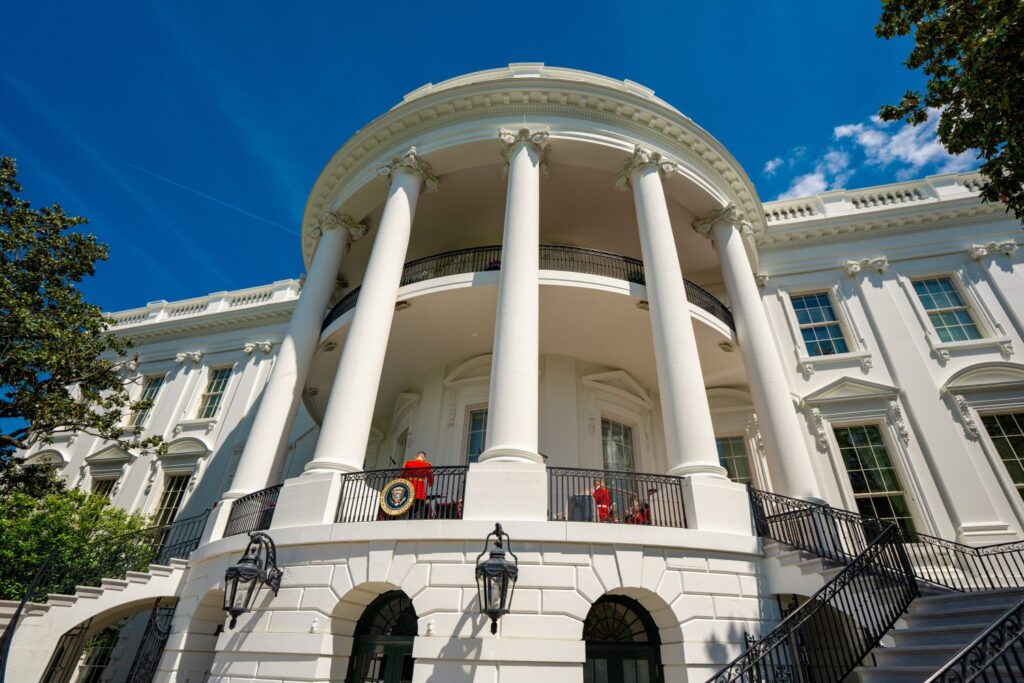
The U.S. will stick to a self-regulatory framework for major artificial intelligence developers following the latest round of discussions between U.S. President Donald Trump’s administration and Big Tech CEOs. Following a roundtable with President Trump, Anthropic, Google, Meta, Nvidia, OpenAI and xAI and signed on to the White House’s “Joint Commitment on Frontier Responsibilities,” a four-point AI safety plan focused on independent audits and “robust internal controls.”
The internal principles include the adoption of controls to “monitor the capabilities and alignment” of a given model while sufficiently empowering relevant oversight personnel to “ensure models do not hack or access technical systems in intended ways.” The third-party evaluation points outline broad assessment requirements while calling for an independent board-level committee to review internal progress reports on company controls.
“The idea is that this isn’t the only thing we will ever do. It is that this is a start,” Meta Chair and CEO Mark Zuckerberg told reporters at a press briefing after the White House meeting.
While there were no enforcement mechanisms announced to uphold the commitments, Trump characterized the agreement as “morally binding” and highlighted the “tremendous self-policing” he has seen among developers on model and user safety to this point.
“It’s very hard to have somebody to come out and get into these models. They’re very complex,” Trump told reporters. “I believe (frontier models) are going to be used for the good. And when they’re not, I believe we are going to nab them.” He listed the Department of Justice, FBI and CIA as agencies that will be able to tackle issues stemming from bad actors, notably omitting the Federal Trade Commission.
Chief executives appearing with Trump touted their ability to balance safety and innovation as a group, with Nvidia President and CEO Jensen Huang noting developers are “moving together as one.”
“There’s no conflict between innovation, technology and safety,” he added. “We are going to have to create technology to advance the capabilities of AI, but we’re also creating technologies to advance the safety of AI. … We’re going to advance this technology that is so consequential to humanity and consequential to the future prosperity of our nation. And we’re going to do it responsibly and safely.”
Safety concerns have reached a boiling point due in part to a flood of AI cybersecurity incidents and calls from developers, many of whom joined the White House roundtable, to pace frontier model development. There has been no louder voice on pacing than Anthropic CEO Dario Amodei, who restated that AI has “very real risks” and means to address them “are still under discussion.”
“We all need to work together to make sure we can win (the AI race) and win safely,” Amodei said following the meeting.
The commitments on internal oversight improvements came as The New York Times reported OpenAI staff concerns over model cybersecurity was ignored months before the Hugging Face hack that ignited the latest safety push. According to company emails seen by the NYT, OpenAI executives called for expedited model testing that ultimately did not occur with appropriate or enhanced security checks.
The liability factor
The new pact represents a stopgap to federal legislation, which President Trump continues to oppose while U.S. Congress remains at an impasse. House Speaker Mike Johnson, R-La., told reporters the AI principles and legislative solutions laid out in a previous report from the House Task Force on Artificial Intelligence have been “rendered obsolete” due to technological advancement and “elusive” consensus.
Developer and deployer liability is not easy to assess without concrete rules. State legislatures continue to step into the federal void despite Congress’ prior attempts to preempt state AI rules, but those legislative efforts are focused on more targeted areas, specifically AI chatbots and automated decision-making technology.
“The only way to reduce the risks and harms of AI to Americans is through robust legal liability, regulation and fundamentally changing the race dynamics that are driving unsafe decision-making by frontier AI developers whose costs are borne by the American people,” Berkman Klein Center for Internet and Society Executive Director Alex Pascal told NPR.
While deployers are not facing the toll of new federal rules, litigation is becoming an increasing business risk.
According to Reuters, Anthropic’s initial public offering prospectus touted the company’s lucrative promise while outlining how it may be subject to “significant and unpredictable legal claims” around its chatbot offerings. It cited the lack of clarity around which laws might apply to chatbot harms.
“These autonomous capabilities could increase the potential for harm, as errors, misalignment, or security exploits may result in real-world consequences,” the company noted.
Meanwhile, OpenAI is facing a class-action lawsuit stemming from the Hugging Face incident. Wired reports the filing by Legal Advocates for Safe Science and Technology and law firm Gerstein Harrow to the California Superior Court of San Francisco alleged the breach violated the Comprehensive Computer Data Access and Fraud Act while the autonomous nature of the incident is not a sufficient defense for OpenAI according to the Transparency in Frontier Artificial Intelligence Act.
In an op-ed for The New York Times, former Federal Trade Commission Chair Lina Khan highlighted the implication of current laws, including those applying to CEOs themselves, as means to foster AI developer accountability.
“Product liability laws apply when goods are defective or dangerous, while tort law establishes basic duties for companies to not act negligently or recklessly,” she wrote. “Consumer protection laws prohibiting unfair or deceptive practices can also kick in when businesses injure others by failing to take adequate precautions.”
Khan added the current self-regulation plan is a “clear mistake” and “our democracy cannot surrender the trajectory of these powerful technologies to a handful of private actors.”