
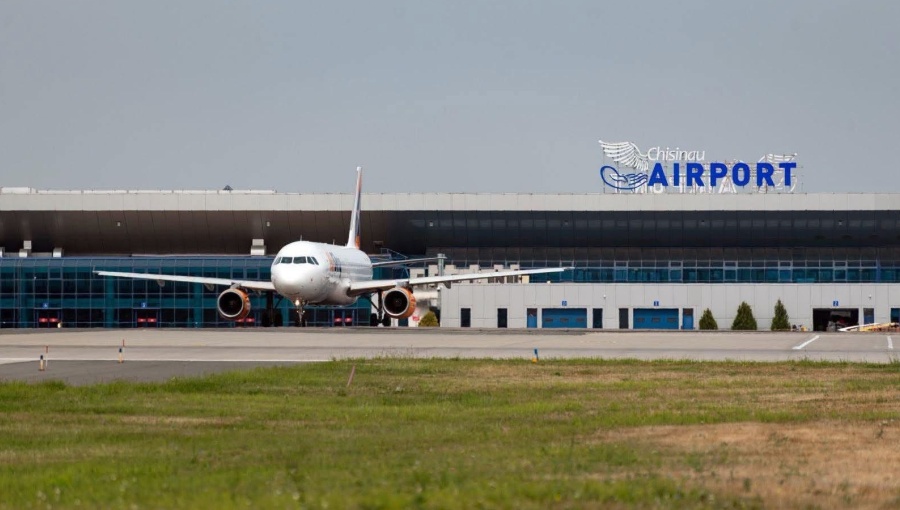
Chisinau’s international airport was evacuated on October 2 after a bomb alert that was later declared a hoax, briefly disrupting flights and highlighting security concerns in Moldova just days after the country hosted a major international investment conference.
Passengers and airport staff were evacuated while specialist interior ministry units searched the Eugen Doga International Airport, with check-in and access to the terminal suspended. The airport later said the alert had not been confirmed and that boarding had resumed.
“Yeah it was a bit crazy. We arrived at the airport, went through security check, sat down for a bit and then security approached us and said calmly: Evacuation,” one passenger told IntelliNews.
“They put us in the buses and drove away not far from terminal. Communication was really bad, we didn’t know what is going on, staff was shouting something in Russian or Romanian,” the passenger said.
The airport said on Facebook that the security checks had been completed and the alert had not been confirmed. Passenger access to the terminal was restored and boarding procedures resumed at about 18.00 local time.
The alert had delayed flights to Istanbul, Frankfurt and Vienna, the airport said. Passengers were advised to check flight information with the airport and their airlines.
The incident came four days after the opening of Moldova Business Week in Chisinau, which brought together about 650 delegates from 50 countries as the government sought to promote the country as an investment destination despite the security risks posed by Russia’s war in neighbouring Ukraine.
The conflict’s proximity to Moldova is increasingly visible, a situation Prime Minister Vasile Tofan addressed at the investment conference.
“The war is the more immediate variable,” Tofan said at the conference, while seeking to reassure investors about Moldova’s ability to attract business.
Asked about the risk of Russian missiles hitting Moldovan industrial facilities and warehouses, Tofan used gallows humour: “Most of the missiles are flying over us and landing in Romania.”
Moldova is not a member of Nato and has limited military capabilities of its own. Its airspace has faced a growing number of violations. The presidency said the country recorded 39 airspace violations in the first nine months of 2026, compared with 17 during the whole of 2025. A Russian drone crashed and exploded in central Moldova on September 30, according to the government.
The government is developing drone detection and interception capabilities with international assistance and has received a €120mn European Union grant towards a medium-range air-defence system. Authorities have also approved measures to protect critical energy infrastructure and address cybersecurity vulnerabilities.
The October 2 airport alert did not result in any reported casualties or damage and there was no indication that an explosive device had been found.
For Moldova, however, the timing added to a difficult backdrop for efforts to attract foreign investment and tourism. National Wine Day, one of the country’s biggest annual tourism events, begins on October 3, when the country normally expects a significant influx of visitors.
The government has sought to pitch Moldova as a nimble investment destination capable of compensating for its small domestic market with proximity to the EU, a skilled workforce and growing links with European supply chains.
Tofan told the investment conference that Moldova could compete for investment through “speed, agility and trust rather than the size of its market”.
The security environment remains one of the main constraints. Moldova borders Ukraine and is also home to the separatist Transnistrian region, where Russia maintains a military presence.