
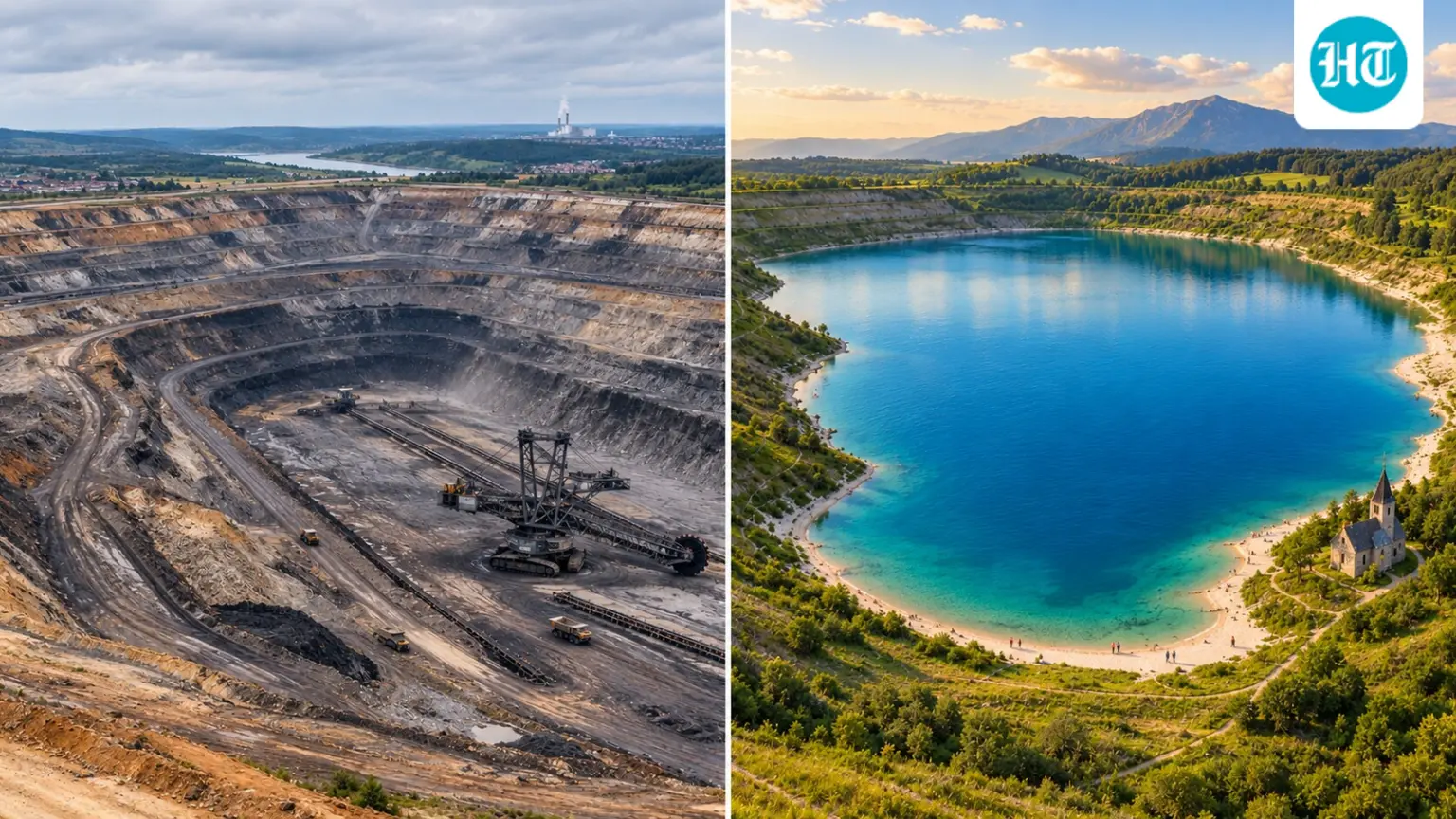
Some places often get a second life. In the north of the Czech Republic, a coal mine got one too. A whole town was torn down to reach the coal. Today, people can swim in a lake in the same spot. According to a chapter by Vráblík, Vráblíková and Wildová in a 2020 Springer book, Assessment and Protection of Water Resources in the Czech Republic, Lake Most was made by flooding a former coal quarry, and the filling was completed in 2014.

Lake Most emerged from the flooding of a decommissioned coal mine in the Czech Republic, providing a new ecological landscape. (AI-generated/ChatGPT)
In the 1970s and 1980s, the old town of Most was demolished to make space for the Ležáky brown coal (lignite) mine. Mining there ceased in 1999. What was left was a huge hole in the ground. The town church was moved to a new location and is still standing by the lake.
People often assume that just water needs to be added to the pit and it becomes a lake. It couldn’t be farther from the truth. The chapter explains that engineers must seal the coal deposit and the lake bed before flooding. They also have to ensure that the slopes will not slide. At Lake Most, the bed was sealed with clay, and barriers were built to protect the banks from waves. Since there was no natural inflow to the lake, water was brought in from the Ohře River. Filling started in October 2008. It was put on hold for two years while the banks were strengthened, and it was finished in 2014, about six years after it began, counting the pause. At that point, final terrain work was still to be done, so the lake was not yet open to the public. It opened to visitors in September 2020.
Lake Most covers a little over 300 hectares (roughly 760 acres). In some parts it is about 70 to 75 meters (roughly 230 to 245 feet) deep. The project cost around 2.5 billion Czech koruna and is one of the largest pit lakes in the country. Visitors can use its beaches, and more than two dozen bird species nest in the area.
In a 2025 study published in Environmental Monitoring and Assessment, researchers analyzed four lakes that were used for mining activities in the past in the Czech Republic: Medard, Milada, Most, and Barbora. Researchers checked the living organisms present in the lakes, as well as their chemical composition. The team found diverse microbes and plankton, and the mix changed with the seasons, which suggests the lakes are still developing. According to this study, water chemistry was mostly within acceptable limits. Sulfates and dissolved solids went over the threshold at Medard and Milada, and one hydrocarbon measure, called C10 to C40, went over at Lake Most. That could be a good reminder that a young lake needs to be tested regularly.
The chapter says Lake Milada, near Ústí nad Labem, was filled between 2001 and 2010 and is used for recreation. Deep new lakes like these are expected to stay low in nutrients and keep their water quality high, but that is an assumption, not a guarantee. Planned lakes include one at the ČSA quarry, which would cover about 1,259 hectares, or roughly 3,100 acres, once flooded.
Lake Most is unlikely to solve all problems. Coal has left its stamp in this area, and the lake is young. But this shows how communities could take back their land that was once only good for digging. This could be a story worth watching for those who have grown up hearing about coal and climate change.