

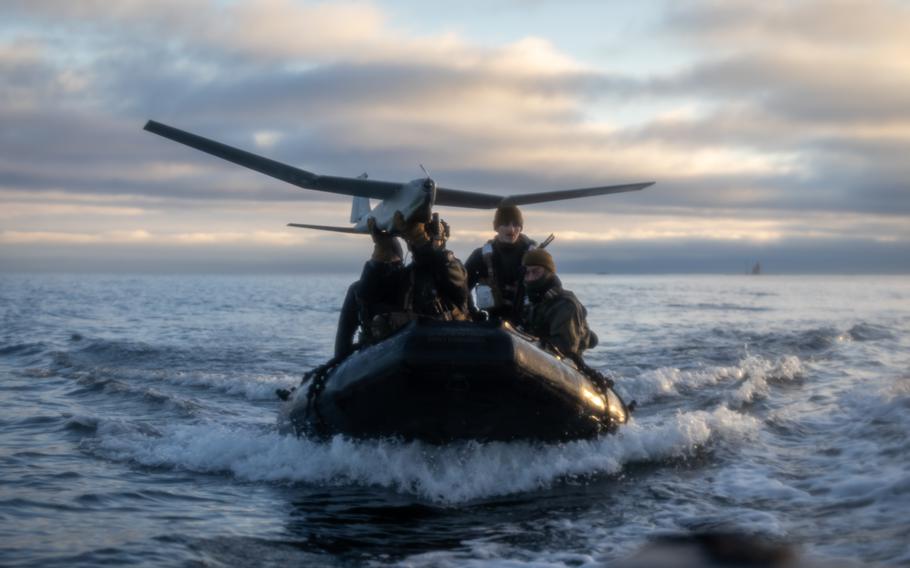
U.S. Marines and sailors with the 2nd Reconnaissance Battalion, 2nd Marine Division, prepare to launch an RQ-20 Puma unmanned aircraft system from a combat rubber reconnaissance craft in southern Finland on Feb. 28, 2025. (Brian Bolin Jr./U.S. Marine Corps)
STUTTGART, Germany — A specialized team of U.S. Marines is being shifted to the Baltic Sea region to help NATO keep watch in an area where tensions are ratcheting up with Russia.
About 50 Marines will bring small drones, coastal sensors and reconnaissance capabilities designed to expand NATO’s surveillance of the Baltic and help protect a web of undersea cables and pipelines running through it, U.S. Marine Corps Forces Europe and Africa said this week.
The mission is part of NATO’s Baltic Sentry operation, launched last year after a series of suspected sabotage incidents involving critical undersea infrastructure.
The operation uses warships, maritime patrol aircraft, drones and national surveillance systems to detect suspicious activity and give the alliance a better picture of what is happening above and below the water.
Maj. Gen. Daniel Shipley, the Marine Corps’ commander for Europe and Africa, said Wednesday that the team of reconnaissance Marines from Camp Lejeune, N.C., will operate with Finnish forces.
“Working side-by-side with our Finnish allies strengthens our collective readiness, ensuring we can operate seamlessly as a cohesive, lethal team to deter hybrid threats in the Baltic littoral,” he said.
The deployment comes at a time of high tension between NATO and Russia. In recent months, allies have accused the Kremlin of repeated airspace violations involving drones and piloted military aircraft.
NATO members also have blamed Russia for acts of sabotage along NATO’s eastern flank and beyond.
On Tuesday, Estonia announced it arrested suspects involved in connection with an August arson attack on a robotics facility. Estonia said the incident was ordered by “special services” of the Russian Federation.
U.S. European Command’s Gen. Alexus Grynkewich said Monday that the security situation in Europe is likely to be unsettled for a protracted period and that threats now extend well beyond just NATO’s eastern edge.
“Those drones can go thousands of miles,” Grynkewich said. If one gets through, “it’s not just a threat on the eastern flank; it’s a threat to the entire alliance, including all the way in North America.”
Meanwhile, Russia this week warned that it could resort to nuclear weapons if NATO attempted to isolate Kaliningrad, the heavily militarized Russian exclave wedged between NATO members Poland and Lithuania.
Russian embassies in several European countries said Moscow had information that NATO was preparing an air and naval blockade of the territory, Reuters reported Wednesday.
NATO Secretary-General Mark Rutte dismissed that notion and called Russian nuclear saber rattling an empty threat.
“That threat is not there, and if anything happens, we are ready to counter it,” Rutte said Wednesday at an event in Brussels.