
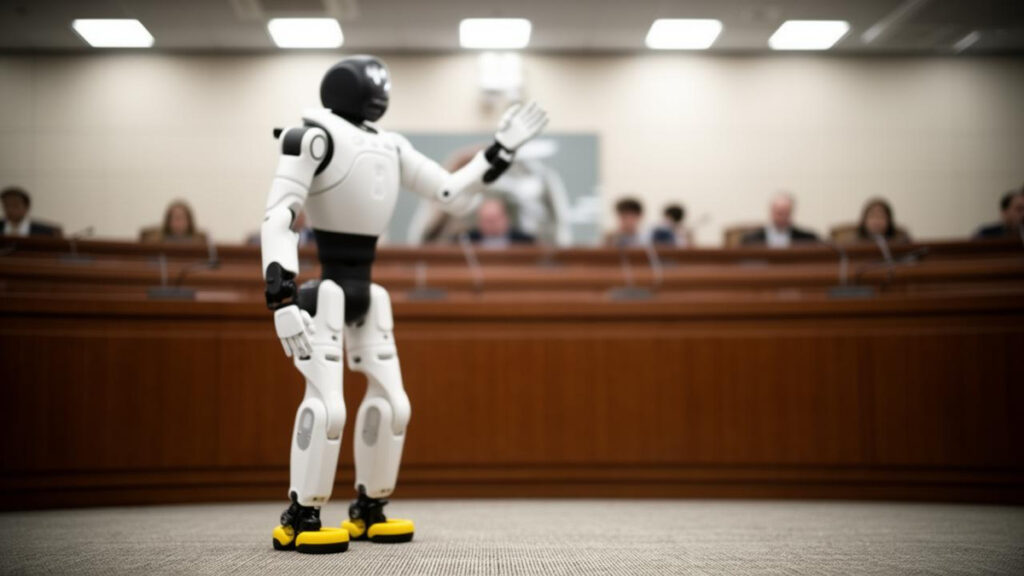
Two Chinese-made humanoid robots made an appearance at the National Assembly Science, ICT, Broadcasting and Communications Committee’s audit of the Ministry of Science and ICT. The demonstration—greeting attendees in Korean and dancing—was staged to illustrate the gap between China’s and South Korea’s physical AI industries.
On the 6th, Democratic Party lawmaker Lee Jung-heon, while criticizing the growth of China’s humanoid industry and questioning South Korea’s domestic physical AI competitiveness during the ministry audit, brought two Chinese-made robots directly into the hearing room. Unitree’s robot entered first, followed by Agibot’s robot. Both robots walked to the center of the meeting room, shook hands with attendees, and performed dance moves while swinging their arms.
Following the demonstration, specific figures illustrating the industrial gap between the two countries were presented. Video footage shot on location in Beijing and released by Rep. Lee showed humanoid robots hanging from conveyor belts being assembled in stages, and hundreds of robots at a large-scale training center repeating motions to accumulate data. “It wasn’t at the level of assembling one or two units like at South Korean universities or research institutes—they had a full mass-production system in place,” he said. “My first impression was one of shock and dread.”
According to global market research firm Omdia, 13,318 humanoid robots were produced worldwide last year, a 480% increase from the previous year. Chinese companies claimed the top six positions globally by production volume. Production figures for the two robots that appeared at the hearing were also disclosed: Unitree’s product recorded 4,200 units produced last year, while Agibot’s product led the world with approximately 5,200 units.
The scale of China’s humanoid industry ecosystem far exceeds South Korea’s. Approximately 160 Chinese companies produce complete humanoid robots, with more than 600 core component suppliers. Annual investment in the robot industry reaches approximately CNY 30 billion (approximately $4.5 billion).
South Korea’s reality, by contrast, is starkly different. Among 2,814 domestic AI companies, only 53—or 1.9%—are hardware firms such as humanoid robot makers. Of these, 29 have failed to attract any external investment, and 85.1% reported difficulties in securing funding.
The technology gap is also widening. In the first half of this year, China’s humanoid patent share among five advanced countries stood at 60.8%, while South Korea’s was just 4.6%. For Robot Foundation Model (RFM) patents—which serve as the “brain” of humanoid robots—China held 66.3% compared with South Korea’s 8.8%. RFM-related R&D budgets were not allocated until 2024, with ₩4 billion (approximately $3.0 million) earmarked in each of 2025 and this year.
South Korea’s research institutions’ reliance on Chinese-made robots was also flagged. According to Rep. Lee’s office, 36 Chinese-made robots are deployed at science museums including the Gwangju National Science Museum, while not a single South Korean-made robot is in use. The Korea Institute of Science and Technology (KIST), the Korea Institute of Machinery & Materials, and the Electronics and Telecommunications Research Institute (ETRI) were also found to have acquired 13 Chinese-made humanoid robots for research purposes.
In response, Deputy Prime Minister and Minister of Science and ICT Bae Kyung-hoon acknowledged that government investment had been insufficient. “I believe investment to date has been woefully inadequate,” he said. “Through the three mega-projects, the Ministry of Trade, Industry and Energy and the Ministry of Science and ICT plan to invest in earnest in the physical AI sector together.”
Deputy Prime Minister Bae also addressed South Korea’s technological capabilities. “I believe South Korea possesses technology on par with China in terms of robot competitiveness, both in technical capability and commercialization,” he said. “For broader deployment, investment in data and hardware robots must be pursued more aggressively.”
He also made clear that physical AI represents a future growth engine for South Korea. “We are preparing to build humanoid robots and a robot ecosystem that can actually be used in industrial settings—not simply dancing robots,” Bae said. “The key is AI and software competitiveness, such as data and robot foundation models,” he added. “We will prepare without disruption to ensure we build competitiveness in these areas without missing the opportunity.”
Physical AI refers to technology in which AI is combined with physical devices in the real world, enabling autonomous judgment and movement to solve challenges in manufacturing, logistics, and other real-world settings. A Robot Foundation Model is a model designed to enable robots to integrally understand visual, voice, language, and sensor data, and to make decisions and act autonomously.