

“It’s important to dare to get involved in the causes you care about and to take an active part in what’s happening; that way, you can make a bigger difference than you think.” These are the words of Nora Sulejmani, who is one of Norway’s youth delegates to the UN since last year.
For many years, Nora Sulejmani has demonstrated a strong commitment to human rights and equality, and she currently serves as Norway´s youth delegate for human rights and equality at the United Nations. Through this work, she has had the opportunity to participate in a number of events, conferences and discussions, where she has been involved in advocacy efforts across various arenas—something she believes is an important form of meaningful inclusion.
The path to the role of youth delegate has not come by itself, and she became involved in human rights at an early age. As a severely visually impaired person, with only five percent vision, Nora has had to stand up for herself from a young age, and this has made her committed to both her own and others’ rights. It was this long-term commitment that led to her being nominated by the Norwegian Association of the Blind and Partially Sighted Youth for the Norwegian Children and Youth Council (LNU). She says:
“It is important to dare to get involved in your heart issues, and to include yourself in what is happening. In this way, you can influence more than you think”.

During her time as a youth delegate, Nora has been involved in what she describes as meaningful influence. Photo: Private
What is meaningful influence?
In her role as a youth delegate, Nora is responsible for representing many people, as LNU is an umbrella organization with a broad membership base. She emphasizes the importance of bringing forward perspectives from several groups, including from people who are part of composite groups.
“Many people fall into multiple categories or groups; for example, you can be a ‘youth’ while also being part of a ‘minority group’ or having a disability.” She goes on to explain that omitting diverse groups often leads to gaps in perspective, and that in this way you are not able to represent everyone.
“We need cross-cutting thinking, not categorization.” She makes no secret of the fact that representing so many young people with diverse experiences is a huge responsibility, but says it’s helpful that there are several delegates with different opinions, so they can discuss multiple perspectives ahead of meetings.

Nora gave a part of Norway’s keynote speeches at both the Conference of States Parties to the CRPD (COSP19) and the Commission on the Status of Women (CSW), together with the Minister and State Secretary from the Ministry of Culture and Equality. Photo: Private
Having the opportunity to participate in meetings and the process of influencing itself is not something Nora takes for granted.
“You have to acknowledge that having a seat at the table doesn’t necessarily mean you have a voice,” she says when asked what she means by the phrase ‘meaningful impact’. She goes on to say that diversity in itself is not necessarily enough inclusion, it depends on when in the process they are invited into the decision-making space.
“If you are only allowed into the decision-making room after a decision has been made, the influence or diversity in the room is not meaningful.”
Nora explains that the voices of the groups that are included in decisions must be included early.
“If these groups do not have a legitimate opportunity to influence the decisions that are made, you cannot say that there is influence. ‘Youth influence’ is not influence without young people being able to take part in the decision.”

The youth delegate says it is important to bring forward perspectives from several groups, including from people who are part of composite groups. Photo: Private
Keynote speech
During her time as a youth delegate, Nora has been involved in what she describes as meaningful influence. She has been included in the processes of advocacy in several bodies, including meetings where they discussed the progress of the CRPD Convention, which is the UN Convention on the Rights of Persons with Disabilities. She also gave parts of Norway’s keynote speeches at both the Conference of States Parties to the CRPD (COSP19) and the Commission on the Status of Women (CSW), together with the Minister and State Secretary from the Ministry of Culture and Equality.
At CSW, she was also able to contribute with input that was included in the final document following the meeting. She explains that it is important to lead by example and show other young people what is possible to achieve, and that feeling that the group you belong to is represented it builds greater trust in institutions. “If you feel seen and represented, it creates a feeling that you, too, can achieve exactly what someone else is doing, which fosters greater engagement and opens up more avenues for influence and representation.”
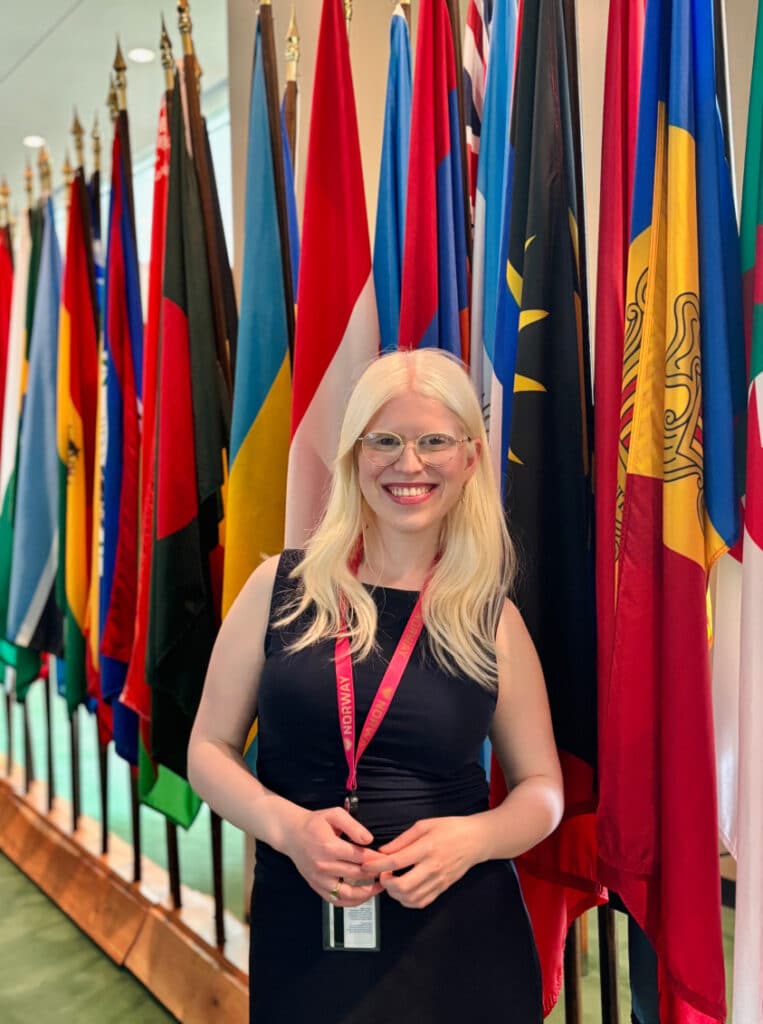
Nora Sulejmani was nominated for the position as youth delegate by the Norwegian Association of the Blind and Partially Sighted Youth. Photo: Elise Knutsen/ LNU.
From convention to national legislation
Even with the opportunity to influence in the international arena, Nora says that it is important not to forget the national legislation. “Even if several member states sign and ratify the UN conventions, it does not automatically mean that it will be implemented in the respective countries right away.” She points to Norway as an example, where the country signed the CRPD convention in March 2007, but did not implement it into its own legislation until 2025.
In these cases, she says it is important to remember to recognize the small victories, not just the big ones.
“You might think that the meaningful influence only happens when all people have equal rights, or when there is peace in the world, and if you keep that mindset, you will be disappointed. You also have to be a little optimistic and look positively at the small victories, because they make a difference for someone.”
“What is decided today has first and foremost consequences for us in the future”
She says that it is important for us to remember that the decisions made today might not have any real impact for decades. This means that it is those who are young today who will have to live with the consequences of what is decided now.
“We need a diversity of voices as we shape our future. We must take greater ownership of what lies ahead, and use our voices, both for ourselves and for future generations. The climate crisis and the development of artificial intelligence, among other things, cut across national borders. Therefore, multilateral cooperation is crucial to find common solutions and create a sustainable future.”
Her most important advice to other young people who want to get involved is to find their heart cause and include themselves. “Find others who share your commitment, dare to take up space. The institutional must include young people more, but it also requires that young people get involved in something they stand for or are interested in.”