
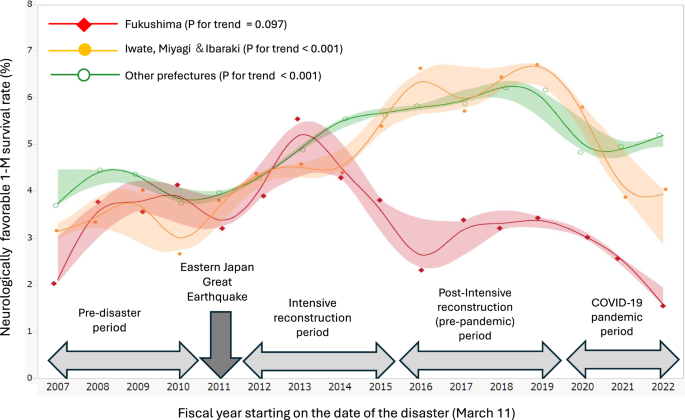
This study identified regional differences in crude temporal patterns, AIPW-estimated changes relative to T0, and adjusted within-period comparisons of neurologically favourable 1-month survival after OHCA. During T2, AIPW-estimated survival improved relative to T0 in all three regional groups. During T3 and T4, the AIPW analysis showed lower adjusted survival in Fukushima than in both comparison groups, and the multivariable logistic regression analysis showed lower adjusted odds in Fukushima than in Iwate/Miyagi/Ibaraki. These findings demonstrate regional heterogeneity over time but do not establish that the tsunami, nuclear accident, or degree of regional recovery caused the observed differences.
Taken together, Figs. 3 and 4 clarify the nature of this regional divergence. Relative to T0, Fukushima showed a statistically significant improvement only in T2; the estimated changes in T1, T3, and T4 were not statistically significant. By contrast, both comparison groups showed significant improvements relative to T0 during T3 and T4. Therefore, the significant between-region differences during T3 and T4 appear to reflect sustained improvements outside Fukushima more than a statistically demonstrable decline within Fukushima from its T0 level. This pattern should be interpreted as Fukushima not sharing the improvements observed in the comparison regions, rather than as evidence that disaster-related factors caused a discrete deterioration. Potential explanations include regional differences in demographic change, bystander response, EMS capacity, and healthcare access; however, these mechanisms could not be distinguished using the available registry data.
Fukushima differed from the comparison regions in the extent of radioactive contamination and the long-term burdens of decontamination and decommissioning9,10. However, the regional classification used in this study served only as a proxy for differing disaster exposures, and the degree of recovery was not directly measured. Therefore, the observed differences in OHCA outcomes cannot be attributed specifically to nuclear accident-related recovery and may instead reflect demographic changes, healthcare-system factors, or other time-varying regional differences.
The scale and funding structures of the Fukushima Daiichi nuclear disaster, the Chernobyl disaster14, and the Three Mile Island accident15 differ substantially. Fukushima continues to face long-term burdens related to decontamination and decommissioning9,16,17. However, this study did not examine prefectural budgets, the allocation of funds to EMS or healthcare, or changes in the geographical coverage of emergency facilities. Therefore, the available data do not support the inference that expenditure on nuclear accident-related recovery constrained the recovery of emergency care systems. The longer EMS response time and lower BLS training activity observed in Fukushima should be interpreted as ecological regional correlates; their causes and contribution to individual OHCA outcomes could not be determined.
During T3 and T4, the adjusted odds of neurologically favourable 1-month survival were lower in Fukushima than in the comparison regions. The adjusted models included only measured patient and prehospital factors; therefore, residual confounding by unmeasured or time-varying regional factors remains possible. The registry data did not allow the mechanisms underlying these regional differences to be identified.
The prolonged decommissioning process and repeated revisions to major milestones provide important context for Fukushima’s extended recovery16,17. However, this study did not measure residents’ risk perceptions, psychological status, economic circumstances, or willingness to participate in community activities. Although Fukushima had fewer participants in EMS-conducted BLS courses and a lower proportion of bystander-initiated CPR without dispatcher assistance, the training data were aggregated at the regional level and could not be linked to individual bystanders or OHCA events. CPR quality was also not recorded in the FDMA registry. Consequently, although previous studies have identified associations between rescuer-related factors and CPR quality18,19,20, the present data do not support the conclusion that psychosocial or economic conditions adversely affected CPR quality or OHCA outcomes in Fukushima.
Healthcare workforce availability is another possible contextual factor. Prefectural reports indicate that the number of physicians per 100,000 residents in Fukushima has remained below the national average and that regional disparities in physician distribution persist21. FDMA reports have also documented comparatively low paramedic deployment indices in Fukushima22. In the present study, however, the proportion of ambulance teams that included a paramedic increased across the post-disaster periods, although it remained lower than in the comparison regions. This temporal pattern alone therefore does not explain the decline in neurologically favourable survival observed after 2015. Although access to timely advanced care may be particularly relevant to the heterogeneous causes of noncardiac OHCA23,24,25, the available workforce indicators and in-hospital treatments could not be linked to individual OHCA cases. Consequently, the contribution of healthcare workforce changes to the observed regional differences could not be determined.
Population decline and population ageing are important alternative explanations for the observed regional patterns. In 2012, the major tsunami-affected prefectures experienced population decreases related to both natural population change and net migration, and population decline subsequently continued in many affected coastal municipalities26. In the present cohort, median patient age increased over time in all three regional groups and was highest in Fukushima across T1–T4. Although age was included in the adjusted individual-level analyses, prefectural or municipal population changes, migration patterns, numbers of healthcare workers, and the location of each OHCA relative to the patient’s residence could not be linked to individual cases. We therefore could not evaluate a time-by-population-change interaction or determine whether depopulation influenced outcomes through changes in case mix, healthcare availability, or EMS coverage. Younger individuals may be more likely to have recently received BLS training through school or driving-school education27,28, but the age and training history of individual bystanders were not available. Further analyses incorporating population and healthcare workforce data are needed to examine these possibilities.
Regional patterns also differed during T4. Neurologically favourable survival remained lowest in Fukushima, whereas the transition from T3 to T4 was associated with significantly lower adjusted odds in Iwate/Miyagi/Ibaraki and the other eastern Japanese prefectures but not in Fukushima. Previous studies have associated the pandemic with changes in bystander intervention, including hesitation related to perceived infection risk, reduced rescue breathing, and fewer BLS educational activities12,13,29. However, the present study did not measure infection-risk perceptions, rescue-breathing performance, movement restrictions, or other pandemic-related behavioural changes at the individual level. Therefore, the observed regional differences during the pandemic cannot be interpreted as evidence that previous tsunami damage or radioactive contamination altered the responses of citizens or healthcare professionals to subsequent health crises.
Limitations
First, this was an observational study based on registry data. The annual temporal trend analyses were unadjusted descriptive analyses, whereas the multivariable logistic regression and AIPW analyses adjusted only for measured covariates. Neither type of analysis can establish a direct causal effect of the earthquake, tsunami, nuclear accident, reconstruction policies, decommissioning process, or COVID-19 pandemic on OHCA outcomes. Regional classification served only as a proxy for complex differences in disaster exposure and regional context, and residual confounding by unmeasured or time-varying factors remains likely.
Second, the FDMA registry did not include several potentially important regional or individual-level determinants of outcome, including population decline and migration, the geographical distribution of healthcare workers and emergency facilities, in-hospital treatment, individual bystander characteristics and training history, CPR quality, and psychosocial or economic conditions. Available population, workforce, and educational indicators were aggregated at the prefectural or regional level and could not be linked to individual OHCA cases. Information on ambulance-station coverage, emergency-facility closures, travel distance, and population dispersion was not available at the individual-case level; therefore, the causes of the regional differences in EMS response time could not be determined. Consequently, the mechanisms underlying the lower survival observed in Fukushima during T3 and T4 could not be identified.
Third, this study was limited to family-, friend-, or colleague-witnessed OHCA in eastern Japan. These results may not be generalisable to unwitnessed OHCA, public-location OHCA witnessed by other bystanders, EMS-witnessed OHCA, or OHCAs in regions outside eastern Japan. This restriction was intended to focus on community-level responses by people close to the patient; however, it narrowed the scope of inference. We also did not examine whether the association between EMS response time and neurological outcome differed by region; this potential effect modification should be evaluated in future studies using linked individual-level, EMS system, and geographic data.
Fourth, EMS educational activity data were aggregated at the prefectural or regional levels and could not be linked to individual patients, actual bystander training status, or the quality of CPR performed. Therefore, these measures should be interpreted as indicators of regional educational capacity, rather than direct patient-level exposure.
Fifth, secular changes in the Utstein data collection, EMS protocols, public-access defibrillation availability, population age structure, migration, and COVID-19-related healthcare utilisation may have influenced the observed temporal patterns. Although multivariable regression and AIPW were used, unmeasured time-varying confounders may remain.
Sixth, the study periods were defined using 12-month intervals beginning on 11 March to align T1 with the date of the disaster. These broad historical categories may obscure short-lived monthly changes and should not be interpreted as ordered stages or direct measures of regional recovery.
Finally, some subgroup estimates were based on sparse events and should be interpreted with caution.