
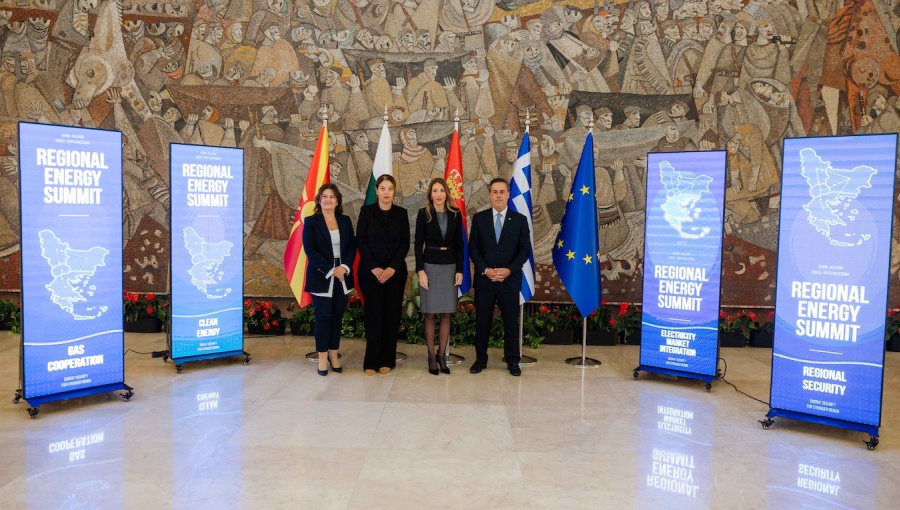
Serbia will begin work on the 145-km gas interconnector with North Macedonia next week, as the two countries, together with Bulgaria and Greece, stepped up efforts to strengthen regional energy security and diversify gas and electricity supply routes.
The announcement came at the second meeting of the four countries’ energy ministers in Belgrade on October 6, where they reaffirmed their commitment to the Vertical Gas Corridor linking Southeast and Central Europe, the Serbian government announced.
The first pipes for the Serbian section have already been delivered, with installation due to start next week. Serbia aims to complete its part in the first quarter of 2028, while North Macedonia expects its section to be completed by 2028.
The Serbia-North Macedonia link will connect to the Greece-North Macedonia interconnector, which is expected to become operational in 2027. Together, the projects will create a new route for gas from Greece, including LNG arriving at the Alexandroupolis terminal, to reach North Macedonia and Serbia and connect them to wider regional supply routes.
Greece expects its gas export capacity towards neighbouring markets to reach 9.5bn cubic metres by 2027, strengthening its role as a southern entry point for diversified gas supplies to the Balkans and Central Europe.
The ministers also agreed to deepen cooperation on electricity markets and transmission infrastructure. Bulgaria presented progress on the East-West Electricity Corridor, while Serbia highlighted plans for a new 400-kV transmission route, the Central Balkan Corridor, aimed at increasing cross-border electricity exchanges and system security.
Discussions also covered renewable energy, battery storage and pumped-storage hydropower, as well as the potential future use of gas infrastructure for hydrogen transport.
The four countries are also considering a south-eastern extension of the product pipeline network along the Thessaloniki-Skopje-Niš route, which could connect Serbia, via North Macedonia, with the port and energy infrastructure of Thessaloniki.
The meeting comes as the region seeks to reduce reliance on individual energy supply routes and strengthen alternatives to Russian gas. The ministers also discussed the decarbonisation of the Western Balkans and the need for EU financial support to help the region meet new requirements, including under the Carbon Border Adjustment Mechanism.
The third ministerial meeting will be held in Sofia in 2027, with Romania expected to be invited to join the discussions.