

On October 8, Azerbaijani President Ilham Aliyev paid a working visit to Turkmenistan to attend the 8th Consultative Meeting of the Heads of State of Central Asia and the Republic of Azerbaijan, a meeting of the CIS Council of Heads of State and the Caspian Environmental Summit.
A number of important documents are expected to be signed as part of the events, including a Joint Declaration on the outcomes of the 8th Consultative Meeting of the Heads of State of Central Asia and the Republic of Azerbaijan. President Ilham Aliyev is also expected to hold a bilateral meeting with Turkmen President Serdar Berdimuhamedov during the visit.
In recent years, expanding ties with Central Asian countries has assumed particular importance in Azerbaijan’s foreign policy and remains one of its priority areas. Developing mutually beneficial cooperation with Turkmenistan is also an integral part of this policy.
Speaking at the 8th Consultative Meeting of the Heads of State of Azerbaijan and Central Asia on October 8, President Ilham Aliyev said relations between Azerbaijan and Turkmenistan had developed dynamically in recent years.
Noting that five high-level visits had taken place since last year, he said this reflected the intensity of the political dialogue and the mutual desire to further strengthen bilateral relations.
The president also particularly highlighted the construction of a mosque in Fuzuli at the initiative of Chairman of the People’s Council of Turkmenistan Gurbanguly Berdimuhamedov. He recalled that they had jointly participated in laying its foundation last year and said the gift from brotherly Turkmenistan was further evidence of the friendship and spiritual closeness between the two peoples.

Cooperation based on brotherhood and good-neighborly relations
It is particularly worth noting that relations between Azerbaijan and Turkmenistan are based on the principles of brotherhood and good-neighborliness. These ties are accompanied not only by bilateral cooperation, but also by mutual support and coordination within international organizations, including the UN, OIC, Non-Aligned Movement and Organization of Turkic States.
Turkmenistan has consistently supported initiatives put forward by Azerbaijan within the Non-Aligned Movement, demonstrating solidarity at both regional and global levels.
The development of relations between the two countries is important in terms of their historical and cultural affinity, cooperation in the Caspian Sea, as well as new opportunities emerging in energy, transport and logistics.
In accordance with the Declaration on Strategic Partnership between the Republic of Azerbaijan and Turkmenistan, signed in 2017, relations of brotherhood and strategic partnership have developed significantly and strengthened further through the political will of the leaders of the two countries.
Azerbaijan’s Ministry of Foreign Affairs has also said that political dialogue between the two countries continued in 2026, with opportunities discussed for expanding cooperation in the economy, trade, energy, transport, logistics, humanitarian and cultural fields.
A total of 108 documents covering various areas of cooperation between Azerbaijan and Turkmenistan have been signed to date.
High- and top-level visits and meetings in recent years, along with important documents signed, have further intensified bilateral dialogue and created a solid foundation for expanding cooperation across all areas.
President Ilham Aliyev has paid two official and five working visits to Turkmenistan.
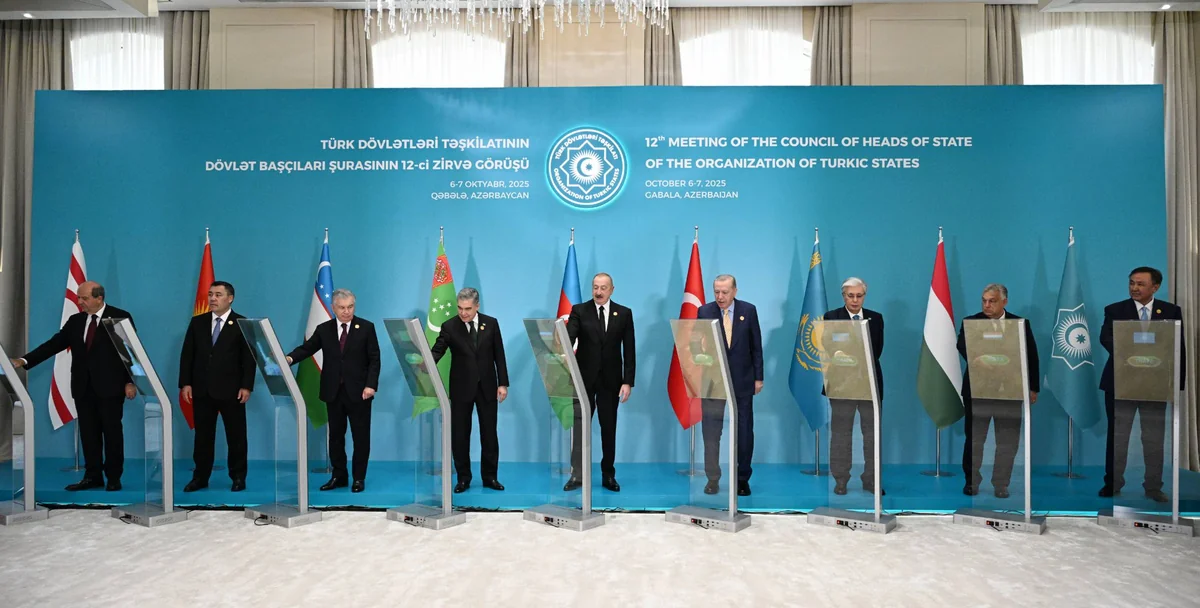
Another important development took place on October 7, 2025, in Gabala, where President of Azerbaijan Ilham Aliyev, Chairman of the People’s Council of Turkmenistan Gurbanguly Berdimuhamedov and other heads of state and government participating in the 12th Summit of the Council of Heads of State of the Organization of Turkic States took part online in laying the foundation of a mosque to be built by Turkmenistan in Fuzuli.
Construction is currently underway and is expected to be completed in May 2027.
In June 2026, President Ilham Aliyev particularly noted Turkmenistan’s support for the reconstruction of Karabakh and welcomed the initiative to build the mosque in Fuzuli.
One of the important indicators of political dialogue between the two countries was Turkmen President Serdar Berdimuhamedov’s state visit to Azerbaijan on June 22, 2026.
The results of the visit showed that Azerbaijan-Turkmenistan relations are no longer limited solely to political ties. The sides are taking steps aimed at expanding practical cooperation in the economy, energy, transport, customs, logistics, humanitarian affairs and other areas.
Mutually beneficial partnership
Alongside political dialogue, economic cooperation between Azerbaijan and Turkmenistan continues to develop.
In 2025, bilateral trade turnover amounted to nearly $209 million. However, the sides note that the cooperation potential is considerably greater, and the Joint Intergovernmental Commission between the two countries is working to increase this figure.
In 2025, the volume of transit transportation between Azerbaijan and Turkmenistan rose by 15% year-on-year to more than 2.3 million tons.
In the first eight months of 2026, the figure exceeded 2 million tons, up 38% compared with the corresponding period.
Another important area of partnership between the two countries is the joint development of hydrocarbon resources at the Dostluq field in the Caspian Sea. A Memorandum of Understanding on the field was signed in 2021.
The Caspian does not divide – it unites
One of the key geographical factors linking Azerbaijan and Turkmenistan is the Caspian Sea.
The Caspian basin creates significant opportunities for developing transport, energy and trade relations between the two countries. The Port of Baku, the Alat transport hub and developing logistics infrastructure are important for linking Turkmenistan with Central Asia’s major transport and energy potential.
This cooperation could expand access to European and Asian markets for the countries located on the two shores of the Caspian Sea.
Azerbaijan has strategic importance for brotherly Turkmenistan in terms of transporting Turkmen energy resources to global markets. Azerbaijan’s transit capacity and transport infrastructure, particularly the Baku-Tbilisi-Ceyhan main export pipeline, have a significant role in this process.
Another factor demonstrating the importance the two countries attach to cooperation in the Caspian basin was President Ilham Aliyev’s gift to Turkmenistan in June this year of the 8,000-ton Dostlug oil tanker, built for Turkmenistan at the Baku Shipyard.

International platforms
Azerbaijan-Turkmenistan relations are developing not only bilaterally but also within trilateral and multilateral mechanisms.
The formation of a trilateral cooperation format between Azerbaijan, Türkiye and Turkmenistan is noteworthy in this regard.
The first trilateral Summit of the heads of state of Azerbaijan, Türkiye and Turkmenistan, held in Turkmenbashi in 2023, was an important event in defining new areas of regional cooperation.
Azerbaijan and Turkmenistan also cooperate within the UN, OSCE, Organization of Islamic Cooperation, Economic Cooperation Organization, Organization of Turkic States and other international and regional platforms.
The current dynamics of Azerbaijan-Turkmenistan relations show that there are opportunities to enrich cooperation with more practical projects in the coming years.

It is also worth noting that in a congratulatory message sent in September 2026 on the occasion of the 35th anniversary of Turkmenistan’s independence, President Ilham Aliyev emphasized that relations between the two countries are rooted in historical ties, shared national and spiritual values and good-neighborly relations.
The Azerbaijani president noted that favorable foundations existed for further deepening cooperation in trade, the economy, energy, transport and logistics, culture and humanitarian affairs.
Thus, the development of relations with Turkmenistan constitutes an important element of the Central Asian dimension of Azerbaijan’s foreign policy.
The parallel development of the political, economic, energy, transport and humanitarian dimensions of Baku-Ashgabat relations demonstrates the increasingly multifaceted nature of the partnership between the two countries.
In this context, further deepening Azerbaijan-Turkmenistan relations could contribute to expanding bilateral economic ties, strengthening cooperation in the Caspian region and developing transport and economic connectivity between Azerbaijan and Central Asia.