
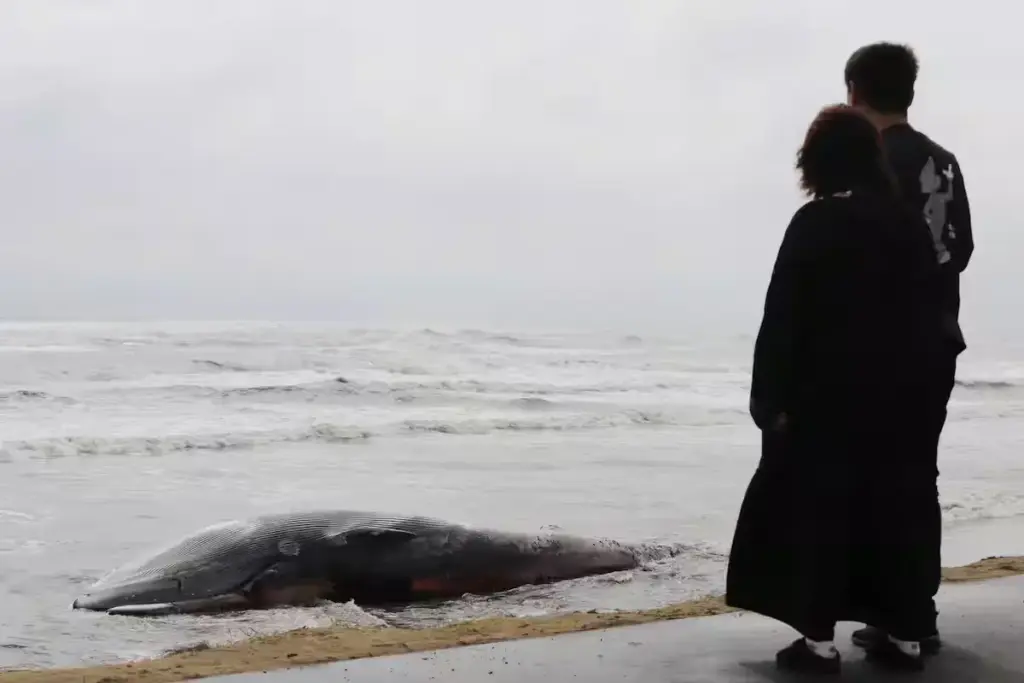
A second whale has washed ashore in Sosa, Chiba Prefecture, just weeks after another was found stranded in late September.
The unusual succession of strandings has drawn considerable attention, with visitors from across Chiba and beyond flocking to the beach for a rare chance to see a whale up close.
A Rare Sight on the Kujukuri Coast
“I had no idea it would be this big,” said a 57-year-old Sosa resident who visited the beach with her husband on the morning of October 5 after hearing the news.
She was struck by the sheer size of the whale lying at the water’s edge on Kayada Beach, a stretch of the long, sandy Kujukuri coastline.
The whale appeared to be dead, its enormous body moving only with the waves. “It’s sad, but it’s part of nature. There’s nothing we can do,” she said quietly.
Other visitors were more enthusiastic. Daiki Komatsu, a 29-year-old architect from Tokyo’s Chiyoda Ward, took time off work to make the trip. “I missed the chance to see the first whale, so when I heard another had washed ashore, I came straight here.”
Komatsu has been fascinated by marine life since childhood. “Whales are beautiful creatures, and I’ve always wanted to see one up close. I just wish it had been alive and well.”
Second Stranding Takes Officials by Surprise
According to the city, residents reported the second stranded whale on September 30, the same day workers finished burying the first. That whale had been found on September 19 along the Shinbori coast, about 1.5 kilometers away, and later died.
“I couldn’t believe it,” a city official said. “Everyone in the office was stunned.”
When the official visited the site on October 1, the whale was still occasionally spouting water in the shallows but appeared severely weakened. Hundreds of people gathered on the beach over the weekend to see it.
City public relations officials said they had never heard of a whale stranding in Sosa before. An 82-year-old man who visited the beach with his wife on October 5 was equally surprised. “I’ve lived here all my life, and I’ve never seen anything like this.”
He wondered whether the strandings might be linked to unusual weather. “We’ve had a lot of typhoon damage this year, too. Could the extreme weather have something to do with it?”

Rescue Efforts Deemed Too Dangerous
The Chiba Prefectural Marine Industries Promotion Division, which is responsible for responding to stranded whales, considered several ways to rescue the second whale, including towing it back out to sea. However, the shallow, gently sloping seabed made it difficult for a vessel to get close enough.
The whale, identified as a fin whale measuring approximately 18.6 meters long, also posed a significant safety risk. Its enormous size and powerful tail made it dangerous to approach.
Experts consulted by the prefecture concluded that the animal was already so weak it was unlikely to survive even if returned to deeper water.
“We all hoped it could return to the sea alive, but there was nothing more we could do. All we could do was watch over it,” said a prefectural official.
The whale was confirmed dead on the morning of October 4.
Burial and Scientific Study
The first whale was buried near the site where it washed ashore, and the prefecture plans to bury the second in the same way.
According to prefectural officials, researchers from the National Museum of Nature and Science are scheduled to examine and dissect the carcass on October 8, collecting specimens for scientific research.
An excavator will dig a pit approximately three meters deep near the stranding site, and a specialized vehicle designed to operate on sand will transport the remains to the burial site.
RELATED:
Whales Beached in Chiba Ahead of Tsunami Alert
(Read the article in Japanese.)
Author: Akihiko Tozaki, The Sankei Shimbun
Continue Reading