
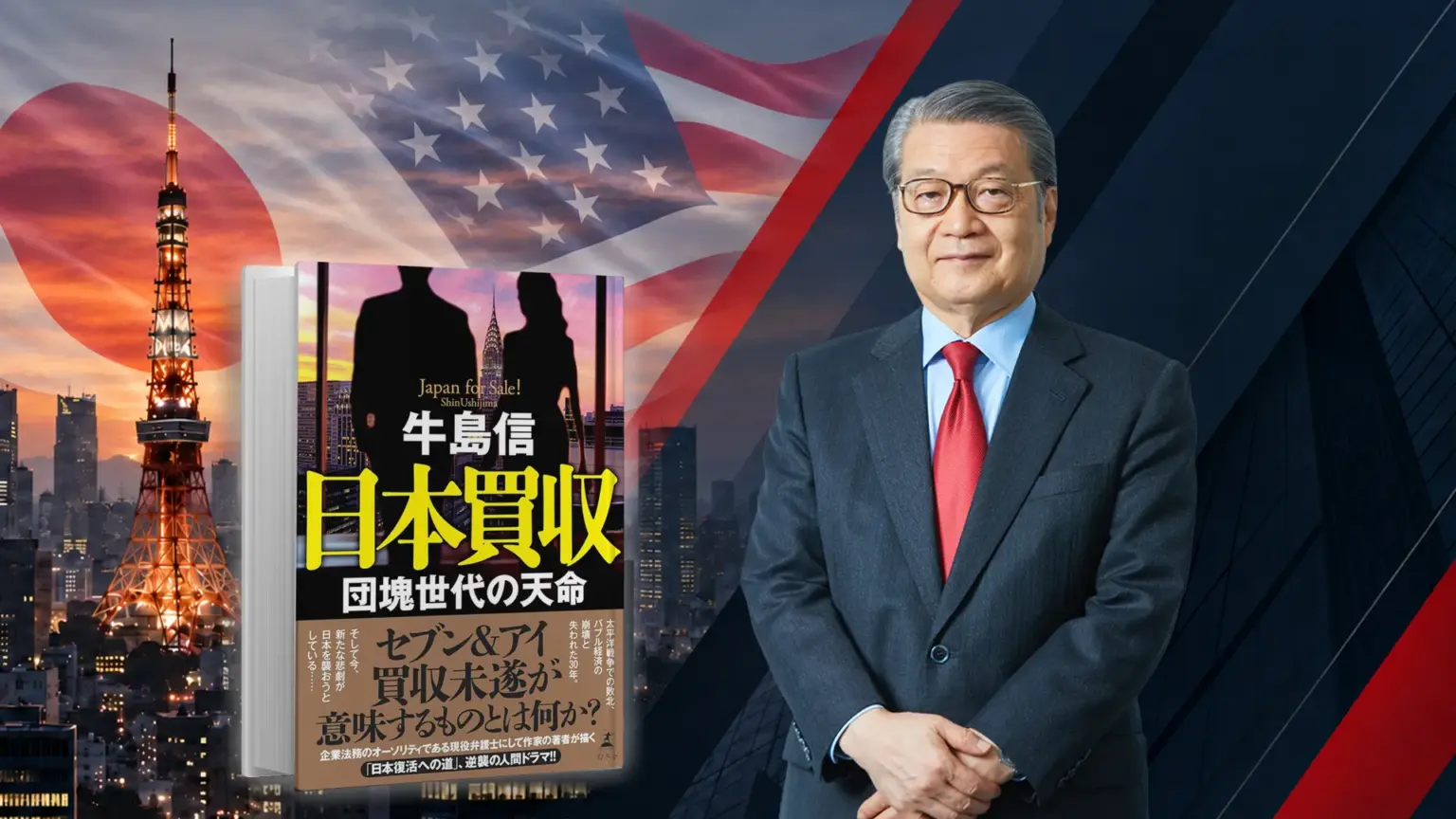
Corporate Japan is changing, and so are the complex relationships between the business world and the individual human beings who own, manage, and make it work. Author and lawyer Shin Ushijima uses his rare talent to weave a fictional story about love, loyalty, betrayal, war and peace, and the collapse and rebirth of the protagonists as well as their country. Join us below for the next chapter in this gripping saga.
Find earlier chapters through the Table of Contents
Chapter 7: Japan for Sale!
The Destiny of the Baby Boomer Generation
Lawyer Ohki only met people at his office who had made an appointment in advance. No exceptions.
Up to a certain time in the past, familiar faces would occasionally show up at the office entrance, asking, “Is he in?” That was back when his office was still in the Aoyama Twin Towers. Back then, whenever someone he knew came to visit, he would spend as much time as he could chatting. That no longer happened.
“Ah, that must have been the last time,” Ohki thought to himself as he remembered one special person. That fellow would always show up unannounced. And the two of them would end up spending a lot of time just shooting the breeze. But it had been decades since they last did that, and Ohki was not even sure the fellow was still alive.
That’s right. That kind of thing happened a long, long time ago, he mused. But it never happens these days. I suppose it’s a sign of the times. And after he had moved to Roppongi, things continued to change more and more.
First of all, nowadays, to enter the building where Ohki’s office was located, a visitor needed a digital reservation certificate the office had issued in advance. Without it, the visitor could not even enter the elevator hall on the first floor.
One day, he got a different call.
“Mr Ohki, we just got a call from the building receptionist. She has a woman named Nishino downstairs who says she has come to see you.”
The secretary on the phone telling him this was the one with the second-longest experience among the firm’s four secretaries. He could see her with the others through the glass partition, sitting four meters away.
Call From the Lobby
Ever since the COVID-19 pandemic, much of his communication with his secretaries was by phone. Even during the pandemic, Ohki showed up at his office without fail, while always making sure to keep his office door closed. It had become an ingrained habit that he continued to maintain.
“Ah, Nishino-san, you say?”
He was not really surprised. After all, they had agreed that she would come to the office to meet him. From her perspective, it must have seemed as though she had duly gone to the location on the business card he had given her, and now was being turned away at the door.
For a 75-year-old woman living in Hiroshima, it might be difficult to imagine needing digital permission in advance to visit an acquaintance. However, since she was the managing director of a mid-sized real estate company in Hiroshima, it would not be surprising for her to be familiar with such facility arrangements. But even so, hadn’t she considered the possibility that Ohki might not even be in Japan when she arrived at his office?
“Please ask the woman at the reception desk to tell her that Mr Ohki will come down to the first floor to meet her shortly, and ask her to wait there for him.”
The secretary answered “Understood” in her usual professional, clear fashion.
Had someone from building management observed Ohki going down personally to the first floor to meet a guest, no doubt they would have been taken aback and concluded that the visitor must be very important.
They would have been right ー that was exactly how it was. Those were Ohki’s thoughts as he rode the elevator down to the lobby. For some reason, the thought of calling his visitor on her cellphone never crossed his mind.

The Colors of a Memory
As he stepped out of the elevator, he looked towards the entrance and spotted a long coat of light pink. The loose-waisted coat covered the figure of Reiko Nishino. He had been struck by how she had seemed to have become a little plump when they met at the class reunion not long before. He guessed that she was trying hard to look slimmer on this occasion.
Today, a loose-fitting light blue suit was visible through the gap in her open coat. Her yellow scarf was the same color as the handbag she was holding. Just looking at her, no one would take her for a 75-year-old woman. At best, in her early sixties. However, for Ohki, it would have been all the same, either way.
Her firm, upright posture, which made it almost seem as though she was suspended from the ceiling by a piano wire, showed she was in excellent health.
She wore a white blouse with frills beneath her light blue suit. Below her slender, long trousers, she wore mid-heeled shoes in a very light beige color, almost white. He was flabbergasted. Suddenly, the image from 63 years before of Reiko wearing that light blue cardigan sprang to mind.
The belt buckle caught his eye. It was large, square, and gave off a golden gleam. And her leather belt was the same color as her shoes. Without a doubt, she had carefully coordinated her outfit. She was carrying a large lemon-yellow bag. It was not a famous brand but looked to have been custom-made. He estimated that it would have cost around ¥500,000 yen. No, probably even more. Women’s fashion was beyond him.
A Slightly Imperious Manner
“Were you surprised by the tight building security? Sorry for the hassle. But I trust the building reception desk treated you courteously.”
Ohki called out to her in a pleasant voice. But Reiko simply signaled to him with her right hand.
Ohki quickly used a card the same size as a credit card to exit the gate. As he hurried towards her, Reiko Nishino was waiting with the same smile she’d had for as long as he could remember. Her slightly imperious demeanor reminded him in a different way of the old Reiko Nishino.
“Okay, use this to go in.” He handed her a visitor’s entry card. Reiko’s hand and Ohki’s fingertips touched ever so slightly. At that moment, he was sure he could faintly hear Reiko’s voice saying, “Just like an outsider.”
No way it could be true. That was 64 years ago. He thought to himself.
However, Reiko’s voice and tone from that time so long ago had clearly been imprinted somewhere in Ohki’s brain as electrical signals, which remained vividly alive within his head.
The moment Ohki’s fingertips touched the back of Reiko’s hand, where the veins were clearly visible, that signal must have instantly replayed in his brain, making him feel as if her voice was ringing in his ears.
Just like an outsider.
That’s what Reiko had said to Ohki 64 years earlier, scolding him in a half-swearing way. The brief exchange had taken place in the old wooden building of Noboricho Elementary School in their fifth-grade “Matsu” classroom. Ohki couldn’t recall what had led to her remark. However, he harbored no doubt that Reiko had hurled that sharp, dismissive reprimand at him. He was ten at the time. It had been lodged there in his brain as a memory ever since.
The Outsiders
Oh, the surprise and anger he felt when the insult was hurled at him. Along with the deep-seated comprehension within Ohki’s heart that it was indeed true.
At the time, it had only been a few months since he had transferred from his elementary school in Tokyo. Renovations on the company housing for Ohki’s family had still not been completed. So, they had moved to an old-fashioned house with a large garden in the Osaka suburb of Fuchu-cho.
The impressive entrance hall gave the place a completely different feel from the cramped, reinforced concrete company housing with three rooms and a kitchen we lived in during our time in Tokyo.
There were several large stones placed in the spacious garden. Also, there was a separate building, which his older brother, who was six years older than him, appropriated for his own use. However, even as a child, it had been difficult for Ohki to get used to the fact that the toilet was an old-fashioned vault-style.
Ohki had transferred from Taisei Elementary School in Toshima Ward, Tokyo to Noboricho Elementary School in Hiroshima during the first semester of his fifth-grade year. The plan was that once the renovations to the company housing in Noboricho were completed, they would move and live within the Noboricho Elementary School district. Meanwhile, he had to take the bus from their home in Fuchu-cho in Aki County to school. It was a Hiroshima Electric Railway bus, affectionately referred to by locals as the “Blue Bus” because of its blue-green vehicle body.
Joining the ‘Temporary Residents’
For Ohki’s parents, this was the only natural course of action. They probably could not even imagine the idea of enrolling their son in a rural elementary school.
Ohki’s parents harbored high expectations for their precious second son, and were already thinking about his entrance exams for junior high school, high school, and beyond. They were determined that this second son would not fail to gain entrance to the University of Tokyo. To achieve that goal, he would need to get into a high school with a consistently high number of students accepted into Todai.
Only three high schools in Hiroshima qualified. The best option was the National Hiroshima University Faculty of Education’s affiliated school, which combined junior and senior high school and was commonly referred to as “Fuzoku.” After that, two private schools that combined junior high and high schools, both Hiroshima Gakuin and Hiroshima Shudo, also enjoyed good reputations. His parents were convinced that, for Ohki to get into any of the three schools, they would have to enroll their boy at Noboricho Elementary School, in the center of Hiroshima City, as early as possible.
There were several boys in the class, like Ohki, who came from outside the school district to attend Noboricho Elementary School. Like him, they all wanted to get into a top-tier junior high school in the future. And they were all labeled “outsiders.”
Their parents used the addresses of acquaintances as their provisional residences so their children could attend Noboricho Elementary. Ohki had learned the expression “temporary residence” from his mother.
Follow the story as it continues.
(To read the book in Japanese, please visit the publisher’s website.)
READ Other Books in English by Shin Ushijima:
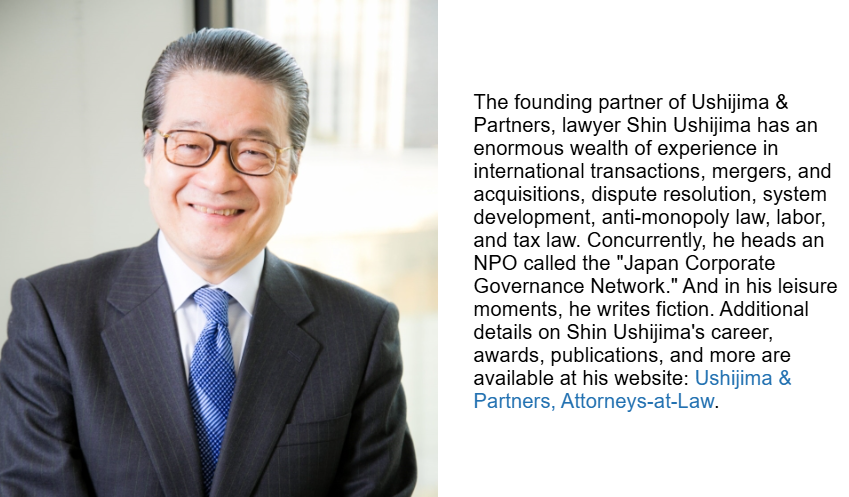
Author: Shin Ushijima
Ushijima & Partners, Attorneys at Law
Translation by: John C Carroll
(Edited by Susan Komori, Japan Forward)
Continue Reading