


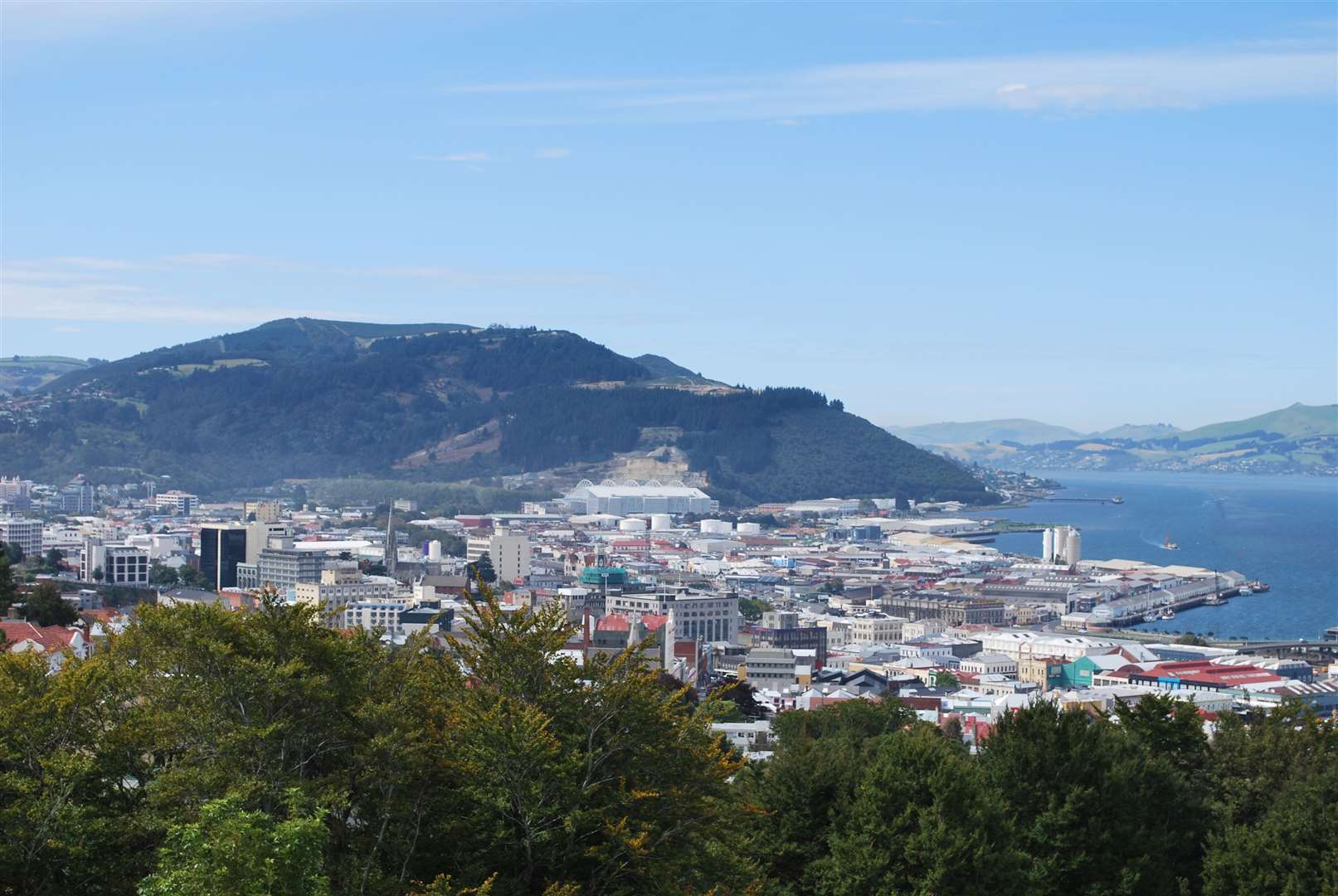
 Dunedin in New Zealand has many streets named after places in Scotland. Photo: Mattinbgn
For people who come from all the islands that stretch both near and far from Scotland’s coast, there will be times when living in New Zealand must seem very confusing.
Stroll the length and breadth of St Kilda on the coast of Dunedin and there must have been moments when former residents of that island looked around its streets and failed to see the guillemots, fulmars and puffins with which they had long been familiar on their former home’s edges.
Steer and drive up Shetland Street in that same city, and there will be moments when a former native will feel walled in by the length and breadth of buildings that exist there, their shadows dominating them in a way that rarely happened in their original location.
It is an issue that particularly affects Orcadians that visit a small community entitled Palmerston in the district of Otago, some 50 kilometres north of Dunedin in the South Island.
Walk through that township and one can glimpse streets named Orkney, Kirkwall, Sanday, Stromness, Stronsa and Ronaldsay.
To add to their bewilderment, there are even locations with titles like Mull and even Burraness; the latter clearly causing confusion in the mind of someone who was brought up in Yell.
Are Orkney and Shetland finally coming together in that vicinity?
One could go on. Among other places I spotted during my time in New Zealand were streets bearing names like Barra, Bernera, Colonsay, Stornoway, Harris and Iona.
There was even one entitled Barvas Street, a location I have been familiar with since my childhood in the Isle of Lewis, with several of my friends and relations staying there.
Some other locations had their origins in the Scottish mainland – Ardrossan, Kilmarnock, Campbelltown, Stirling and even Dunedin, based on the original Gaelic name for Edinburgh. It might even have been possible for some of the Scottish people who had arrived in New Zealand to believe they had never left their homeland, that somehow or other it had clung onto them through all the vast distances they had steamed and sailed.
Yet their new location was not solely or as simple as they might have thought. There are placenames like Brighton, Sheffield and Lincoln, Scandinavian-inspired locations like Norsewood and Dannevirke, localities that have Irish titles like Kerrytown, Athenree, Cronadun … Most importantly of all, there are a horde of towns, villages, small and large communities with Māori titles.
There were many I visited during the two months in which we lived in New Zealand. They included the likes of Wanaka, Oamaru, Pukeuri, Timaru, or Paraparaumu, the main town in the Kāpiti Coast where we stayed with the member of a family whom I grew up alongside in my native village in the island of Lewis.
Just about everyone I met was friendly towards the Māori people. (The descendant of my former neighbour had been involved for years in promoting the sporting life of Naenae, following his father’s example. The same was undoubtedly true with Peter Glesnor and his sister Margaret Smith, who had strong Shetland connections yet also supported the culture of the original inhabitants of New Zealand.)
Yet there was the occasional remark I overheard that was hostile to the Māori people’s culture and language. They complained that too much money was being spent on the country’s native tongue, the mindset and traditions of those who had lived there throughout more generations than anyone else.
It is an attitude that is – unfortunately – having its own effect on contemporary politics within New Zealand.
Clearly, I have come across people with perspectives like that before. I have encountered individuals in Edinburgh who have claimed their city of Dùn Èideann has no Gaelic connections. Clearly they must keep their eyes and minds shut when they wander through the likes of Costorphine, Balerno, Dalry, Drumsheugh … I have also encountered people who object to bilingual signs in various locations throughout Scotland, coming up with imaginative accounts of how expensive these particular items are.
These individuals should not be allowed to travel to the likes of Bolzano in South Tyrol, Italy. The trilingual road-signs there would cause them permanent bewilderment and confusion.
I have to confess I’m a great believer in bilingualism. It provides people with a wider range of perspectives, even making them more aware of the outlooks, sense and rhythms of their own range of tongues.
One can see the importance of this in the museums and other cultural outlets in New Zealand. There are often bilingual inscriptions alongside artwork and other creations.
Sometimes, this is underlined by poetry. Sometimes, it is even apparent in the music that accompanies some bright and imaginative illustrations.
This approach should be commended and imitated throughout much of Scotland and beyond. And yes. That is especially important in a certain island community which has its own distinctive and different language, drawn – in historical terms – from a variety of tongues.
Do you want to respond to this article? If so, click here to submit your thoughts and they may be published in print.