
A new radiocarbon study finds that the fortified villages of northern Spain were abandoned in less than a hundred years around 400 BC, and that the exodus began in Asturias. The villages that replaced them took at least two centuries to spread.
Around 400 BC, Europe was changing, though not in a single direction. Athens had just lost the Peloponnesian War (404 BC), and Roman tradition says the Gauls would sack Rome around 390 BC. Farther north, Iron Age communities reacted in almost opposite ways.
In the south of the Netherlands and the southeast of Gaul, people gathered into fewer villages and inequality grew. In central Europe, social hierarchies that had been building for generations seem to stall. Population fell along the middle Rhine, in France’s Champagne region and around Nitra in Slovakia. In Britain it rose in the Midlands while dropping in Essex.
Archaeologists usually treat this moment as a hinge between two periods rather than a subject worth studying in its own right. Climate, migration and conflict have all been proposed as causes, and the study discussed here points out that a mix of several factors is the likeliest answer. What is missing is something more basic: when each thing happened, and where.
That is the question taken on by Samuel Nión-Álvarez, a researcher at INCIPIT-CSIC in Santiago de Compostela, in an open-access paper in the Journal of Archaeological Science. He focuses on the north of the Iberian Peninsula for a practical reason: the region has a large number of Iron Age radiocarbon dates. He also argues that its social dynamics were mostly homegrown, without the direct pressure of colonial powers that was felt along the Mediterranean.
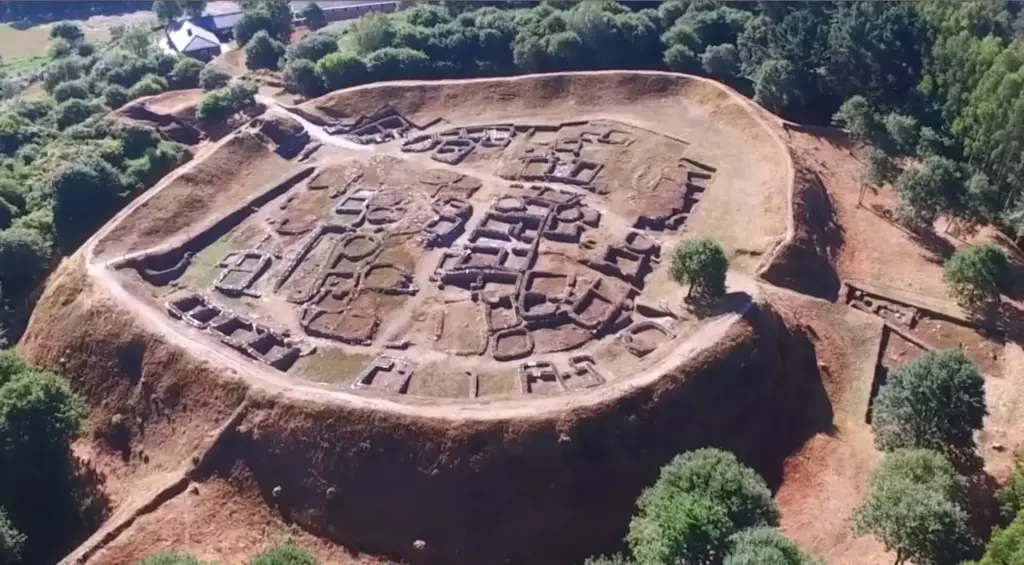
In this northern strip, the Early Iron Age is recognised by the castros, fortified villages built on hilltops, the Iberian cousins of the hillforts of Iron Age Britain and France. From the ninth or eighth century BC they replaced the more mobile societies of the Bronze Age. Around 400 BC, that landscape changed completely.
 Settlements in the area of study. Credit: S. Nión-Álvarez 2026
A clock with stuck hands
Dating this episode is hard, for a technical reason. Radiocarbon dating measures how much carbon-14, a slowly vanishing form of carbon, is left in organic remains such as wood, charcoal or bone, and a calibration curve turns that measurement into calendar years. Between roughly 750 and 420 BC the curve flattens out, a stretch known as the Hallstatt plateau. It is like trying to read a clock whose hands barely move for more than three centuries: samples from different periods give almost identical readings. And the plateau sits right on top of the crisis the study wants to date.
The solution is to trust many dates at once rather than one. Nión-Álvarez gathered 272 dates from 109 sites, spread across five zones: the Atlantic seaboard (mostly Galicia), the western Cantabrian area (where Asturias lies), the eastern Cantabrian area, and the western and eastern halves of the Meseta Norte, the high interior plain of northern Spain. He kept only samples from reliable contexts, such as the end of an Early Iron Age village or the start of a Late Iron Age one.
He then applied Bayesian models, a statistical method that combines the dates with what excavation tells us. If one village was built on the ruins of another, the second must be older, and that logic narrows the margin of error. The results were cross-checked against other techniques, including one that traces how active each phase probably was over time. The author admits that no method removes uncertainty, because we never study the past directly, only the traces of it that survive today.
A fast collapse, a slow rebuild
The main result is that the abandonment of the hillforts was broad and brief. According to the study, settlements across the north were left behind within less than a hundred years, whatever their local culture or type of settlement. Within any single region the change was faster still: the social landscape was transformed in about one generation.
It did not happen everywhere at once. The data suggest that it began in the western Cantabrian area in the first third of the fifth century BC, then moved to the Atlantic coast and the west of the Meseta. The last abandonments came in the far west and, above all, in the east of the study area, probably in the final decades of that century. The author places the Asturian start between the last decades of the sixth century and the beginning of the fifth BC.
Did the old world and the new one overlap? A little. On the Atlantic seaboard the estimated overlap averages 69 years, while in the eastern Cantabrian area it shrinks to a few years, with a low probability. The exception is the east of the Meseta Norte, where the overlap would have been longer.
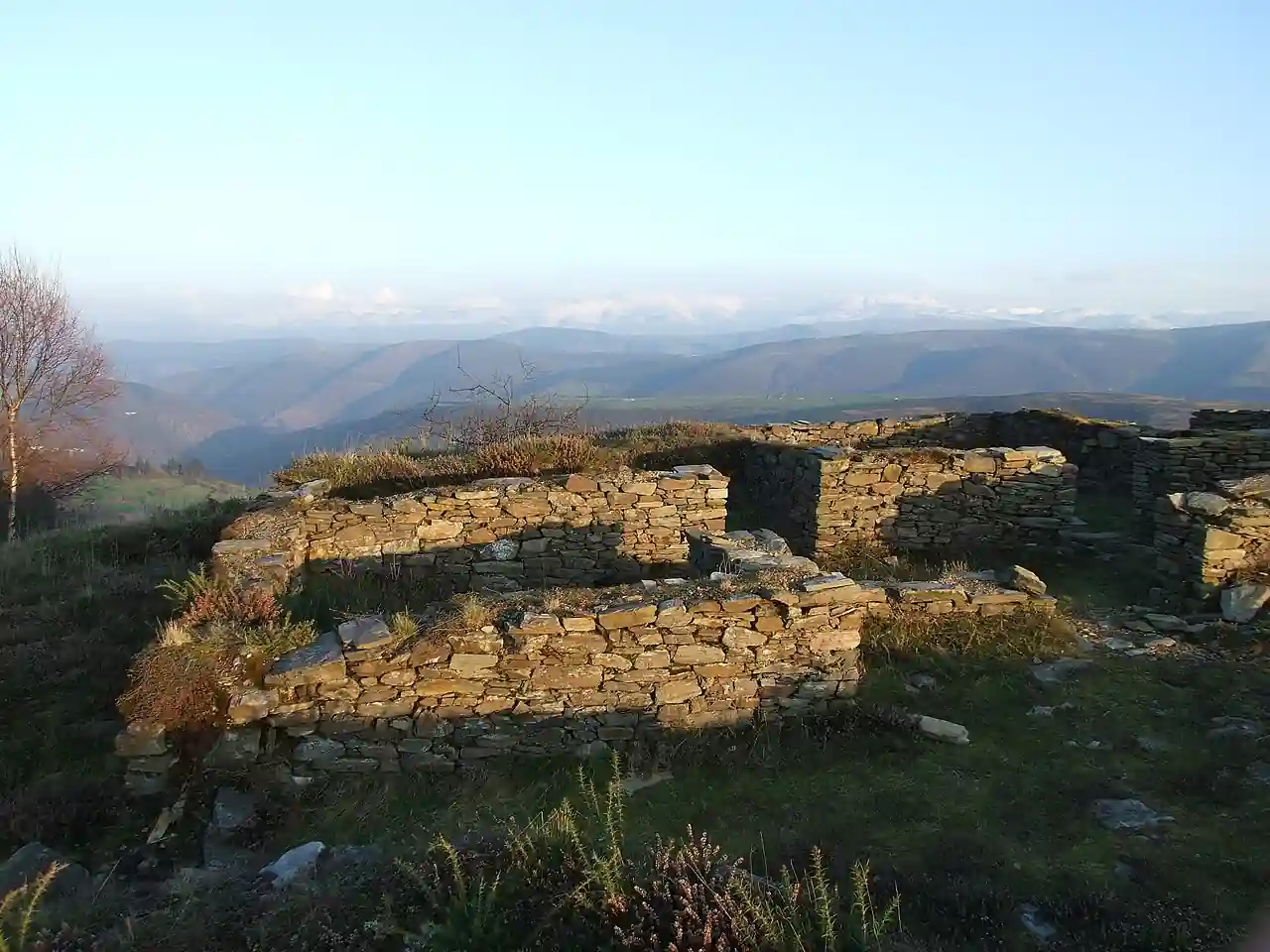 Hillfort of San Chuis, Asturias. Credit: xabeldiz / Wikimedia Commons
In 18 of the 109 sites there are dates for both phases, and they point to a gap between the two. That is what appears in Asturian hillforts such as Pelou, Llagú and San Chuis.
San Chuis, in the municipality of Allande, is one of the most thoroughly excavated fortified villages in Asturias. Digging began in 1962 under Francisco Jordá Cerdá and resumed in 1979, in an area rich in gold deposits that the Romans would later mine on a large scale.
In between, the study picks out some curious places, which it describes as temporary sites. They are short-lived open settlements and funerary or ritual spaces, concentrated in the last third of the fifth century BC and mostly on the Atlantic coast. No open villages or burial grounds were known there for the Iron Age, so they are a novelty. The sample is small, though, and the author asks for caution before speaking of a general trend.
What came next looks little like a collapse. Villages of the Late Iron Age start to be founded at the beginning of the fourth century BC, first in the western Cantabrian area and on the Atlantic coast. The movement then spreads gently across the rest of the north, in waves, over at least two centuries. In the far east, fortification did not become widespread until the early third century BC.
The new hillforts are bigger and more complex, sit closer to farmland and show deeper social differences, in a model that would last until the Roman conquest. In the east of the Meseta, the dates match the birth of the Celtiberian world. The old order fell quickly, and the new one needed much longer to settle.
Why Asturias first?
Here the study is cautious: it dates the phenomenon but does not explain it. The author acknowledges that the causes remain largely unknown.
The fact that the abandonment started in Asturias is striking because the communities there are usually seen as more resistant to change and to inequality. Until now, their Iron Age was thought to be a late phenomenon, shaped by the Atlantic world of Galicia.
For the author, the Asturian exodus may have been the first step of a deeper social transformation. Other researchers, such as Carlos Marín Suárez, have suggested a shift from an egalitarian ethos to a warrior one, which would have strengthened the identity of the Astures (the people the Romans would later fight in the Cantabrian Wars of 29–19 BC) during the Late Iron Age.
If so, the structure of society did not necessarily change, but war would have carried more weight as the glue holding communities together. That unrest could have spread to neighbouring areas, something similar to what has been proposed for parts of central Europe.
Conflict shows up elsewhere. In the east, the author cites La Hoya, a village near Laguardia (Álava) that, according to a study by Teresa Fernández-Crespo and colleagues published in Antiquity in 2020, was attacked and burned between the mid-fourth and late third centuries BC. The researchers read it as a clash between rival local communities.
Other drivers are also on the table, such as population growth on the western Meseta and along the Atlantic. Nión-Álvarez notes, however, that these hypotheses still do not explain why the Asturian hillforts were abandoned earlier.
What the data cannot tell us
The work should be read with its limits in view. The 109 sites are a small fraction of the 4,500 to 5,000 estimated for the area, and they are unevenly spread, with far more in the Atlantic zone than in the eastern ones. Data on temporary sites are scarce outside the Atlantic coast, and the results are less firm in the eastern Cantabrian area. The Hallstatt plateau itself forces the study to speak in decades, not years.
The author also does not judge what happened to the identities of the communities that left their hillforts. He describes local responses to wider changes and leaves the consequences for other studies.
That leaves the most awkward question. If the transformation on the Atlantic side, with the first forms of inequality, was taken to be the trigger of the crisis, what emptied the hillforts of the Astures first?
A version of this article is also available in Spanish: Léelo en español
SOURCES
Samuel Nión-Álvarez, Close to the edge: A chronometric approach to Early-Late Iron Age transition (450-350 BCE) in the Iberian Peninsula. Journal of Archaeological Science, vol.194, October 2026. doi.org/10.1016/j.jas.2026.106689