
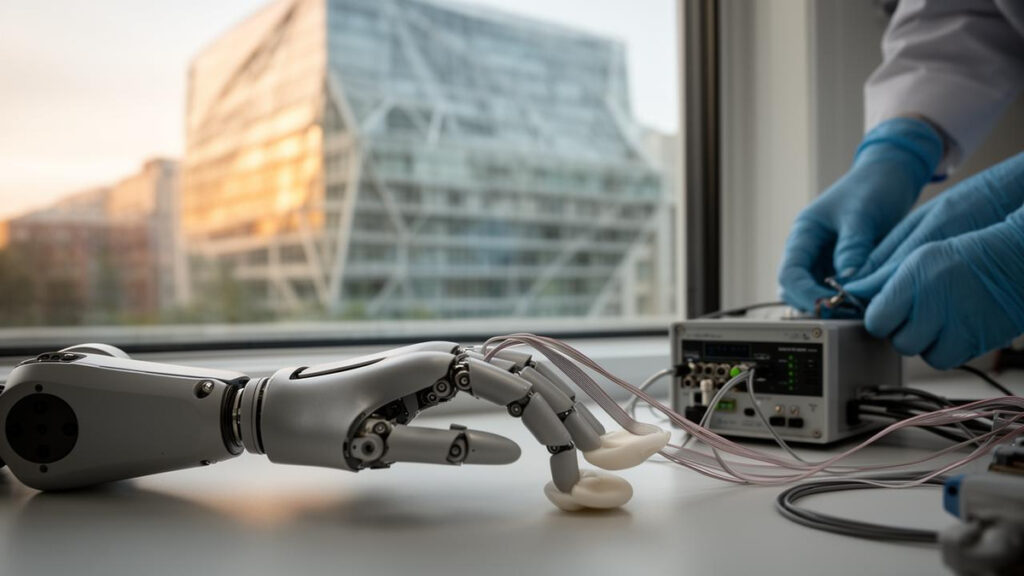
Hong Kong-listed robotics technology company Leju Robotics (01236.HK) announced that it has officially signed a cooperation agreement with Huazhong University of Science and Technology (HUST), one of China’s leading science and engineering institutions. The two parties will jointly invest in technology research and development in the field of flexible 3D tactile sensing for embodied robots. This collaboration is viewed as a critical step in Leju Robotics’ strategy to build a “Physical AI Perception Infrastructure,” signaling that the company is extending beyond its vision-centric approach into tactile sensing—a core perceptual dimension through which robots interact with the physical world.
According to the company announcement, the collaboration will focus on the practical needs of tactile sensing for embodied robots, encompassing technology development and scenario validation of flexible 3D tactile sensing devices and array systems. The cooperation covers three main areas: first, the development of flexible 3D tactile sensors and high-density sensing arrays, with the goal of enhancing sensor perception capabilities and long-term stability under complex operating conditions; second, the development of supporting signal acquisition hardware, 3D force decoupling, and tactile imaging algorithms to form a complete technical solution spanning from individual sensing devices to full array systems; and third, validation of the deployment capabilities of this 3D flexible tactile sensing system on practical platforms such as robotic dexterous hands and robotic arms.
Leju Robotics stated that the company has long been committed to advancing comprehensive perception solutions and intelligent robot systems through accumulated technical and industrial expertise, continuously pushing forward technology initiatives in next-generation sensors, deep AI integration, and spatial interaction models. The goal is to drive robots from basic environmental perception toward deeper scene understanding. This collaboration with HUST represents a key initiative to complement the company’s existing visual perception capabilities with tactile sensing.
Through joint research and development with HUST on flexible 3D tactile sensors and array sensing systems, Leju Robotics will explore cutting-edge technologies including contact-based 3D force sensing and tactile imaging, further completing the full technology chain from sensing devices and supporting algorithms to array systems. The company noted that the resulting technologies are expected to be applied across multiple scenarios including dexterous hands, robotic arms, humanoid robots, collaborative robots, and intelligent service robots, while establishing a foundation for future exploration of visual-tactile fusion perception and the expansion of multidimensional, comprehensive perception products and solutions for embodied robots.
As a key university in China’s engineering and materials science fields, HUST possesses deep expertise in sensor technology, micro-electromechanical systems (MEMS), and robotics-related research. This industry-academia collaboration model enables Leju Robotics to leverage the university’s fundamental research capabilities to accelerate the transition of laboratory-stage flexible sensing technologies toward industrial validation. For HUST, partnering with a company that has full-system manufacturing and industrial deployment capabilities provides real-world application scenarios and engineering feedback channels for its research outcomes.
From an industry perspective, tactile sensing has long been one of the key bottlenecks in embodied robot development. Compared to vision and hearing, tactile sensing involves complex physical quantities such as 3D force distribution, material identification, and slip detection, placing extremely high demands on sensor flexibility, density, sensitivity, and durability. Currently, most robots on the market still rely on rigid sensors, which struggle to adapt to fine manipulation tasks in unstructured environments. Leju Robotics’ focus on the “flexible 3D” technology pathway signals its intent to enter the high-value-added domain of dexterous manipulation capabilities.
Notably, Leju Robotics specifically emphasized concepts such as “deep AI integration” and “spatial interaction models” in its announcement. This means tactile data will not be processed in isolation but will be combined with visual, proprioceptive, and other multimodal information for fusion analysis through AI algorithms. This multimodal perception architecture is regarded as one of the core technology pathways for achieving autonomous operation in humanoid robots and advanced collaborative robots.
Market observers noted that Leju Robotics has noticeably accelerated its strategic positioning in perception technology recently. From earlier investments in visual perception and spatial modeling to the current expansion into tactile sensing, the company is attempting to build a complete technology portfolio covering the major perception modalities of robots. This “perception infrastructure” positioning distinguishes the company from pure robot manufacturers, aligning it more closely with a platform-type enterprise providing underlying technologies and solutions.
However, the journey from signing a cooperation agreement to actual technology deployment still requires a lengthy research, development, and validation cycle. Production consistency of flexible 3D tactile sensors, performance degradation under prolonged use, and integration challenges with different robot platforms are all engineering hurdles that must be overcome. The explicit inclusion of a “scenario validation” phase in the cooperation agreement indicates that both parties are focused on the practicality and deployability of the technology, rather than remaining at a purely academic level of collaboration.
Leju Robotics’ stock price remained stable following the announcement, reflecting the market’s cautious stance toward such strategic cooperation agreements. Investors generally recognize that the signing of an industry-academia cooperation agreement is still far from actual revenue contribution, making it difficult to quantify the financial impact in the short term. However, from a medium-to-long-term perspective, if flexible 3D tactile technology can be successfully integrated into dexterous hand and humanoid robot product lines, it would help the company establish differentiated advantages in the embodied intelligence competition.
Overall, this collaboration marks a further step in Leju Robotics’ efforts to complete its multimodal perception technology framework. Against the backdrop of the ongoing embodied intelligence boom, tactile sensing—as a critical gap in robot-physical world interaction—is attracting increasing industrial capital and technical investment. Leju Robotics’ decision to partner with HUST reflects both the company’s emphasis on fundamental technology research and its ambition to seize an early advantage in the perception technology race.