

Healthcare is one of the fasted growing industries in the state of Connecticut and that means a constant need for the trained and talented people who provide that care more than 11 million times each year.
“We have a need for healthcare workers that exceeds the healthcare workers coming out of school,” said Melanie Tucker, senior vice president human resources and talent strategy at Hartford HealthCare.
To address that need, Hartford HealthCare and the Goodwin University System are launching a partnership, believed to be the first of its kind in Connecticut, to create the next generation of healthcare workers for the state.
Through the partnership, which will begin with Connecticut River Academy, which is the middle and high school part of the East Hartford-based Goodwin University Magnet School System, students will be offered exposure to healthcare careers and a program that can help them go directly into healthcare professions, leaders of both organizations said. It will expand into various fields including nursing, respiratory, radiography, primary care and others, the leaders said.
 Stencils of the Hartford HealthCare logo are taped to a classroom wall before being painted at the Connecticut River Academy in East Hartford on Wednesday, Oct. 7, 2026. (Aaron Flaum/Hartford Courant)
While the partnership is aimed largely at high school, it will extend through college, advanced degrees and career advancement opportunities from elementary school through doctoral programs, leaders of the organizations said. In addition to students, it aims to benefit working adults and benefit communities.
‘Family sustaining careers’
In part, elements that drive the need for healthcare workers, in addition to normal turnover, is that young people are leaving the state to pursue opportunities, and that they might not be aware of the opportunities here, according to Dr. Peter Yoo, a surgeon and the chief academic officer for Hartford HealthCare. “It’s a really, really complicated landscape,” he said.
One part of the landscape is the number of people in Connecticut who need healthcare each year. The Connecticut Hospital Association reports that hospitals here provide care to more than 350,000 admitted patients each year, more than 9.7 million instances of outpatient care and 2 million days of inpatient care. Connecticut hospitals also employ more than 115,000 people, according to the association. The association cited data from various sources, including the state Office of Health Strategy.
Further, Hartford HealthCare has 48,000 employees, with more than 500 locations in 185 towns and cities, including Rhode Island and Massachusetts, as well as nine hospitals, urgent and virtual care, surgery centers, home care, senior care, rehabilitation, and mobile neighborhood health sites, according to the health system.
Connecticut officials have said the healthcare system here needs to hire about 3,000 nurses per year because of retirements, departures, and burnout in the profession.
Yoo said in an interview that the reality also is that at the same time the healthcare needs for staffing are increasing, work in the field can be part of the ladder to “successful, family sustaining careers.”
“There are a broad range of careers that will get them onto that ladder,” Yoo said.
He noted the need to expose students to careers in healthcare, with the goal of sparking interest, and that the desire to be “employed in our communities,” is part of the goal of the new partnership to make those pathways available.
“There is no need to leave the state,” he said, when there are available “satisfying, family sustaining careers.”
Traditional students
Tucker said part of the partnership includes Hartford HealthCare educators working with educators at the schools, which she said “truly is access to real opportunity, opportunity to great careers,” and “we will continue to be able to support their students.”
“These are students that are working in the communities that we serve, it really is win-win all around,” Tucker said.
Mark Scheinberg, president of Goodwin University, agreed.
“Goodwin is unabashedly a workforce institution, not a research institution,” he said. He said he sees Hartford HealthCare as “one of the most innovative organizations in the state.”
Scheinberg said 95% of Goodwin students stay in the state and that “you cannot be successful at what we do unless you are successful with Hartford HealthCare.”
“To make a real impact … in this state and this community we need to be deeply embedded within each other,” he said. “It all feeds each other really naturally.”
“We have so many residents who are not traditional students; we can’t leave anybody on the side,” Scheinberg said.
-

A new sign highlighting the four pathways offered at the Connecticut River Academy in East Hartford is displayed at the school on Wednesday, Oct. 7, 2026. (Aaron Flaum/Hartford Courant)


1 of 7
A new sign highlighting the four pathways offered at the Connecticut River Academy in East Hartford is displayed at the school on Wednesday, Oct. 7, 2026. (Aaron Flaum/Hartford Courant)
Scheinberg noted Goodwin’s average age is 30, and that can mean going back to school, a second chance in a career and more. The partnership will create a bridge, for “folks in the community.” The college has multiple healthcare programs, he said.
“These are wonderful people just looking for the chance we will be able to offer to them,” he said.
“We are so thrilled to have like-minded people [in Hartford HealthCare] … the purpose is to take the friction away,” Scheinberg said. “They can keep on advancing at Hartford HealthCare.”
Tucker said giving students an opportunity for a strong career path uplifts the community while also making sure that the best healthcare can be provided to Connecticut residents.
“Talent is everywhere, but access to opportunity and education is not,” Tucker said. “Our values could not be more aligned, including in uplifting the community.”
Beth Coones, who now works as a Hartford HealthCare Medical Group nurse in Pawcatuck, said she was among second-career students at Goodwin University, and needed the ability to attend at night. She said she found a “supportive” setting where she received guidance toward her goals. She graduated in April and said the new partnership is a great idea for students to take advantage of.
“I am happy, so glad I made the decision and everything worked out the way it was supposed to be,” Coones said. “I knew that my trajectory was pediatrics; where I am is where I want to be.”
This includes working directly with patients and families now in an outpatient primary care office and pursuing another degree so she can work in pediatric mental health, she said.
“I enjoy the rapport with my families,” she said, noting the office serves from newborns to geriatrics.
So many roles
Yoo said an important element to consider when thinking about healthcare positions is that there “are a lot of roles that are apparent and there are so so many roles that are essential to [patient] care that may not be so apparent.”
“In general delivery of healthcare, there are so many roles that are absolutely essential,” Yoo said. “It really is a microcosm of an entire economy within a health system — nurses, doctors and others there are are a tremendous variety of roles that we depend on that can be derived from this partnership.”
The healthcare system is very deliberate in choosing its partners, as “it goes beyond sick care and to being involved in our communities,” Yoo said.
 Guests tour IBA’s ProteusONE, which will perform proton beam therapy for cancer patients, at the Connecticut Proton Center during the official opening of the state’s first proton therapy center in Wallingford on Tuesday, Sept. 1, 2026. Hartford HealthCare, Yale New Haven Health and Proton International celebrated the opening. (Aaron Flaum/Hartford Courant)
Tucker said Hartford HealthCare, like other healthcare systems, “is like a little city unto itself,” based on all its needs.
“It takes all types of roles,” she said. “There really is a place for everybody in healthcare.”
In the classroom
Salvatore Menzo, superintendent of Goodwin University Magnet Schools, which includes Connecticut River Academy, said that the unique part of the partnership is that it goes beyond exposure to possible career paths.
The magnet school district is now working with Hartford HealthCare to develop in-class programming for students in preK to grade 5, which can include play and learning in a medical center simulation setting “to give them an active setting,” and events and lessons in classrooms.
Certain certification learning is already in place for the high school and associate’s degree classes begin this year, Menzo said.
“We are able to get students access to those classes; they can enter workforce upon graduation,” he said. The district serves 40 communities, working for equitable opportunities, he said.
“There is a lot of natural integration,” Menzo said. “We are opening the window for them on a world they might not know existed; it takes it to a whole other level.”
The district has more 1,400 students from PreK through 12th grade, including more than 700 at Connecticut River Academy, which serves sixth through 12th grades. It also is a district that is part of the Regional School Choice Office’s portfolio of schools associated with the Sheff v. O’Neill case, with students recruited from Hartford and surrounding towns, said David S. Daye, chief operating officer for the Goodwin University Magnet School System.
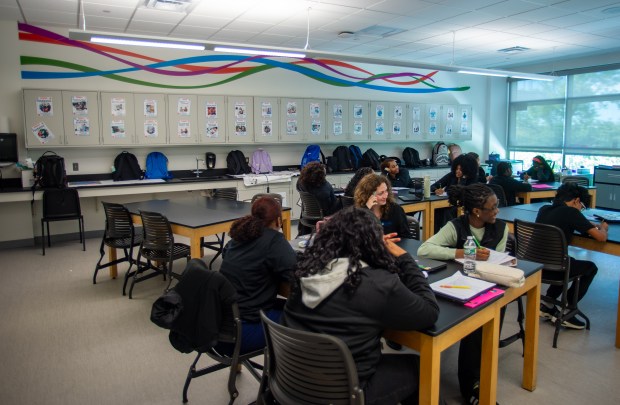 The colors of the Hartford HealthCare logo are painted on the walls of a classroom as students attend class at the Connecticut River Academy in East Hartford on Wednesday, Oct. 7, 2026. (Aaron Flaum/Hartford Courant)
The Sheff civil rights lawsuit, which alleged racial discrimination in Connecticut’s public education system, sparked a school choice program that includes a network of specialized magnet schools in Greater Hartford.
All students receive free breakfast and lunch; because of its partnership with Goodwin University, family members of our student households are able to take one college class for free, Daye said.
“The way that we see this [partnership], our students when we talk about this, it is actually creating an additional level of value to their diploma and that is something you can’t put a price on,” Menzo said. “Their diploma is going to have a great exchange rate; this really takes it to a level that I have never seen.”