
OAKLAND – Forecasters predict that this year’s El Niño could be the strongest on record, causing higher sea levels, coastal flooding and torrential rain across parts of the western coast of the United States.
For the many low-lying waterfront communities in the San Francisco Bay Area, these predictions only add to preexisting concerns about the flooding and erosion that occur during times of high tide and severe weather. That concern manifests for some as an urge to stock up on canned goods or weather-proof their home in case of an emergency. But for others, environment-related anxieties inspire creation.
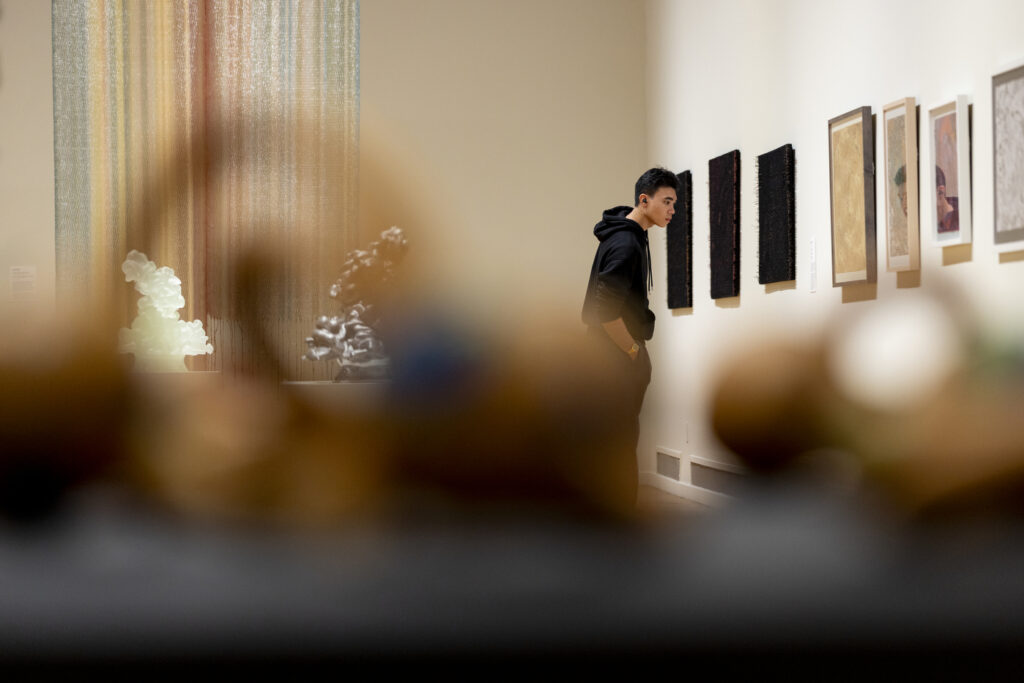
This was the case for artists Amanda Ugorji and Sophie Weston Chien – part of Boston-based artist collaborative Just Practice, whose work was previously featured in Gallery 360 on Northeastern’s Boston campus – in creating “Touching Toxicity.” They used tufted cotton to craft colorful depictions of six Bay Area locations in proximity to areas with contaminated groundwater, which can be pushed closer to the surface by rising sea levels. Now displayed at the Mills College Art Museum on Northeastern University’s Oakland campus, their work and the exhibit’s other physicalized representations of natural science concepts are inspiring professors from across campus to use them as part of their respective curricula.
Kristina Faul, professor of earth and ocean sciences, plans to take students from two of her classes to the museum for tours based around climate change. She said combining the artwork with a real-world case study of the incoming El Niño gives her students – who come to Oakland from around the world – a uniquely personalized learning experience.
“I like to get people familiar with Oakland or California examples, because that’s where they are right now,” she said during a break from overseeing a chemistry lab for first-year students.
El Niños raise temperatures in the equatorial waters of the Pacific Ocean, disrupting winter weather for most of the Earth. According to the National Oceanic and Atmospheric Administration, this year’s “Super” El Niño has a 75% chance to be the strongest since record keeping began in 1950. For the Bay Area, that means a high likelihood of severe rain and flooding, Faul said.
“Because we are a bay that is surrounded by urban areas, all of those could be inundated,” said Faul, who has lived in the Bay Area for about 30 years. “We’re also surrounded by hills, so it’ll be coming up from the sea and that runoff.”
When dense saltwater moves toward land, it accumulates beneath the soil and can spread pollutants or hazardous materials embedded within, according to Ugorji and Chien. A number of toxic sites are buried along the bay, most notably the Hunters Point Naval Shipyard, where radiation testing occurred during the Cold War. These areas can be contaminated with radioactive materials, petroleum tanks or other toxic chemicals which, if lifted from the soil by rising tides, could harm Bay Area wildlife and nearby residents, Faul explained.


+12
Kristina Faul, professor of earth and ocean sciences, plans to take students from two of her classes to the museum for tours based around climate change.
Ugorji and Chien’s “Touching Toxicity” series documents this relationship between the contamination, environments and East Bay communities, they said. Drawing on conversations with local scientists and activists, their textured panels highlight six locations around the bay known for their proximity to toxins – including the areas around Hunters Point, MLK Shoreline, and the Oakland Airport.
One of the panels, titled “Toxic Soup,” cites an area in the Northern Bay near Marin City and depicts a vertical slice of the underlying soil containing veins of groundwater laced with embedded toxins, shown with hot pink threads.
“We actually have a very poor understanding of what goes on an inch below our feet,” said Chien. “For us, learning about this very specific ecology of the area’s tides, its rising water table, what kind of rocks are underneath the ground, helped us to better understand its unique conditions.”
She and Ugorji studied Bay Area census tract data from past decades to grasp the scope of the environmental impact of the contamination, then used it to inform their artistic depictions and convey the severity to viewers, they said. It was important to them to highlight the contamination’s imbalanced effect on lower-income communities and people of color, Ugorji said, and that a “major storm will not affect everyone the same way.”
Stephanie Hanor, director of the Mills College Art Museum and a co-curator of the exhibit, said students in a Northeastern writing class explored these works during a visit earlier in the semester. One of their assignments involved choosing a piece of art and describing it in exacting detail, then entering that description into an AI tool and asking it to generate an image based on their words.
For instance, even when students felt confident in their descriptions of artist Nathalie Miebach’s “Bird Sirens” – a collection of complex and colorful sculptures showing the effects of climate change on animal species – the AI tool would generate an image with inaccurate materials, Hanor said. The goal was to surprise students with the differences between the original art and the AI’s manufactured interpretation, she said, showing them that readers can sometimes misunderstand their words.
“The Data at Hand: Data Physicalizations of Earth and Space” exhibit, created in collaboration with Gallery 360, includes a number of other data-centric pieces that piqued the interest of Melanie Tory, a Northeastern professor of practice with appointments in the Khoury College of Computer Sciences and the College of Arts, Media and Design.
“I’m going to figure out a way to bring my students in here,” she mused during a tour of the exhibit by Hanor.
Using the museum and approaching El Niño storms as vehicles for teaching, Faul said her environmental science students are coming to a more comprehensive and multi-disciplinary understanding of their own fields of study.
“That is the beauty of what we have here,” she said. “The campus is small enough to make connections between different disciplines, and it’s amazing.”