
The South Korean container ship *PanStar Acro* completed a round-trip voyage to Europe via the Arctic route. The South Korean government believes the operation enabled the accumulation of polar navigation experience and technical data to assess the commercial viability of the corridor.
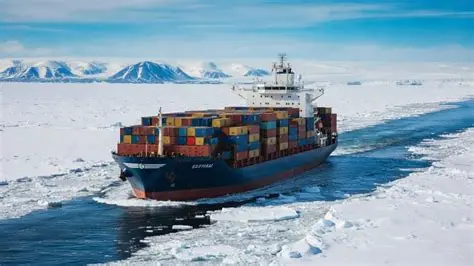
The South Korean container ship PanStar Acro returns to the port of Busan after completing its first test voyage along the Arctic route to Europe. Photo: EFE
October 13, 2026 Hour: 10:46 am
-
-
-
-
-
-
PDF
🔗 Comparte este artículo
South Korean President Lee Jae-myung reaffirmed his country’s commitment on Tuesday to developing a new trade route via the Arctic Ocean, following the first voyage to Europe completed by a South Korean container ship.
The leader stated that the initiative aims to diversify Asian maritime routes and strengthen Busan as an international logistics hub.
RELATED:
Putin and Tokayev Meet at SCO Summit to Boost Kazakhstan-Russia trade
During a ceremony in Busan to welcome the vessel PanStar Acro, Lee affirmed that South Korea would open the Arctic route with the confidence of the international community. “I will strive to ensure that the new route does not serve the exclusive interests of any single country, but rather leads to mutual prosperity,” the president declared, according to the Yonhap news agency.
The PanStar Acro, with a capacity of 2,758 TEUs (standard 20-foot containers), returned to Busan this Sunday after completing a 50-day voyage through the Arctic via Russian waters. The vessel made stops in the United Kingdom, the Netherlands, and Poland before returning to the South Korean port.
The voyage marked the first time a South Korean container ship completed a round trip to Europe via the Arctic route. The South Korean government believes the operation provided valuable experience in polar navigation and technical data to assess the corridor’s commercial viability.
2030 Plan
In May, South Korea’s Ministry of Oceans unveiled a plan using this trial run as a first step toward establishing a regular service along the Arctic route by 2030. The strategy seeks to revitalize Busan—the country’s second-largest city—and other southern localities, while also consolidating more efficient trade links between Asia and Europe. Lee linked the project to the development of a southern maritime hub region, integrating Busan’s ports and maritime finance, Ulsan’s shipbuilding and green energy sectors, and South Gyeongsang’s marine equipment industry.
The project has raised concerns because the route runs largely through Russian waters; some analysts warn this could allow Moscow to mitigate the impact of international sanctions imposed following the “Special Operation” in Ukraine. In response, Lee emphasized that Seoul would strictly adhere to international regulations and the sanctions principles established by the global community.
The initiative is also a response to the crisis in the Red Sea, which led numerous shipping companies to avoid the Suez Canal, drove up shipping costs, and forced the rerouting of voyages between Asia and Europe.
Although some companies have begun to gradually resume transit via that route—aided by improved security conditions—South Korea is positioning the Arctic route as a strategic alternative to potential disruptions on traditional shipping lanes.

Logistical and financial obstacles
Meanwhile, Eve Barré, a sector economist at Coface, noted that Arctic shipping routes are attracting attention because they shorten distances. However, commercial interest remains very limited for the foreseeable future and is concentrated primarily on raw materials.
Aurora García, of Ocean Infrastructures Management, identified further hurdles: incompatibility with existing logistics networks; the loss of intermediate port calls—a key revenue source for major shipping lines; high seasonality; and a lack of rescue capabilities. Navigation is permitted only during the warmer season, which conflicts with the annual contracts used by shipping companies.
Costs are also a factor: shipowners face higher insurance risk premiums and greater amounts of tied-up capital. Polar-class vessels are between 25% and 60% more expensive due to the extra steel thickness in the hull.
If the route were to become a viable alternative, certain European ports reliant on Suez traffic could be affected. In Spain, García noted that Algeciras would be the most exposed facility due to its high volume of transit traffic, whereas Valencia would face a lesser impact, as its import and export traffic would not be directly affected.
Author: HGV/JF
Source: TeleSur/EFE