
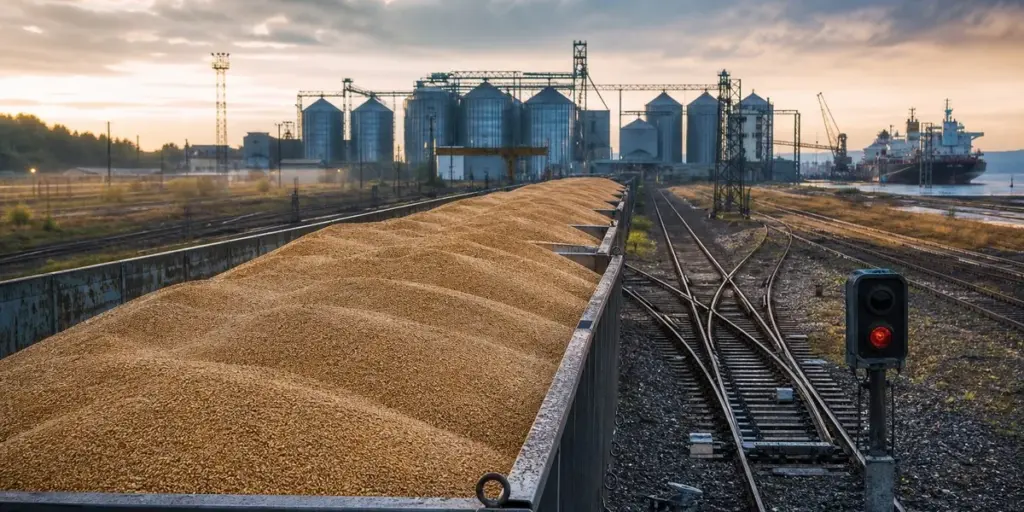
Latvian Prime Minister Andris Kulbergs said that the country currently cannot completely ban the transit of grain from the Russian Federation — an aggressor state — or introduce the planned 300% increase in the fee for using railway infrastructure for such cargoes. He said this after a government meeting, LSM English reports.
Risk of lawsuits
According to Kulbergs, the issues of tariffs and transit fall under the exclusive competence of the European Union. Latvia can act under certain conditions, but this involves risks. Government members were informed that a ban on the transit of such grain could result in immediate lawsuits worth between €200 million and €800 million.
The prime minister also said that Russian grain is still not under sanctions. According to him, it belongs not to Russia, but to companies from the United States, Switzerland and Japan, which also buy grain from farmers in the Baltic states.
Kulbergs noted that Lithuania is involved in a similar €12 billion court case. According to him, the country will likely have to pay €450 million this year as part of this dispute.
More current news is available on the UA.News Telegram channel Telegram.
Appeal to the European Union
Kulbergs said that he will travel to Brussels this week to discuss the issue. Last week, he, Estonian Prime Minister Kristen Michal and Lithuanian President Gitanas Nausėda sent a joint letter to European Council President António Costa and European Commission President Ursula von der Leyen. In it, they called for a ban on the transit of Russian grain through the EU.
According to Kulbergs, Estonia previously introduced national sanctions banning the transit of Russian and Belarusian grain, but at the time of that decision, no transit contracts had been concluded there. In Latvia, he said, such contracts have already been concluded for 300,000 tonnes.
On September 17, the Latvian Saeima urgently adopted amendments to the Railway Law, making it possible to accelerate, by the end of the year, the revision of infrastructure charges for grain transit whose departure station is listed as Russia in the documents. These provisions will remain in force until December 31, 2026. The government also authorized the Food and Veterinary Service to take samples of transit grain and verify the declared country of origin in laboratories.
Read us on


Download our app


