
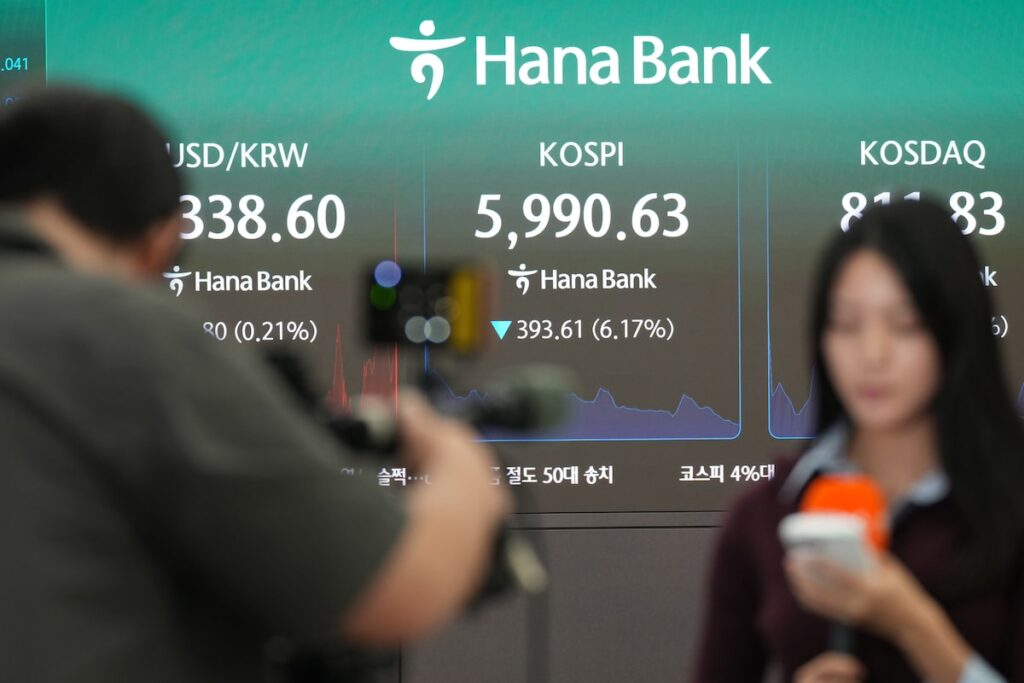
The Korea Composite Stock Price Index (KOSPI) dipped below 6,000 points during trading on Tuesday.Lee Jin-man/The Associated Press
South Korea is well known for K-Pop music and K-beauty brands, but its stock market is attracting attention, too.
The Korea Composite Stock Price Index (KOSPI) almost tripled over one year to a record high of 9,115 in June, fuelled largely by two memory-chip stocks, before plunging in the summer and again this week to around 6,000.
The KOSPI is still up about 43 per cent this year and, despite being the worst major market globally in the third quarter, the following three investment experts remain upbeat on it over the longer haul.
Matthew Strauss, portfolio manager, senior vice-president and co-head of equities at CI Global Asset Management in Toronto
“We’re still positive on the South Korean market over the medium and longer terms,” Mr. Strauss says.
The caveat is that two companies, SK Hynix Inc. (SKHY-Q) and Samsung Electronics Co. (SSNLF), make up two-thirds of this market, says Mr. Strauss, who has both as top holdings in his CI Emerging Markets Fund.
These firms, along with Boise, Idaho-based Micron Technology Inc. (MU-Q), are global leaders in high-bandwidth memory and a critical part of the supply chain that powers AI servers and data centres.
“We think demand will remain strong for memory makers,” he says, and these stocks should do well “not necessarily from month to month” but over the next 12 to 36 months.
KOSPI’s woes began in late May after South Korean regulators approved single-stock leveraged ETFs tied to the index’s two biggest stocks and many domestic retail investors piled in.
When a sell-off began in June, many ETF investors liquidated their investments because of margin calls, while many foreign investors also took profits because they “knew it was a bubble,” Mr. Strauss says.
More profit-taking occurred after regulators banned new leveraged ETF listings by late July and put trade restrictions on them, which included requiring a minimum cash deposit from investors.
It’s clear the market rally in the second quarter had become leverage-driven rather than based on fundamentals, Mr. Strauss says.
“We’re back now to what I would describe as a more rational market with normal liquidity and volatility.”
For now, he says he’s focused on the secular growth theme in high-end memory stocks that plays into the AI explosion for the next two to four years.
Mr. Strauss’s two other higher-conviction South Korean stocks are Doosan Corp., an industrial conglomerate, and Hanwha Engine Co. Ltd., maker of marine diesel engines.
He also has a small position in KB Financial Group Inc. and in Hyundai Motor Co. (HYMLF), which he considers to be oversold on concerns of rising competition from Chinese electric vehicle (EV) makers.
Tyler Mordy, chief executive and chief investment officer at Kelowna, B.C.-based Forstrong Global Asset Management Inc.
Mr. Mordy is cautious on the South Korean market in the near term but constructive over the medium and long terms.
“We don’t think the [South] Korean rally is necessarily over,” says Mr. Mordy, whose firm uses exchange-traded funds in its ETFs and mutual funds, and in strategies for institutional and private clients.
The fundamentals remain compelling, but after the spectacular surge and drawdown in the South Korean market, “we see better risk-reward in other markets,” he says.
“We prefer to see some of that speculative enthusiasm washed out a little bit more before we establish a bigger position there.”
Forstrong holds Franklin FTSE South Korea ETF (FLKR-A) in its global ex-North America equity strategy.
Forstrong Global Growth ETF (FGRW-T), Forstrong Global Balanced ETF (FGBL-T) and mutual funds get exposure to South Korea exposure from Vanguard FTSE Emerging Markets ETF (VWO-A).
The strongest bull case for the KOSPI is that the artificial intelligence cycle remains intact, he says. Goldman Sachs recently projected that AI infrastructure spending by hyperscalers (the large cloud service providers) could reach US$1.2-trillion in 2027.
South Korea has one of the highest-beta, pick-and-shovel plays on that spending, Mr. Mordy says. Its semiconductor exports surged 262.8 per cent to US$60.3-billion in September from a year earlier.
Ken Chen, portfolio manager for index strategies at Global X Investments Canada Inc. in Toronto
Mr. Chen is also bullish on the South Korean market over the medium and long terms as investors gradually see it as more than a memory-chip play.
“There’s a lot of hidden themes in the South Korean market that are just waiting for valuation spikes in certain industries,” he says, noting the country’s strength in EV battery, shipbuilding and defence sectors.
Although China dominates the EV battery industry, South Korea has the second-largest market share with companies such as LG Energy Solution Ltd., and Samsung SDI Co. Ltd., Mr. Chen says.
South Korean EV battery makers may also benefit from a friend-shoring strategy in which foreign firms seek supply-chain diversification from China, he adds.
South Korea is also the second-largest shipbuilder globally after China, Mr. Chen says. HanWha Ocean Co. Ltd. was a contender for Canada’s $12-billion contract to build 12 new submarines but lost out this year to Germany’s ThyssenKrupp Marine Systems.
South Korea’s defence industry can benefit from rising military budgets globally amid geopolitical tensions, he says, noting that Poland has a deal with Hyundai Rotem Co. for battle tanks.
Given longer-term opportunities in the South Korean market, Global X recently launched Global X Korea KOSPI 200 Index ETF (KORX-T), which tracks the country’s major companies.
Still, investing in the KOSPI 200 is not a low-risk investment because South Korea is still an emerging stock market with higher volatility – both on the upside and the downside, Mr. Chen says.
The risks stem from the KOSPI’s high concentration in AI-related memory plays, while EVs face strong competition from China and there’s no guarantee defence budgets will keep rising, he says.
South Korea’s market can offer investors international diversification, but given the potential volatility, he says, investors “need to make sure it’s a risk they can tolerate.”