

Jazz & Wine, the 14th edition of which took place in the small southern Austrian town of Leibnitz is a good festival which can tick a lot of the right boxes: it has great location, in this case in the heart of a major wine-growing area, excellent venues and imaginative programming, by experienced club owner Otmar Klammer. It’s a tribute to the trust in his choices that all the concerts were sold out despite no real superstars.
There were three nights with evening concerts. The first, in the elegant wine cellars of the castle of Seggau, had a fascinating double bill. First the trio Haezz (pronounced “Hess”), which incidentally means “clothing” in the dialect of Vorarlberg, in western Austria, and from where two of its members – bassist Tobias Vedovelli and Martin Eberle – come. The third member is Czech saxophonist Stepan Flagar. This was the third time that I have heard them and they never cease to bring pleasure. They made great use of counterpoint-style interaction, as it lacked both percussion and a true rhythm section. It allows us to appreciate all the musicians as none of them gets submerged. The momentum engaged us completely.
 The three double basses of Triple Double
Next was the trio of New York downtown trumpeter Kirk Knuffke with special guest Charlie Burnham on violin, A whole range of inspirations, such as from walking around Brooklyn, the poetry of Carl Sandburg and even Appalachian folk. It had the classic feel of that scene where it’s often hard to tell where tunes end and freer improvisation starts.
The second and third evenings both had triple bills. They mostly took place in the medium-sized Hugo Wolf Saal in the culture centre. First was Swiss drummer Florian Arbenz’s Sonic Organism with Greg Osby. All the musicians had extended solos, one in particular by François Moutin being especially memorable, while Greg Osby let loose with virtuoso phrases that cut through. A sonic contrast was provided by accordionist João Barradas, but the main overall vibe was one of gleeful positivity.
Andromeda Mega Express Orchestra from Berlin is like a classical chamber ensemble. An intriguing lineup with a front line of saxophone and three flutes, two guitars and electronics as well as bass and drums gave an intensely mellow texture. The energy and soloing of vibraphonist Evi Philippou were poignant. There was a subtle Brazilian, almost Jobim, feel and, indeed, the band played a couple of Hermeto Pascoal tunes. A momentum from minimalism reminded me of groups such as Penguin Cafe Orchestra.
A particular highlight was the late night gig which followed, in the nearby former cinema, of Monk’s Casino, the long-standing project led by Alexander von Schlippenbach. 88 years old and slightly frail in walking on the stage, but once he sat down at the piano he played nonstop. With perhaps 15 Monk tunes over the hour’s performance, he was undoubtedly inspired, and was inspired by, the effervescence of the rest of the band, including Rudi Mahall on bass clarinet and Axel Dörner on slide trumpet. Serious fun!
An intriguing lineup on the third evening was the premiere of Triple Double, a trio of three double basses, led by Anders Jormin alongside Thomas Markusson and Morten Toftgaard Ramsbøl. The three revelled in the rare chance to play together. A diverse mixture including an engaging performance of John Taylor’s “Ambleside”.
Taiko Saito led the fascinating Koko Trio. She played marimba and vibraphone. Niko Meinhold was pianist, and Moritz Baumgärtner was drummer. The music had an ethereal element due to the marimba and vibes, but also had a percussive side given the nature of the instruments.
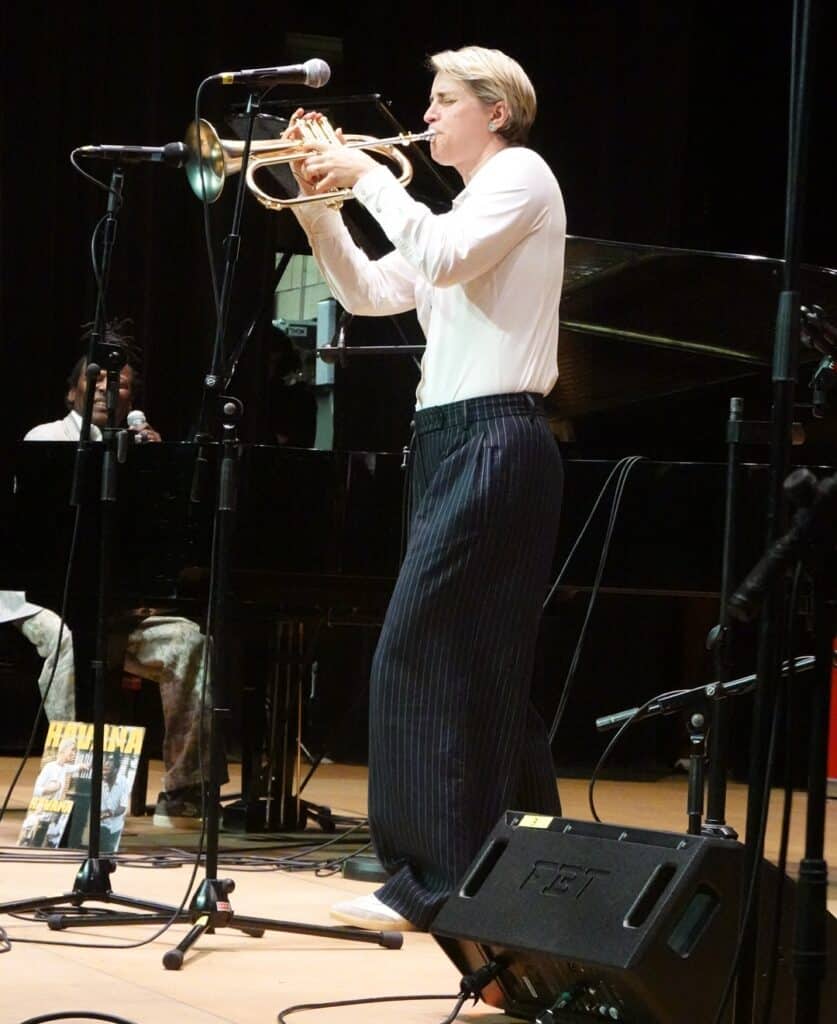 Maite Hontelé with Ramón Valle
The final gig of the night was the trio of pianist Ramón Valle, a gorgeously Cuban way to end the night, with special guest Maite Hontelé on flugelhorn. Both Valle and Hontelé have a great empathy and can balance upbeat energy and technique to get us dancing and even singing.
Generally the gigs took place inside, But a couple took place in the open air. It was good to hear young trumpeter Lorenz Widauer featured with guitarist Philipp Schiepek, as I had heard him several times with Yvonne Moriel and on the recording with young oud player Avin Ahmadi. He has a clear sound which cuts through and a facility improvising, in this case mainly on standards.
The weekend ended at a brunch at the beautiful castle Schloss Ottersbach with the latest repertoire of accordionist Vincent Peirani’s Living Being band as focus. Peirani has an incredibly diverse range of musical enthusiasms, and seems to be able to mix African, psychedelic pop and more without it seeming disjointed. They started with a tribute to Lionel Loueke and ended with a smart medley of English pop from different decades, fusing Queen, Bowie and The Beatles. He is helped by a totally responsive band, especially his regular sparring partner, Emile Parisien, who, on showings like this, is arguably one of the leading soprano saxophonists in Europe today.
Stepan Flagar/Georg Vogel, Porgy & Bess, Vienna 28 September
The following day, at Vienna’s Porgy & Bess club, I had the chance to hear Haezz’s saxophonist, Stepan Flagar, again, in an intimate setting of a duo with pianist Georg Vogel. Vogel has a near classical facility with perhaps hidden influence of Morton Feldman and beyond. Flagar responded accordingly. Some parts felt through-composed, other parts quite free. An interesting combination of originals, covers by the likes of Andrew Hill and iconic Austrian composer Christoph Cech, with an album ready soon.