
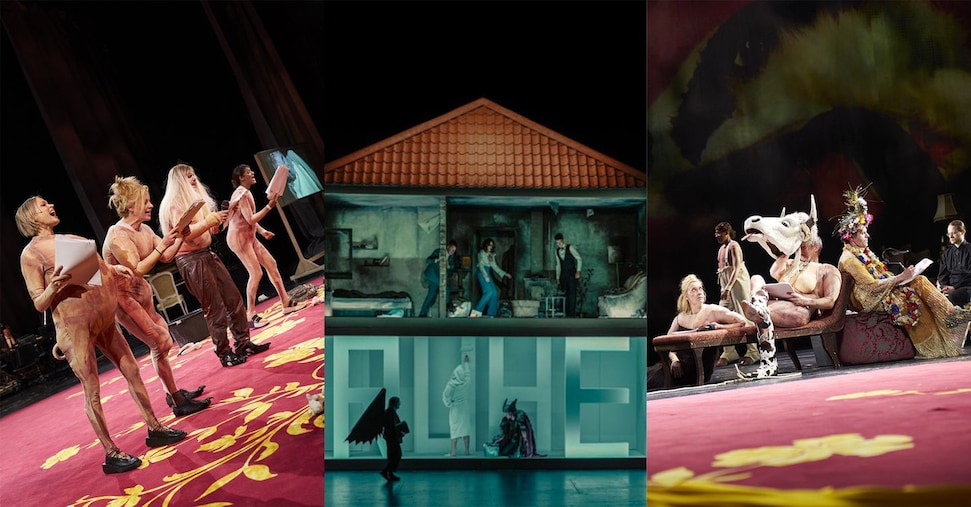

In Nicolas Stemann’s stage adaptation, the brilliant *Fra animali* – which, from a distance, seems to echo George Orwell’s *Animal Farm* – has been transformed on stage into a boisterous kaleidoscope.
The acquisition of part of his archive
In addition to the two performances, in Vienna – Jelinek’s adopted city – an agreement has recently been reached whereby part of the author’s literary archive, comprising manuscripts, typescripts, correspondence, documents and a press clippings collection she herself had compiled over the years. This acquisition is certainly smaller than the €2.1 million deal struck by the Austrian state in 2022 to transfer Thomas Bernhard’s archive to the National Library, but in Jelinek’s case it certainly does not represent her entire archive, and the current agreement, which includes a commitment to subject the materials to in-depth study and make them accessible to the public, offers hope that the collection will be completed in the future.
Its location at the Wienbibliothek im Rathaus means that it is, moreover, housed alongside many other archives and collections of correspondence belonging to distinguished figures from Vienna’s cultural, artistic and political spheres, including Franz Grillparzer, Karl Kraus and Arthur Schnitzler, as well as Schubert and the Strauss family.
Other celebrations
The programme of events to mark her 80th birthday, organised by the Elfriede Jelinek Research Centre, the Viennese university centre dedicated to research on the author, ranges, amongst other things, from a series of lectures and talks by the director, Pia Janke, at Austrian cultural institutes in Paris, Warsaw, New York, São Paulo and Tokyo, to a screening series at the Metro KinoKulturhaus in the Austrian capital, featuring films adapted from her works.
In Italia this autumn, the University of Udine is organising (on 18 November) a tribute to Jelinek and, in particular, to her work as a playwright, featuring a discussion with the scholar Ute Degner, coordinated by Elena Polledri.