
Lebanese security forces recently seized hundreds of kilograms of explosives from a vehicle at a checkpoint on the highway linking Beirut and the Bekaa Valley. Hezbollah admitted the shipment belonged to the organization and demanded its return.
“The vehicle and its cargo belong to the resistance,” Hezbollah lawmaker Hassan Fadlallah said, also demanding the release of those arrested. The Iran-backed organization said the material was intended for attacks against Israeli forces in Lebanon.
The Lebanese government should reject that demand. Its security forces have taken a concrete step toward enforcing state authority. Returning the explosives would undermine their work and confirm Hezbollah’s assumption that it can overrule them.
Lebanon has repeatedly said that weapons should be held by the state alone. In March, the government specifically banned Hezbollah’s military activities. Lebanese President Joseph Aoun has reiterated the state’s commitment to seizing illegal weapons and combating smuggling. The issue now is whether Beirut will enforce those decisions when Hezbollah openly challenges them.
US Secretary of State Marco Rubio, who pressed Aoun to retain the explosives, was right. According to a US State Department official’s account of their call, Rubio said returning them should be “out of the question” and urged accountability for those who ordered, financed, and directed the shipment.
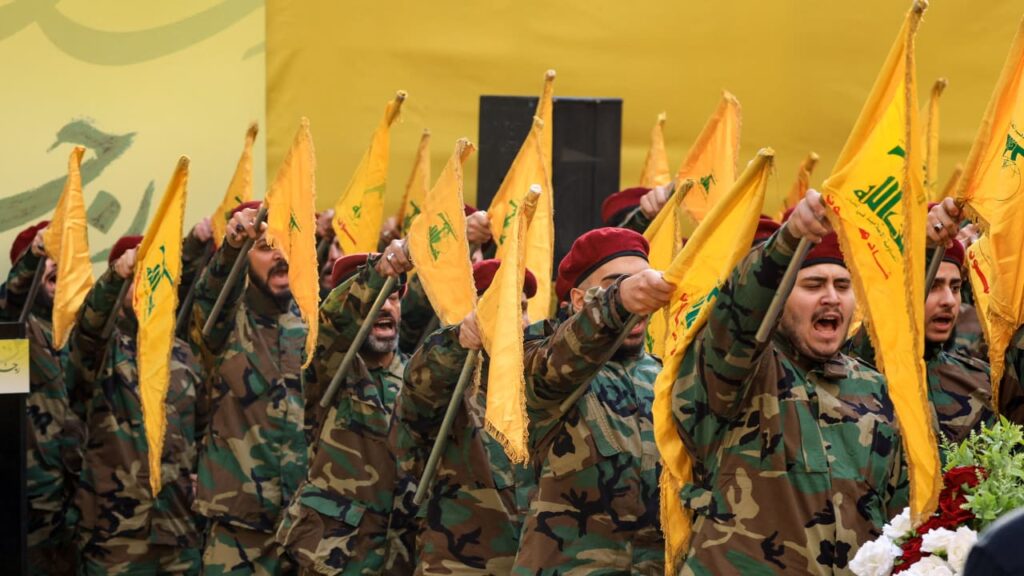
 People hold Hezbollah flags while commemorating Israel’s withdrawal from southern Lebanon in 2000, in the southern suburbs of Beirut, Lebanon, May 25, 2026. (credit: REUTERS/Raghed Waked)
No sovereign government should accept an armed group moving hundreds of kilograms of explosives around the country without state authorization.
Lebanese military delegation to participate in US-hosted trilateral talks
A Lebanese military delegation is expected to participate on Tuesday in US-hosted trilateral talks in Tampa, Florida. Beirut plans to press for an end to Israeli attacks in Lebanon. Under the US-brokered framework, Hezbollah’s disarmament is linked to a gradual Israeli withdrawal. Hezbollah continues to refuse to disarm while Israeli forces remain on Lebanese territory.
Lebanon’s demand deserves to be taken seriously. Israel should seek a security arrangement that will allow its troops to withdraw. An indefinite military presence carries costs, while repeated strikes cannot provide a permanent solution.
Any withdrawal must also prevent a return to the conditions that existed before the war. For years, agreements intended to keep Hezbollah’s forces away from Israel’s border went unenforced. Hezbollah accumulated missiles, built military infrastructure, and maintained an armed organization stronger than the Lebanese state itself.
Israel cannot responsibly ask residents of the North to return to that reality.
Full disarmament will take time. Lebanon can begin with the weapons already in its possession: retain the explosives, preserve the evidence needed for the investigation, and arrange their safe destruction.
Authorities should investigate the shipment, prosecute anyone proven to have violated Lebanese law, and apply the same policy to future seizures regardless of who claims ownership.
Such action would strengthen Lebanon’s position at the negotiating table. If Beirut wants Israel to cease its strikes and withdraw its forces, it needs to demonstrate that Lebanese territory will remain secure against renewed preparations for attacks on Israel.
Supporting Lebanon to assert sovereignty over its borders
Israel also has a responsibility to support progress. Jerusalem says it wants the Lebanese government and Lebanese Armed Forces to replace Hezbollah as the effective authority in the south.
Sustained, independently verified progress toward disarmament, preventing smuggling, and extending state control should be matched by phased Israeli steps under the agreed framework, consistent with the security of northern communities.
A single seizure cannot establish that those conditions have been met. It can, however, help demonstrate whether Lebanese authorities intend to enforce their decisions consistently.
Verification should include access to suspected weapons sites, clear reporting on confiscations, and evidence that dismantled outposts remain closed. Lebanon’s partners should help its army carry out those tasks and insist that political pressure never determines which shipments pass through a checkpoint.
The European Union’s newly approved mission to train and advise Lebanon’s military and internal security forces offers further support. Its deployment remains pending. Foreign assistance will have limited effect unless Beirut is prepared to uphold its authority against Hezbollah’s demands.
Who decides which armed forces operate on Lebanese soil? If the answer is the Lebanese state, then Beirut already knows what to do with Hezbollah’s explosives.