
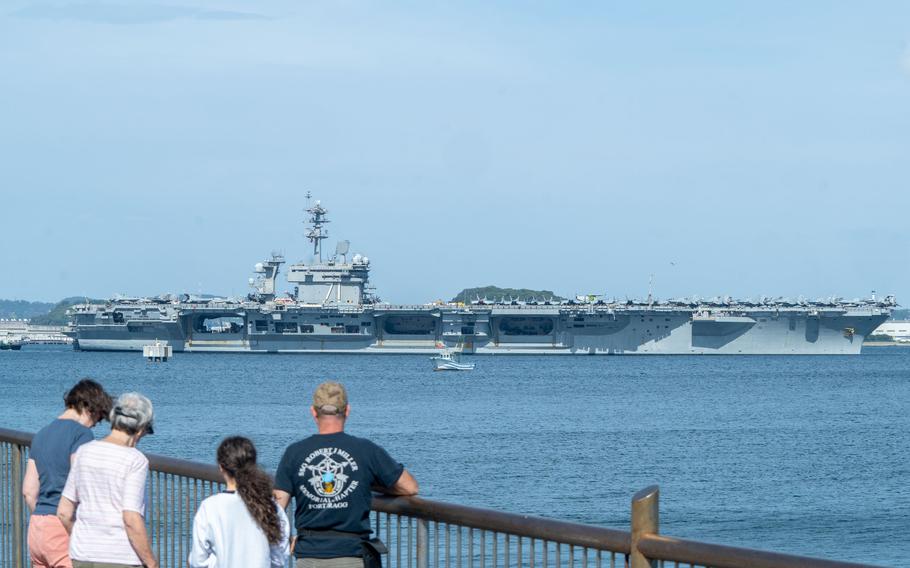
People gather to watch the aircraft carrier USS Theodore Roosevelt leave Yokosuka Naval Base, Japan, Oct. 19, 2026. (Jonathan Baez/Stars and Stripes)
YOKOSUKA NAVAL BASE, Japan – The aircraft carrier USS Theodore Roosevelt ended a brief stay at the home of 7th Fleet and steamed out of Tokyo Bay on Monday to join Keen Sword, a large-scale exercise in and around Japan.
Keen Sword, a biennial exercise, this year includes about 56,000 U.S. and Japanese troops along with forces from seven partner nations.
The exercise began Monday and runs through Oct. 29 as a test of the participants’ ability to defend Japan. It entails drills in air and missile defense and maritime operations, according to a Monday news release from the exercise’s Combined Joint Information Bureau. The exercise also tests troop resupply, casualty evacuation and facilities repair.
The Roosevelt arrived at Yokosuka on Friday alongside the guided-missile cruiser USS Chosin and guided-missile destroyer USS Decatur for a port call that included maintenance and resupply ahead of the exercise.
Carrier Strike Group 9 also planned exchanges with Japanese naval counterparts ahead of Keen Sword, 7th Fleet said in a Friday news release.
Keen Sword primarily takes place in western and southern Japan, including the island chain that includes Okinawa and stretches from Kyushu to just east of Taiwan; the Sea of Japan, or East Sea; and the East China Sea, according to the Monday release.
Japan is contributing about 45,000 personnel, 6,100 vehicles, 40 vessels and 260 aircraft, according to a Sept. 29 news release from the Japan Joint Staff.
The United States is expected to field approximately 11,000 troops and the Roosevelt’s strike group, which also includes the guided-missile destroyers USS Paul Hamilton and USS Carl M. Levin, according to Maj. Ephesian Poinsette, spokesman for Keen Sword.
“This is about training how our forces work together,” he told Stars and Stripes by phone Sunday. “That means sharing information, coordinating decisions, communicating across services and different platforms, and then sustaining those operations.”
While the exercise is meant to rehearse the defense of Japan, it is “not directed at a particular country or a response to a single regional event,” Poinsette said.
“This routine, defensive training exercise builds readiness that makes deterrence credible and preserves peace across the region,” he said.
Australia, Canada, France, Germany, the Netherlands, New Zealand and the Philippines will join the exercise, nearly double the participants from 2024, according to the release.
South Korea and the United Kingdom are sending observers, Poinsette said.
This year’s iteration will mark the U.S. Marine Corps’ first deployment of two of its newest missile systems – NMESIS, the Navy-Marine Expeditionary Ship Interdiction System, and MADIS, the Marine Air Defense Integrated System – to Japan’s westernmost island, Yonaguni.
About 60 troops from the 12th Marine Littoral Regiment and the U.S. Army will deploy to Yonaguni alongside the missile systems, according to a Japanese Defense Ministry planning document posted Oct. 2 on the Okinawa Defense Bureau’s website.
Japan will also mark a first by deploying its Type-25 surface-to-ship missile, which has previously been kept at its permanent base of Camp Kengun on Kyushu, the southernmost of Japan’s four main islands, a Joint Staff spokesman previously told Stars and Stripes. It will take part in anti-ship training but will not be fired during the exercise.
Some Japanese government officials must speak to the media on condition of anonymity.