
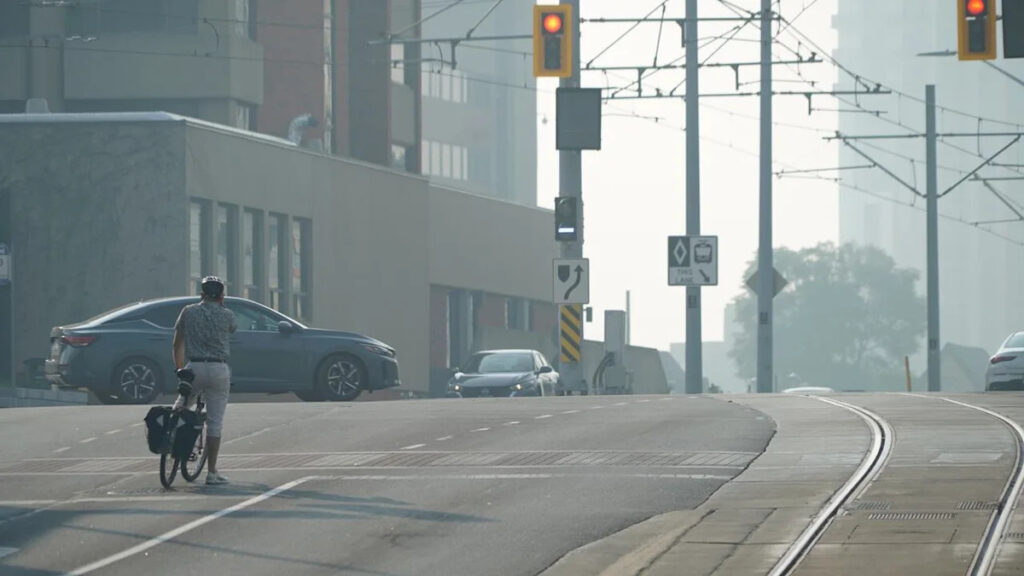
Kitchener’s Joseph Brannan says he’s seen the impacts climate change can have on his neighbours during hot summer days or extreme weather.
“Suffering through the heat in the summer and seeing that when we have big rain storms, people will often be caught off guard by the impact a storm can have and we’ll be seeing more of that going forward,” Brannan told CBC News.
“Our communities have to be prepared for those changes and be prepared to change as much as we can to mitigate those effects.”
It’s why he says climate and the environment will be top of mind when he makes his decision next week at the polls. Brannan tries to do his part by biking year-round and being a one-car family, but for him the issue of climate is not an isolated one.
“Housing affordability, the livability of our cities, how we get around, what industries do our jobs support are all tied into our climate and environment, and I think the framework for how our cities work to move forward on that issue is so foundationally important,” he said.
About a third of the 654 people across Waterloo region, Guelph and Wellington County who filled out CBC Kitchener-Waterloo’s survey said climate and the environment are front of mind this election.
The survey asked participants to rank their top three election issues and what they would do if elected mayor. The survey is not scientific and will help guide CBC Kitchener-Waterloo’s coverage during the municipal election.
More options to leave the car behind
In Cambridge, Simon Roethlisberger is seeing his community grow and often thinks about the impact that rapid development will have on local traffic and the environment.
Roethlisberger lives in downtown Hespeler where more housing developments are going up.
“I don’t know how many hundreds of people will be living in that new development, but all of them will probably go into a car in the morning and drive to work through an already quite congested small downtown area,” he said.
“That of course has impact on the environment again as a result.”
Roethlisberger said he’s in favour of the LRT coming to Cambridge because it will give people more options to leave their car behind. He also feels discussions around climate have fallen by the wayside and hopes the new term of council bring the issue forward.
“I generally feel that we’re putting a lot of effort on building housing and developing housing and the environment just comes as an afterthought,” he said.
Water is also top of mind for some voters
Water has also been an issue for some voters as the Region of Waterloo continues to work on addressing an issue around water capacity that ultimately put the approval of new development on hold in parts of the region for several months.
The region announced it now has more water flowing into the system to build housing for 7,000 residents and, by the end of the year, the region will have enough water to support homes for 28,000 people, which is 80 per cent of the region’s projected growth in the next five years.
Alex Latta, who lives in Kitchener, said the water capacity issue that was identified 10 months ago is a signal that municipalities need to think about growth more intentionally.
“If we’re for building more roads and more parking lots and more housing on top of really important recharge areas of the moraine, then we are only going to deepen our water crisis,” he said.
“We were trying to be intentional and now being intentional is more difficult because of the province taking away those regional planning authority.”

In January 2025, the region lost it’s planning and official plan approval roles under the province’s Bill 23 and Bill 185. It means the region is “no longer the approval authority for subdivisions and condominiums,” and each municipality now has to make those decisions through their official plans.
Kyra Chisholm with Climate Action Waterloo Region said municipalities have a big part to play in addressing climate as the first level of government to make decisions around services and infrastructure people use daily.
“Those for example are transportation for supporting a local clean economy and green jobs, for affordability, for zoning and land use planning, public health and infrastructure, so improving the resilience of roads, buildings, grids, water systems, all of those things,” she told CBC News.
“And those are so close to us at home, but also a lot of areas where we can make bigger [climate] reductions happen.”
How candidates plan to address climate change
CBC Kitchener-Waterloo reached out to all mayoral and regional candidates running in the Region of Waterloo and Guelph about how they would tackle the issue of climate change.
Of the 60 candidates, half replied to CBC News by deadline.
The majority of candidates talked about being more “climate resilient” by improving existing infrastructure and building more resilient homes and structures.
Other’s talked about the importance of protecting and growing local tree canopies, as well as protecting groundwater and local farm land.
Kitchener mayoral candidate Wazhma Frogh said that’s why she would like to prioritize development in areas where infrastructure already exists and ensure new projects undergo a climate review.
“It shouldn’t be just the issue of the contractor, city hall and the planning department. It has to include everybody in the community,” Frogh told CBC News.
“The climate review of a building should be done by the community themselves. What about the insulation, the heating, parking? Can we [implement], for example, solar panels?”
In Wellesley Township, mayoral candidate Chris Martin said he is in favour of exploring the idea of wind turbines — an idea that was proposed by Renewable Energy Systems during township council in June.
“I think we need to look at all energy alternatives and what we can do in our township, even in a small way, is helpful,” he said.
Martin said aside from the climate perspective, wind turbines could also be a source of revenue for the township and local land owners.