

Featuring: Iván Espinoza-Madrigal, Priya Lane, Charlie Baker, Mike Minogue, Shawn Oliver, Bob Rivers, John Fish, Reshma Kewalramani, Jeff Tengel, Greg Maynard, Jim Stergios, Shannon O’Brien, Greg Reibman, and more.
 Voters and business leaders are giving the race between businessman Mike Minogue and Governor Maura Healey a shrug.Ryan Huddle/Globe staff; photos by Danielle Parhizkaran/Globe Staff; Adobe stock
One would think a Republican fiscal conservative who’s been a rock-star life sciences CEO would have the business community buzzing about his gubernatorial prospects.
Yet it’s been crickets in the circles Jon and I run in.
There was early chatter about whether Maura Healey could be in trouble with voters feeling beleaguered by the high cost of living. Add to that, Mike Minogue’s millions: So far he’s poured $17.3 million into his own campaign, according to state campaign filings.
But since the primary, we’ve found fewer and fewer people even talking about the governor’s race. People seem more focused on the national midterms and a handful of ballot questions – like Question 7, the measure that would require most communities to allow single-family homes on lots as small as a basketball court.
Unseating an incumbent is hard, and a Globe/Suffolk poll released on Tuesday showed Healey with a 23-point advantage over Minogue, similar to a UMass Amherst/WCVB-TV survey out the day before. And while these are uncertain times for the Massachusetts economy, the governor’s race after two debates feels like an afterthought in the private sector. Perhaps even more so now, with the Republican slate in free fall after Minogue’s running mate, Shawn Oliver, agreed to leave the race after crashing his car over the weekend and pleading not guilty to drunken driving.
Why isn’t Healey getting blamed for anemic job growth and young people leaving the state? Call her the Teflon governor. Not once, as one business leader told me, has anyone sized up the state’s economic woes and declared: We need a CEO as governor!
But here’s another reason why Minogue hasn’t gained much traction. He’s been trying to appeal to Charlie Baker supporters, but that lane now belongs to Healey.
That’s not by happenstance. The moderate Democrat has worked at cultivating business relationships, keeping on speed dial CEOs like Eastern Bank’s Bob Rivers, State Street’s Ron O’Hanley, Vertex Pharmaceuticals’s Reshma Kewalramani, and Suffolk Construction’s John Fish.
Healey has been seen as business-friendly since her time as attorney general. And if there were any concerns she would tack too far left as governor, Healey put them to rest in her January 2023 inaugural address: “Let me speak directly to the business community. You help drive our economy and you will help build our future. In me, you will have a partner every step of the way.”
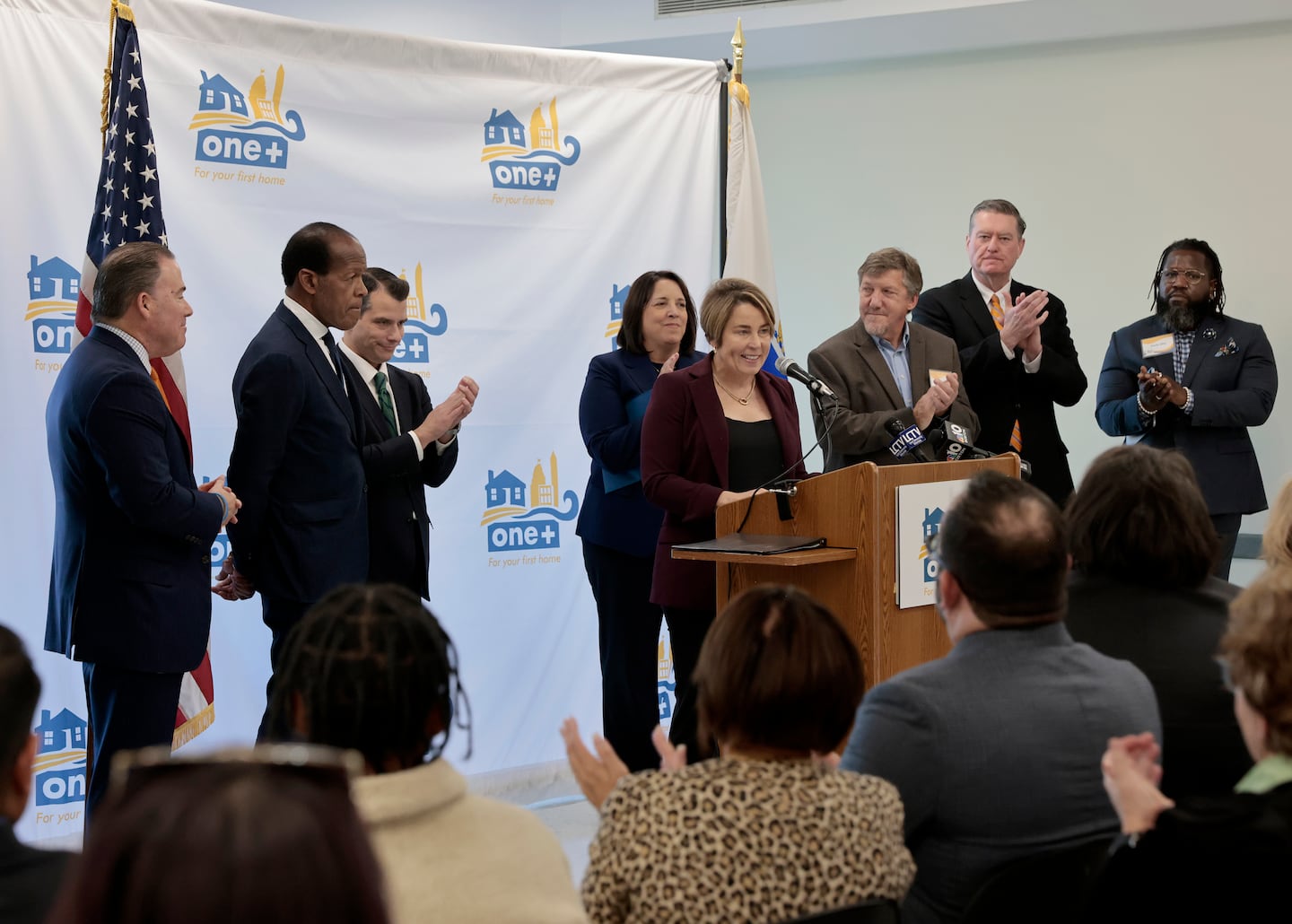 Governor Maura Healey, seen here with Eastern Bank CEO Bob Rivers and other community and business leaders, has courted the business community throughout her first term.Pat Greenhouse/Globe Staff
All of which must be frustrating for Minogue and his supporters. On paper, he’s got the bona fides to be a viable gubernatorial candidate: a West Point graduate, a Desert Storm veteran, and a successful CEO.
In the first debate, Minogue talked about creating more jobs as CEO of Abiomed than Healey did as governor. That’s not as wild a claim as one might think given how few jobs were created since Healey took office — just 3,500 net new jobs, or an increase of 0.1 percent, while US employment grew 2.8 percent during the same period.
Minogue was at the helm of Abiomed for 19 years, turning the Danvers company into a medical device juggernaut, benefiting from both state and federal grants. He made a crucial pivot from artificial hearts to heart pumps, doubled the size of its headquarters, and added hundreds of engineering and manufacturing jobs.
Abiomed employed about 2,200 globally when Johnson & Johnson bought it for $16.6 billion in December 2022. Minogue departed shortly after, netting an exit package likely exceeding more than $240 million, according to federal securities filings.
“I am grateful to God for providing me a purpose in my career to serve my patients, employees, customers and stakeholders,” Minogue wrote in a LinkedIn post when he retired from Abiomed. “I believe in the saying: ‘work like everything depends on you and pray like everything depends on God.’ ”
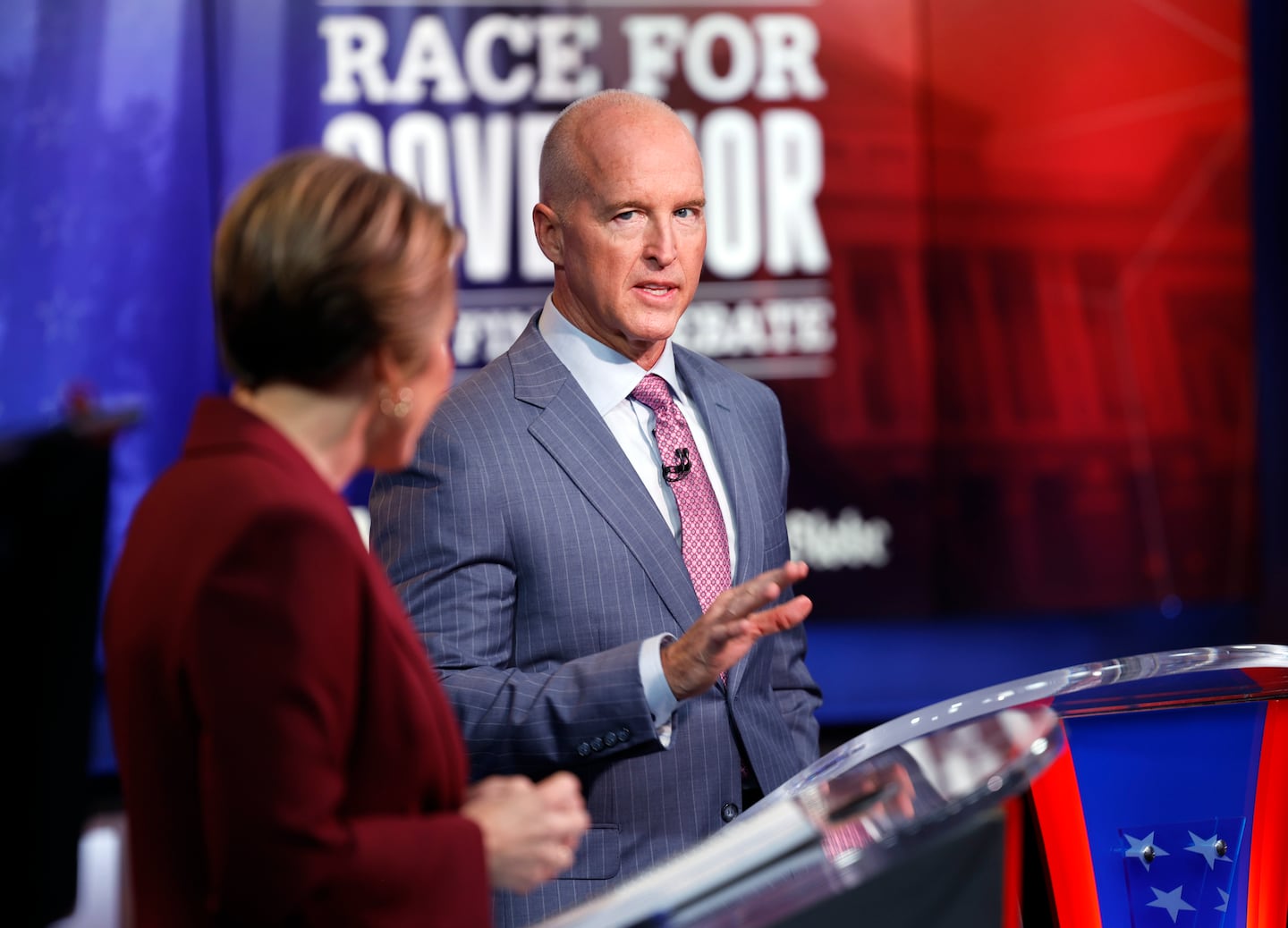 Gov. Maura Healey, left, and Republican challenger Mike Minogue faced off at the final gubernatorial debate.Danielle Parhizkaran/Globe Staff
But now positions that were perfectly acceptable in the business world – supporting Trump and being pro-life – have become cudgels for Healey to bash the former CEO.
Healey, however, shouldn’t mistake the business community’s continued support as a sign they’re fully satisfied. Business leaders remain deeply worried about the state’s ability to remain economically competitive, and their to-do list seems ever-growing: fix the state’s unwieldy unemployment insurance system, eliminate the estate tax, lower energy costs, and supercharge housing construction.
As for Minogue, he’s a first-time candidate viewed as credible. Just the wrong time and wrong state.
Which political contests will you be following most closely on election night? Take our poll.
 BizGrow Central, a new small business hub for entrepreneurs of color, opened in Boston.Meleck Eldahshoury for The Boston Globe
The Lawyers for Civil Rights opened its free coworking space, BizGrow Central, in Downtown Crossing on Monday, and the place teemed with women and entrepreneurs of color seeking a professional home. The second floor space on Tremont Street – with views of the Embrace monument and the State House dome – accommodates up to 40 entrepreneurs a day at no charge, says BizGrow director Priya Lane, though 200 people are already on a waiting list. LCR has long provided free legal advice to small businesses. The idea for a physical space came from a local baker who, with LCR’s help, was signing her first major contract yet had nowhere to meet her buyer. “We realized that access to justice must also mean access to space, resources, connections, and community,” said executive director Iván Espinoza-Madrigal. The nonprofit advocacy group is fundraising to cover the $1 million expense of setting up the space.
Greg Maynard has become one of Mayor Michelle Wu’s most vocal critics, with his volleys on property tax and school issues — and now he’s getting a little more firepower. He merged his one-man-band Boston Policy Institute with the much larger Pioneer Institute, led by Jim Stergios. Maynard joined the libertarian-leaning Pioneer as a senior fellow and says he’ll continue BPI’s work as the “Pioneer City Initiative.” Maynard and Joe Caiazzo launched BPI in 2023 to take a closer look at municipal governance, particularly in Boston. They raised around $1 million over that time, supporting Maynard’s salary and outside consultants. But they never disclosed their donors — they didn’t have to as a 501(c)(4) — prompting some questions about their motivations. BPI has ended but the headaches for Wu probably won’t: Maynard says he has already filed public records requests to look into financial questions at Boston Public Schools raised by state Inspector General Jeff Shapiro.
 Rockland Trust is relocating its headquarters to this office at One Technology Place in Rockland.Photo courtesy of Rockland Trust
Finally, everyone will be under one roof. That must be what Rockland Trust chief executive Jeff Tengel is thinking as he prepares to start moving into a new headquarters next month. Tengel first told his staff in the spring of 2025 that the bank — which has grown quickly in recent years thanks to a series of acquisitions — would be consolidating five south-of-Boston offices into one, at EMD Serono’s former campus off Route 3 in Rockland. (The biotech company decamped for the Seaport.) Last week, Tengel mentioned on an earnings call that the new office is finally ready. In an email, the CEO says he’ll move 400 employees into the 140,000-square-foot complex in waves, starting in mid-November and wrapping up by January. His current office building, which he just put up for sale, is actually in Hanover. So now he’ll have a headquarters that matches the bank’s name again.
Memo to House Speaker Ron Mariano: Get on board with local control of liquor licenses. Both Governor Maura Healey and Senate President Karen Spilka support the idea, and so do more than 90 percent of Power Play readers we polled in our newsletter and on LinkedIn. Last week, we wrote about a report from auditor Diana DiZoglio highlighting how the state’s antiquated liquor laws have created widespread inequities, leaving most cities and towns in a perpetual mismatch of supply and demand. Here’s what Shannon O’Brien, former state treasurer and former Cannabis Control Commission chair, had to say about giving all cities and towns the power to issue liquor licenses: “Unlike cannabis, there is a robust historic infrastructure at the local level, and I believe the additional layer of regulation at the state level does not allow for enough flexibility for equity in accessing licenses across the state.” Added Greg Reibman, president of the Charles River Regional Chamber: “It’s patently unfair that Cambridge can have unlimited licenses but when its next-door neighbor Watertown wanted to exceed its state-imposed cap, it needed Beacon Hill’s permission. That process took a year and a lot of political capital.”
THANKS FOR READING POWER PLAY.
This newsletter was written by Shirley Leung and Jon Chesto, edited by Aaron Pressman, and produced by Asia Alexander.
Have a question for the team? Email us at powerplay@globe.com.
Delivered Tuesday and Thursday.
Shirley Leung is a Business columnist. She can be reached at shirley.leung@globe.com. Jon Chesto can be reached at jon.chesto@globe.com. Follow him @jonchesto.