
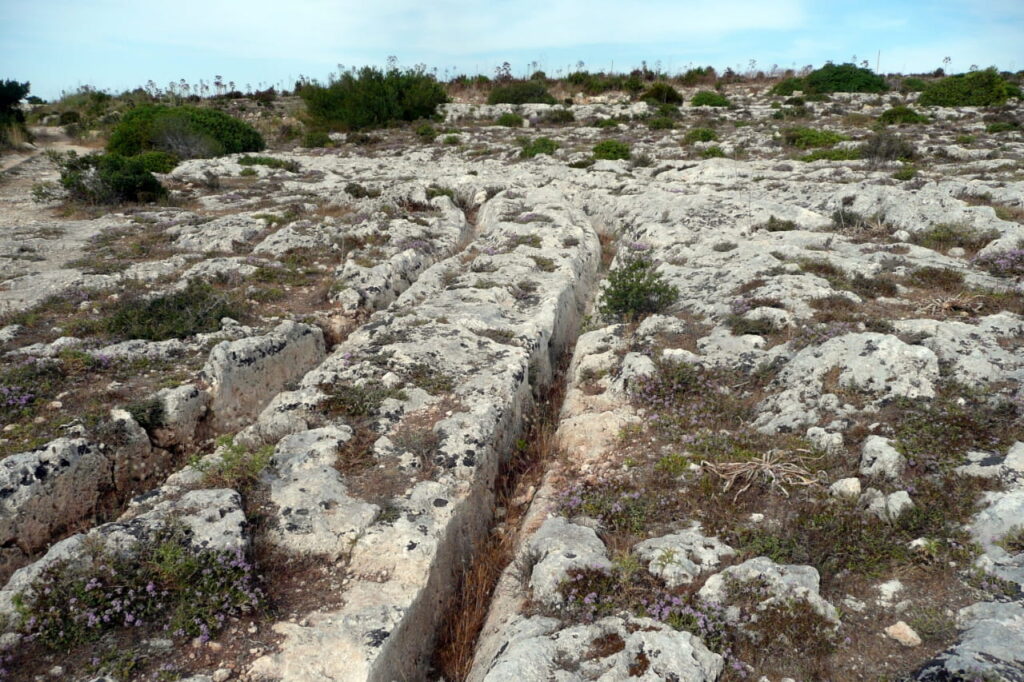
Malta is covered with pairs of deep grooves cut into its limestone, and people have argued about their age for hundreds of years. A new study by Joel Grima of the University of Malta, published in the Journal of Archaeological Science: Reports, weighs all the evidence and finds most of these cart ruts come from the Classical era, between about 750 BCE and 870 CE.
 Cart Ruts in Misrah Ghar il-Kbir, Malta. Credit: Lysy, CC BY-SA 3.0
Grima ran the biggest survey of the ruts so far, counting 2,628 separate tracks on Malta and Gozo, adding up to roughly 31 miles. He built 3D models of 155 sites from drone and camera photos and pulled in data on 88 more from digs, satellite images, and plans. Of all the tracks he counted, only 48 are modern, and those are narrower and follow country lanes lined with stone walls.
Dating the ruts is tough because they’re worn into bare rock, so no layer inside a groove holds a date. A building or tomb sitting on top gives a latest possible age for a rut, while a dated surface underneath gives an earliest age, and few sites offer either one.
The sites with clear evidence all point the same way. In Mdina, a pair of ruts runs down a street between Roman houses, with at least seven Roman road surfaces stacked above the bare rock. In Marsa, a drawing from 1794 showed ruts worn into the doorway slabs of a Roman warehouse that has since been torn down. At Ta’ Laroka, one track wears into the floor of an early quarry and a later quarry cuts straight through it, and researchers agree the quarries are Classical.
 dataset of ancient burials from across Malta was also compiled from 1. A dense cluster of overlapping cart ruts at Misraħ Għar il-Kbir. This stretch of ruts measures just 80 by 100 metres across. Credit: J. Grima, Journal of Archaeological Science, Reports (2026). CC BY-NC-ND 4.0
Quarries and tombs repeat the same pattern across the island. Quarries cut through ruts in 112 places, and ruts wear into quarry floors in 17 more. Punic or Roman tombs slice through ruts in at least seven spots, which earlier writers took as proof of a much older date. Grima reads the evidence differently, since abandoned tracks sat beside busy ones and Romans buried their dead along roads. Of 1,690 mapped burials, 34 percent lie within 164 feet of a known track, far more than random placement would give.
Recent digs add more to the picture. Outside the walls of ancient Melite, workers found a Roman cobbled road with ruts worn into the rock beneath and into the cobbles themselves. At Ta’ Qali, ruts under a Classical road had been filled with gravel, likely to resurface the road. At tal-Qares, tracks form a junction between an olive oil press and the living quarters of a Roman farm.
Grima also answers the old arguments for a Stone Age date. One rut pair runs into the sea at Birzebbuga, but sea level around Malta has risen about 4 feet in 2,000 years. Cliff collapses cut ruts at three sites, but Maltese cliffs have slumped more than a third of an inch a year in places, so no vast stretch of time is needed. Iron-rimmed wheels wore Pompeii’s hard basalt streets more than 7 inches deep within a few decades, and wet Maltese limestone fails under a wooden cart weighing about 2,000 pounds.
Grima finds no solid proof of a prehistoric date for any pair of ruts, though he doesn’t rule the idea out. Settling the question will take lab dating, which nobody has tried in Malta so far. Material found inside rut fills would give minimum ages for the tracks.