
Summary: German industrial coatings specialist Mankiewicz has broken ground on a MX$449.25 million (US$24 million) facility in Corregidora, Queretaro, to manufacture high-performance surface systems for North American aerospace, automotive, and railway sectors. The project anchors a broader influx of German capital into the state, complemented by Liebherr’s planned mobile crane service hub and Phoenix Contact’s MX$1.623 billion automation plant in El Marqués. Supported by institutional initiatives like Plan México and strong technical workforce pipelines, these developments reinforce Queretaro’s position as a primary nearshoring hub for European advanced manufacturing.
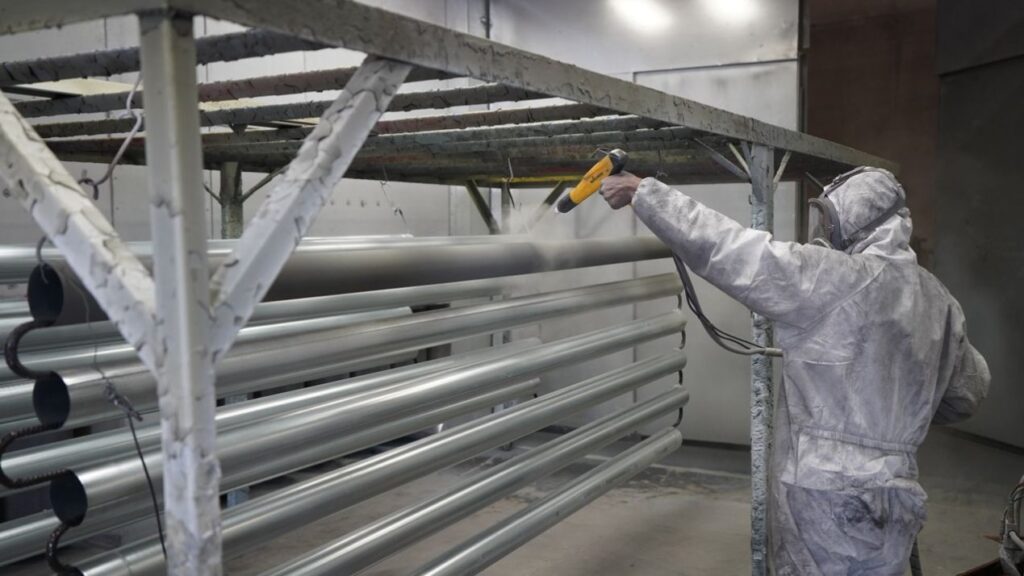
German industrial coatings specialist Mankiewicz has broken ground on a MX$449.25 million (US$24 million) manufacturing plant in Corregidora, Queretaro, reinforcing the state’s position as a premier nearshoring destination for European advanced manufacturing.
The capital investment will fund the construction of a modern production facility designed to create 214 specialized jobs. The project significantly expands the Hamburg-based company’s Mexican footprint, providing high-performance coatings and specialized surface protection systems to automotive, aerospace, railway, energy, and heavy industrial clients across North America.
Founded in 1895, Mankiewicz operates across 18 international locations with more than 1,800 workers worldwide, supplying specialized chemical formulations engineered to enhance surface durability, material resistance, and factory efficiency. Company representatives emphasized during the official groundbreaking ceremony that local engineering talent, technical expertise, and operational capabilities will remain vital drivers for scaling their North American operations.
The expansion comes as Queretaro solidifies its industrial reputation, ranking second nationally in the 2026 State Competitiveness Index published by the Mexican Institute for Competitiveness (IMCO). Marco Antonio Del Prete Tercero, Head of Queretaro’s Sustainable Development Ministry (SEDESU), noted that the state added 8,653 formal jobs in September alone, driven by integrated supplier networks, technical talent, and expanding utility infrastructure. Chepe Guerrero, municipal president of Corregidora, added that private industrial capital remains an essential engine for local municipal growth and high-wage formal employment.
This influx of specialized chemical manufacturing forms part of a broader acceleration of German capital into central Mexico, where heavy equipment manufacturers are simultaneously establishing dedicated technical hubs.
Specialized Service Centers Anchor Heavy Industry
Complementing Mankiewicz’s coatings facility, German heavy equipment manufacturer Liebherr confirmed plans to establish a specialized mobile crane service center in Queretaro. Spanning up to 15,000 m2—including a 2,000-m2 main workshop—the industrial complex will centralize mobile crane maintenance, overhaul operations, and specialized engineering support nationwide, reported MBN.
The initiative follows high-level strategic meetings between Liebherr corporate executives and state authorities, with the enterprise scheduling a full operational relocation to Queretaro in 2027. Industrial analysts view the move as part of a wider strategic trend among global equipment builders to localize technical support and spare-parts logistics closer to active construction, mining, and infrastructure corridors.
Workforce development remains central to Liebherr’s project. The company plans to recruit and train local engineering and maintenance personnel, capitalizing on Queretaro’s network of technical education institutions. State officials noted that access to highly skilled technicians has become a decisive criterion for multinational machinery firms looking to reduce equipment downtime and improve response times for domestic industrial clients.
While specialized service infrastructure strengthens aftersales ecosystems across the Bajio region, massive capital outlays in high-tech component manufacturing are expanding the state’s factory floor even further.
High-Tech Manufacturing Expands in El Marqués
Underscoring this manufacturing momentum, German automation and connectivity supplier Phoenix Contact recently inaugurated a MX$1.623 billion peso (US$95 million) production complex in the municipality of El Marques. Covering 22,000 m2, the advanced manufacturing facility is projected to generate 700 specialized engineering and production jobs.
The facility manufactures industrial connectors, cabling, and sensor technologies, functioning as a key operational pillar in the group’s global “Phoenix Contact 2030” growth strategy. Phoenix Contact Chief Financial Officer and Chief Executive Axel Wachholz stated that the plant is engineered to enhance customer proximity, strengthen supply chain resilience, and serve markets across the Americas, including providing direct operational support for Phoenix Contact USA, reported MBN.
Queretaro Governor Mauricio Kuri highlighted that the plant’s opening reflects long-term investor confidence supported by legal certainty, sustainable utilities, and skilled labor. Del Prete pointed out that the facility’s product catalog provides the critical digital hardware necessary to support cleaner, smarter, and more automated manufacturing ecosystems throughout North America.
These corporate commitments are not taking place in isolation; they are deeply anchored in institutional economic strategies designed to position Mexico as Germany’s primary industrial partner in the Americas.
Mexico And Germany Strengthen Industrial Ties
The wave of German investment in Queretaro comes amid broader efforts to deepen economic cooperation between Mexico and Germany, particularly as global supply chains shift and nearshoring accelerates. At a recent event held at the Mexican Embassy in Berlin, government officials and business leaders presented Plan México, a national strategy aimed at attracting foreign investment and accelerating the relocation of global manufacturing operations.
The event, attended by more than 100 executives and officials, coincided with Hannover Messe 2025, where Mexico expanded its participation with representation from 17 states. The initiative highlighted the country’s competitive advantages as a manufacturing hub with access to the North American market.