
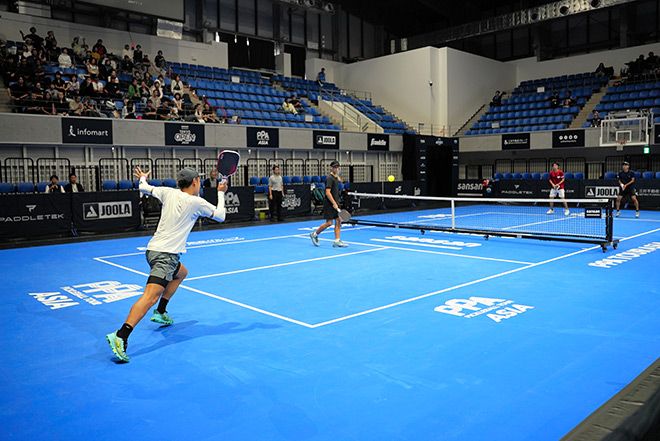
Selected athletes practice on a dedicated pickleball court in Tokyo. (Ryuta Sometaya)
Pickleball, a sport often called a miniature version of tennis, has gained so much in popularity in Japan that the country lacks enough courts for the players.
The game, played with rackets about twice the size of a table tennis paddle and a perforated plastic ball, is currently experiencing a global boom.
An international professional pickleball association has been formed, prize money has soared, and plans are being pursued to include the sport as an Olympic event.
A Japanese company has started developing players who can compete at the world level.
But infrastructure in Japan is not keeping pace with the spread of pickleball.
The Pickleball Japan Federation, a governing body established in April, has received repeated requests from schools, businesses and local communities to set up dedicated pickleball courts.
A pickleball court is about the same size as a badminton court and uses a surface similar to hard courts in tennis.
Although gymnasiums and other facilities are often used as substitutes for pickleball courts, many players still complain that it is almost impossible to make reservations.
Some venues have even announced that they are no longer accepting new reservation requests for pickleball courts.
PROFESSIONAL CIRCUIT
The PPA (Professional Pickleball Association) ASIA 500 Sansan Tokyo Open was held at an indoor sports arena in Tachikawa in July with 750 competing players.
Among the enthusiastic audience was a 60-year-old corporate worker from Tokyo’s Katsushika Ward, who started playing pickleball after seeing the sport on YouTube videos.
He said he was amazed by the skills of the top-level talent in the arena.
“The shots hit by professional players are totally different from ours,” he said.
Pickleball originated in the United States in the 1960s. The number of participants skyrocketed during the COVID-19 pandemic, particularly in areas where indoor sports outings were prohibited.
The normally outdoor sport is relatively inexpensive and fairly easy to learn.
Because the ball moves much slower than in tennis, even beginners can enjoy extended pickleball rallies.
Pickleball players also use a different strategy, dealing with such rules as no hitting volleys from an area near the net known as the “kitchen.”
According to the Sports and Fitness Industry Association in the United States, the number of pickleball players in the country increased sixfold from about 4.2 million in 2020 to about 24 million in 2025.
Money is following the sport’s rapid rise.
A major U.S. investment firm invested about $225 million (about 35.5 billion yen) in the sport’s world tour and other events in April and May this year.
TV broadcasts frequently air live matches. And top players can earn several hundred million yen a year.
Nikolas R. Webster, a clinical assistant professor of sport management at the University of Michigan, expects the sport to become even more commercialized.
Businesses, he says, are looking for a distinct competitive advantage. And a place like a restaurant where people can both eat and play pickleball offers a unique value proposition.
Among Asian countries, Vietnam is leading in terms of number of pickleball players and courts.
After international organizations pledged to make efforts to add the sport to the 2032 Brisbane Olympics, U.S. media outlets reported that inclusion could be possible, reflecting pickleball’s popularity.
In Japan, company executives have used the sport for networking since around 2023.
Over the past several years, entertainers have tried the sport on Japanese TV programs while influencers have streamed their attempts at pickleball.
These moves have helped to spread the sport’s popularity among young people in their 20s and 30s.
“Morning pickle,” played by people before they head to their offices, has become part of the daily routine of many workers.
TRIAL SESSIONS DRAW MANY
Well Racket Club held a trial pickleball session in Katsushika Ward for beginners one afternoon in July.
Four participants rallied while a coach called out, “Hit the ball gently so it lands in the kitchen.”
Takahiro Tojo, 47, and his wife, Maiko, 46, who live in Tokyo, joined the session after seeing former professional tennis player Shuzo Matsuoka playing pickleball on television.
They thought it looked fun.
“If I really get into it, I’d like to try competing in a tournament,” Maiko said.
Well Racket Club, based in the ward, has been operating as a tennis organization for 36 years. In April 2025, amid growing interest in pickleball, it converted an outdoor tennis court that had fallen out of use into four pickleball courts.
The club attracted 324 participants to its trial pickleball sessions in spring 2025, and its membership has grown to 3,000 over the past year.
“Even first-time players can rally after about an hour,” said Sho Fujimoto, the club’s systems manager. “At the same time, the sport has a depth that makes it hard to stop once you get hooked.”
According to Pickleball One Inc., a company that operates pickleball courts and sells related equipment in Tokyo’s Chiyoda Ward, the number of players in Japan reached about 330,000 in 2026.
Frequent television coverage has helped fuel rapid growth, with the player population surging from about 9,000 in 2024 to about 45,000 in 2025.
DEVELOPING PROFESSIONAL PLAYERS
In 2025, Sansan, a major Japanese provider of cloud-based business card management services, started a top-player development project called “Pickleball X.”
The company has selected 36 athletes from among former tennis or badminton players and provided them with training opportunities in pickleball.
This year, Sansan is considering organizing a league competition involving about 50 players split into six teams.
One participant is Nasa Hatakeyama, 29, who was a top-level competitor in university tennis.
After joining a major advertising company, he started playing pickleball on the recommendation of a friend.
Determined to take on “a challenge that can only be pursued now,” he left his job and turned professional. In May 2026, he won an Asian tour tournament event in men’s singles.
“I want to go from Asia to the world stage and break into the top ranks,” he said.
Ryosuke Koike, head of Sansan’s Pickleball business promotion office, said, “The spread of the sport will accelerate only if there is a system for developing top players whom people can follow on social media, watch compete, and cheer for.”
In July, Sansan opened a dedicated pickleball facility with seven indoor and outdoor courts in Tokyo’s Ikebukuro district, converting a former indoor swimming pool.
The company aims not only to provide a training environment for elite players but also to meet growing demand for recreational purposes.
BEYOND BOOM
Can Pickleball take root beyond the current boom?
“The key is whether people feel the sport matches their circumstances and age, while also offering something different from the sports they have played before,” said Yoshifusa Ichii, a professor of sports culture studies at Ritsumeikan University.
To ensure pickleball’s appeal as a sport by a wide range of people, he stressed, “It will be important to determine how to balance its growth and commercialization.”
People ranging from corporate employees before their work shifts to older adults play at Pickleball One Inc.’s court in Tokyo’s Chiyoda Ward on Sept. 13 and Sept. 16. (Yuki Shibata)