
With its release on Monday of its initial-public-offering paperwork, Anthropic answered a bunch of questions — not the least of which was whether the artificial-intelligence giant still planned to head to Wall Street this year.
But the San Francisco-based company’s filing left a whole bunch of other questions unanswered — some knowable, some not, at least not right away.
How it answers those questions — which include fundamental ones about its business prospects and expected valuation — will determine not only the success of its offering but also its long-term future.
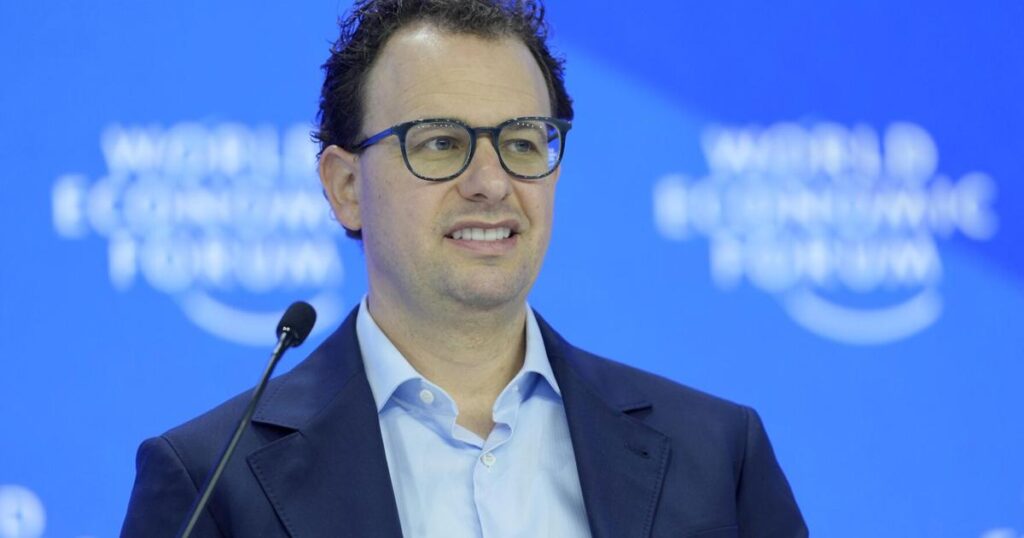
Despite its rapid rise, Anthropic is competing in a market where little is certain, according to venture capitalist Sean Foote, a faculty member at UC Berkeley who teaches classes on entrepreneurship and innovation.
There’s still some uncertainty about what business model AI companies such as Anthropic will settle on. It’s not clear how much customers will use or be willing to spend on the companies’ products, he said. Nor is it obvious what the best ways are to measure how such companies are performing or to estimate their potential, he said.


Despite its rapid rise, Anthropic is competing in a market where little is certain, according to venture capitalist Sean Foote, a faculty member at UC Berkeley.
Craig Lee/The Examiner
“There’s still so much we don’t know,” said Foote, who also works for Google’s analytics group.
What we do know is that Anthropic plans to press forward this year with its IPO.
Anthropic’s public filing of its offering paperwork is a declaration that it plans to go out this year while the window is still open. Indeed, the company is targeting its IPO for the week of Nov. 16, The Information reported. That’s the week immediately before Thanksgiving week.
The company answered some other questions — notably about how it’s performing — that could help boost demand for its offering.
Confirming previous reports, Anthropic’s filing showed that its revenue soared in the first half of this year. In the June quarter, the company posted $11.6 billion in sales, which was up 144% from the March quarter and up by $10.8 billion from the same period in 2025.
The IPO paperwork also showed that it has been holding the line on costs. After Anthropic’s operating loss soared to $3.1 billion in the third quarter of 2025, the company steadily began reducing that number in ensuing quarters before turning the loss into an operating profit of $974 million in the second quarter of this year.
Rob Siegel, a lecturer in management at the Stanford Graduate School of Business, called Anthropic’s revenue growth stunning. He said it’s also a good sign that the company’s unit economics — how much money it’s making or losing on selling its products after accounting for the cost of providing them — are improving.
“This is a real business,” Siegel said.
“To see a business that has become this big, this powerful, this fast is amazing and impressive,” he said.
Anthropic did post a whopping $66 billion net loss in the second quarter of this year — on the heels of a $14 billion loss in the first quarter — but almost all of that red ink was due to an on-paper adjustment in the value of its convertible debt.
Because of that factor, in spite of the huge reported loss, Anthropic’s operations actually generated about $3.4 billion in cash in the first half of 2026 — even after accounting for its sizable investments in property and equipment.
In recent years, IPO investors have shied away from companies that were growing rapidly without any concern for their costs, said Avery Marquez, the director of investment strategies at Renaissance Capital, an investment bank and financial-research firm that focuses on the IPO market.
Such investors are likely to view it positively that Anthropic is not only growing rapidly, but it’s also improving its cost structure, she said.
Marquez said she herself was surprised that Anthropic posted positive cash flow.
“I think that’s pretty incredible for a company like this,” she said.
But Anthropic’s IPO filing left some important details unanswered. Among the biggest: It didn’t disclose how many shares it plans to sell or what valuation it intends to seek in its offering.
As such, Anthropic is likely to have an easier time pulling off its offering if its valuation ends up being closer to the $1.5 trillion number, she said.
Even so, people who buy Anthropic’s shares in its offering are going to be making huge bets — ones more akin to those venture capitalists make than public investors typically do, investment experts told The Examiner.
They’ll be betting that a company with sales in the tens of billions of dollars will grow into a trillion-dollar valuation, Foote said.



There’s a “reasonable hope” that wager will pay off, said Robert Hendershott, an emeritus finance professor at Santa Clara University.
But on the flip side, there’s also good reason to think investors will lose all their money, he said.
“It’s that massive uncertainty that is my concern,” said Hendershott, the chief investment officer at Hendershott Wealth Management, an investment advisory firm.
Anthropic also didn’t disclose in its filing its results for the third quarter, which closed at the end of September. News outlets had previously reported, based on leaked documents, that Anthropic posted $16.8 billion in sales for the quarter and was cash-flow positive. But the company hasn’t officially confirmed those details nor shared what its costs looked like in the period.
The revenue figure and other data that have come out could raise some questions about Anthropic’s growth story. Assuming the $16.8 billion figure is accurate, its sequential revenue growth slowed to 44% — still impressive, but dramatically slower than what it posted in the second quarter.
Meanwhile, the company’s costs almost certainly increased substantially in the period. SpaceX disclosed in its own IPO paperwork in May that it had just signed a deal to allow Anthropic to use its data centers. Under the agreement, Anthropic would pay a discounted rate in May and June before paying $1.25 billion a month starting in July — the beginning of the third quarter.
The $3.75 billion it was on the hook to pay SpaceX in the third quarter is more than Anthropic spent on computing and infrastructure expenses in the first quarter of this year.
In its offering paperwork, the company did provide some information about how much it has agreed to pay companies such as SpaceX over the course of their multiyear deals. But what it disclosed only gave rise to more questions — most pertinently, where it will get the money to pay what it owes under those agreements.
In non-cancellable deals that stretch out in at least one case to 2036, Anthropic has committed to spending at least $661.5 billion to access data centers, or to lease or buy computing equipment, according to its IPO filing.
All told, including deals it could cancel in the future, the company’s committed to spending $855 billion in coming years on computing and data centers, according to an estimate from PitchBook, a venture-industry research firm.
By contrast, Anthropic had about $16.2 billion in sales in the first half of this year, had about $132 billion in cash and short-term investments at the end of June and had long-term spending commitments from its own customers of $10.8 billion.
The deals Anthropic has committed to are basically unprecedented, Siegel said — especially for a company that has nowhere near the current revenue or cash flow to finance them.
“Holy moly, these are some big numbers,” he said.
Where it will get the money to pay those deals is an open question. It could need to raise more cash, even after its public offering, Foote said.
It could also grow into the deals, if its revenue continues to soar. That’s what its partners seem to betting on, said Harrison Rolfes, a senior analyst at PitchBook, in a research note.
“Growth is not optional for this company; the contracts assume it,” he said.
Other details in the filing also raised questions. The company indicated insiders such as executives and early investors will sell shares in its IPO. But it didn’t say how much they plan to unload.
If the number of sales offered by insiders — as opposed to those offered by the company itself — amounts to half or even a quarter of the total shares sold in the deal, that would be a “yellow flag” for public investors, Marquez said.
It would prompt investors to wonder “why are insiders wanting to get out when this company is supposedly at the pivotal point in its growth story,” she said.
Meanwhile, the company disclosed it will have a labyrinthine ownership structure, with five different classes of stock with different voting rights. Everyday investors will own its Class A stock — which, for the foreseeable future, will never have majority control of the company, no matter how many shares Anthropic issues or is owned by them.
Instead, Anthropic has set up a trust comprising independent trustees that will collectively hold a class of shares that give it the ability to name a majority of the company’s board of directors.
CEO Dario Amodei, President Daniela Amodei and Anthropic’s other founders — collectively, through a limited-liability company — will hold yet another class of shares that will give them the ability to name the rest of the directors to its board. Its shares will also give the LLC a majority of all voting power at the company when it comes to shareholder votes.

Anthropic President Daniela Amodei speaks at the Bloomberg Tech conference at the St. Regis hotel in San Francisco on June 4.
Randall Gee/Courtesy Bloomberg
“The governance is wacky,” Siegel said.
It’s not unusual for tech companies to have governance structures that give disproportionate power to founders to appoint directors or determine the outcome of shareholder votes. The argument is that such power allows company insiders to focus on the business’ long-term future rather than having to respond to short-term stock movements or economic fluctuations.
The evidence of how such structures have played out in practice has been mixed.
Regardless, Anthropic’s governance structure is far more convoluted than those of its Silicon Valley predecessors. At base, it will ensure that everyday investors won’t be able to control the company, Siegel noted.
But it’s a huge question about how that structure will work out in practice, Hendershott said.

Santa Clara University professor Robert Hendershott: “It’s not that I think [Anthropic’s governance structure will] play out badly. It’s that there’s no history to base a prediction on.”
Craig Lee/The Examiner
“How that will play out, I don’t know,” he said. “It’s not that I think it’ll play out badly. It’s that there’s no history to base a prediction on, so it’s just another risk.”
If you have a tip about tech, startups or the venture industry, contact Troy Wolverton at twolverton@sfexaminer.com or via text or Signal at (415) 515-5594.