
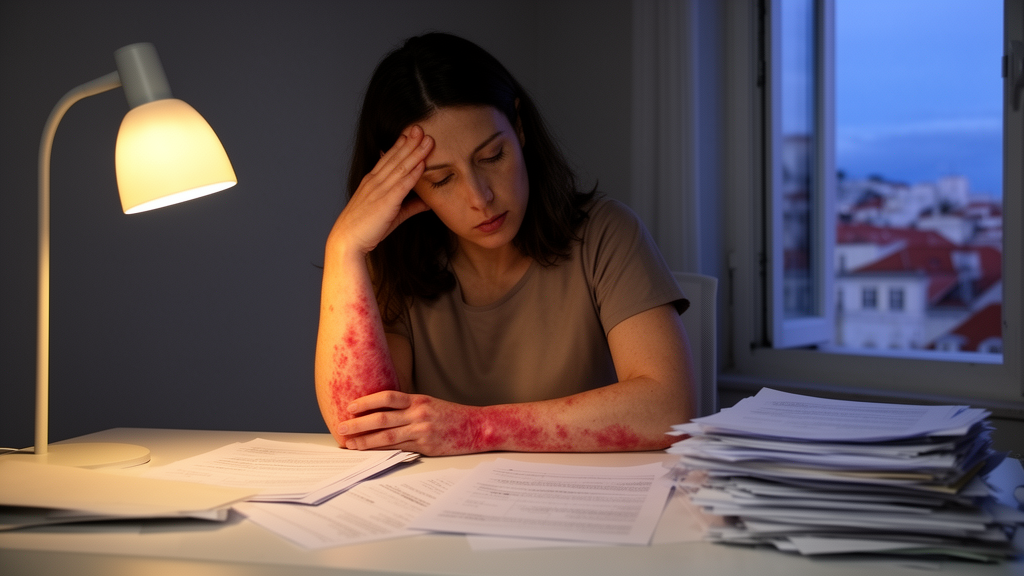
Chronic urticaria, a condition marked by recurring wheals and angioedema that persists for more than six weeks, costs Portuguese adults far more than clinic visits and prescriptions suggest. A new patient-reported cost-of-illness study, published in Dermatology and Therapy, estimates the weighted mean annual societal cost at €4687 per patient, and finds that a single component—reduced productivity while at work, rather than days off sick—accounts for nearly two-thirds of that total. The figure is the first full patient-level cost estimate for the disease in Portugal, and it arrives with a striking asymmetry: employed patients lost an estimated 64.2 working days per year to impaired performance at work, against just 1.5 days of formal absence.
The study, led by Pedro S. Coelho, Jorge M. Mendes and João Maia Silva, surveyed 147 adults with a physician-established diagnosis of chronic urticaria, recruited through APUrtica, the Portuguese national patient association, with support from the Portuguese Society of Dermatology and Venereology. Data were collected between November 2021 and February 2022 through a structured, self-administered online questionnaire. Participants were adults resident in Portugal whose diagnosis had been made by a dermatologist or an allergologist/immunologist, ascertained from patient self-report without independent clinical re-verification. The survey did not distinguish chronic spontaneous urticaria from chronic inducible urticaria, and it covered sociodemographics, disease characterisation, employment, healthcare use, medicines and expenditure attributable to the condition over the preceding 12 months.
Because recruitment through a patient association strongly skewed the sample toward more active disease—76.9% of respondents reported severe disease, against a population expectation far lower—the researchers applied post-stratification weighting to the severity distribution of the AWARE study, the largest real-world characterisation of chronic urticaria severity in comparable European settings. The AWARE distribution assigns 56.1% of patients to mild, 29.3% to moderate and 14.6% to severe disease; the corresponding weights were 6.34, 2.05 and 0.19. Severity was classified using the Urticaria Activity Score over 7 days, with bands of 0–15 for mild, 16–27 for moderate and 28–42 for severe disease. Because the UAS7 was reconstructed from a retrospective rating of a typical day rather than a prospective diary, the resulting scores are multiples of 7, and the authors caution that misclassification between bands would affect the weights.
The costing followed a bottom–up, prevalence-based design with a one-year horizon from a societal perspective, expressed in 2022 euros. Direct healthcare costs were separated into those financed by the National Health Service and those paid out of pocket, while indirect costs were valued with the human capital method at the mean gross daily labour cost in Portugal for 2022, €80. NHS consultations, emergency visits, hospitalisations and blood tests were priced at national reference tariffs, and NHS medicines at reimbursed prices from INFARMED applied to standard reference doses. All biologics were costed as omalizumab at 150 mg in 12 administrations per year, at €2448 per treated patient—a dose below that recommended for chronic spontaneous urticaria, which makes the base case conservative. Patient time was valued at €9.43 per hour, based on the mean net daily income of the sample divided by seven working hours.
The weighted results paint a picture of a disease whose heaviest costs are largely invisible to health systems. Presenteeism accounted for €2927, or 62.4% of the total annual cost, followed by out-of-pocket healthcare costs at €570 (12.2%), patient time at €559 (11.9%), NHS costs at €410 (8.7%), out-of-pocket non-healthcare costs at €152 (3.2%) and absenteeism at just €69 (1.5%). Indirect costs made up 63.9% of the total and direct costs 24.2%. Mean self-reported productivity impairment while at work was 29.7%, converted into 64.2 equivalent working days lost per year, meaning presenteeism exceeded absenteeism by a factor of about 40. Per employed patient, the cost of presenteeism alone was €5136 per year. Patients also reported spending a weighted mean of 4.9 hours per month managing the disease, or 59 hours annually.
Direct costs told a story about who pays. The total direct cost was €1132 per patient after weighting, of which patients paid 64% and the NHS 36%. The NHS share rose steeply with severity, from 3% in mild disease to about 52% in both moderate and severe disease, an increase driven almost entirely by the reimbursement of biologics: roughly 90% of NHS medicine costs corresponded to biologics, concentrated in the severe stratum, where 43 of 113 participants reported biologic therapy. For most patients with mild disease, the direct cost is therefore largely private, driven by out-of-pocket medicines and privately funded consultations. One third of patients used privately funded care, with no difference by severity, a pattern the authors link to capacity constraints in the Portuguese public system that routinely push patients toward specialist care at their own expense—an equity concern that aggregate cost figures do not capture.
Beyond the cost totals, the study examined whether quality-of-life impairment tracks with productivity loss. Among the 97 employed patients, each one-point increase on the Dermatology Life Quality Index was associated with €270 of additional annual productivity loss after adjustment for the severity strata (95% confidence interval 131–408; p = 0.0002). Because the DLQI includes an item asking directly about the impact of skin disease on work or study, the researchers tested whether the association was an artefact of shared item content: excluding that item left the coefficient essentially unchanged at €268, and omitting the severity strata gave €283. A difference equal to the DLQI’s minimal clinically important difference of 4 points corresponded to approximately €1080 of annual productivity loss per employed patient. The authors stress that the design is cross-sectional, so the direction of the association cannot be established, and that the coefficient is associational and should not be interpreted as the effect of any intervention.
At the national level, the estimates are deliberately framed as indicative. Applying per-patient figures to Portugal’s adult population of roughly 8.6 million and employed population of about 4.9 million, and using a base-case prevalence of 0.8%—the 12-month prevalence reported in a representative European survey—the annual societal cost was €322 million: €206 million in productivity losses, €78 million in direct costs (€28 million NHS, €50 million patients) and €38 million in patient time. Across four prevalence scenarios ranging from 0.5% to 2.3%, the national estimate ranged from €202 million to €927 million per year. Because no Portuguese estimate of chronic urticaria prevalence exists, and because all participants had a specialist diagnosis, these figures refer to diagnosed disease and depend heavily on both the prevalence assumption and the representativeness of the weighted sample.
Sensitivity analyses tested the fragility of the headline number. Using the omalizumab posology recommended for chronic spontaneous urticaria—300 mg in 13 administrations per year, at €5304 per treated patient—raised the total to €4965 and lifted the NHS share of direct costs to 49%. Using the weighted sample employment rate of 44.1% instead of the national rate lowered the total to €4009. Four more conservative presenteeism assumptions, including excluding the most extreme respondent and valuing only half of the reported impairment as lost output, reduced the total by between 9.0% and 31.2%. In every scenario examined, indirect costs still exceeded direct costs. The one-way analysis found the total most sensitive to the daily labour cost, the employment rate and presenteeism days, while medicine costs shifted the total by less than €90 in either direction.
The authors are explicit about the limits of their work. The sample is a non-probability convenience sample recruited through a patient association, no response rate can be computed, and the gap between weighted (€4687) and unweighted (€7014) estimates shows how much the results depend on the weighting assumptions, which cannot be verified with the available data. The mild stratum rests on only 13 patients, three of whom were employed, so estimates that depend on it carry wide uncertainty. Presenteeism was measured with a single, non-validated item over a 12-month recall period, and its conversion into working days assumes that reduced performance translates proportionally into lost output. All costs and resource use were self-reported and not validated against administrative records, item non-response reached 44% for patient time, and the study did not measure informal care hours, the costs of psychiatric comorbidity, or time spent attending appointments—meaning the reported costs may understate the true burden. With those caveats, the central finding stands: the dominant cost of chronic urticaria is reduced productivity among people who continue to work, generating no claim or administrative record and remaining largely invisible to healthcare systems, while the most direct costs fall on patients themselves.
Subject of Research: Cost-of-illness and productivity burden of chronic urticaria in Portuguese adults
Article Title: The Economic Burden of Chronic Urticaria in Portugal: A Patient-Reported Cost-of-Illness Study
Article References: Coelho, P. S., Mendes, J. M., & Maia Silva, J. (2026). The Economic Burden of Chronic Urticaria in Portugal: A Patient-Reported Cost-of-Illness Study. Dermatology and Therapy. https://doi.org/10.1007/s13555-026-01955-z
Image Credits: AI Generated
DOI: 10.1007/s13555-026-01955-z
Keywords: chronic urticaria, cost of illness, presenteeism, productivity loss, Portugal, patient-reported outcomes, DLQI, out-of-pocket costs, post-stratification weighting, omalizumab, National Health Service, societal cost