
North Korea is often reduced to a familiar collection of images: missile tests, military parades and an authoritarian government largely closed off from the world.
At Oakland University on Oct. 15, Swiss humanitarian worker Katharina “Kathi” Zellweger and former CNN correspondent Mike Chinoy offered another view — one shaped by famine, aid work and the ordinary people Zellweger met during decades inside the country.
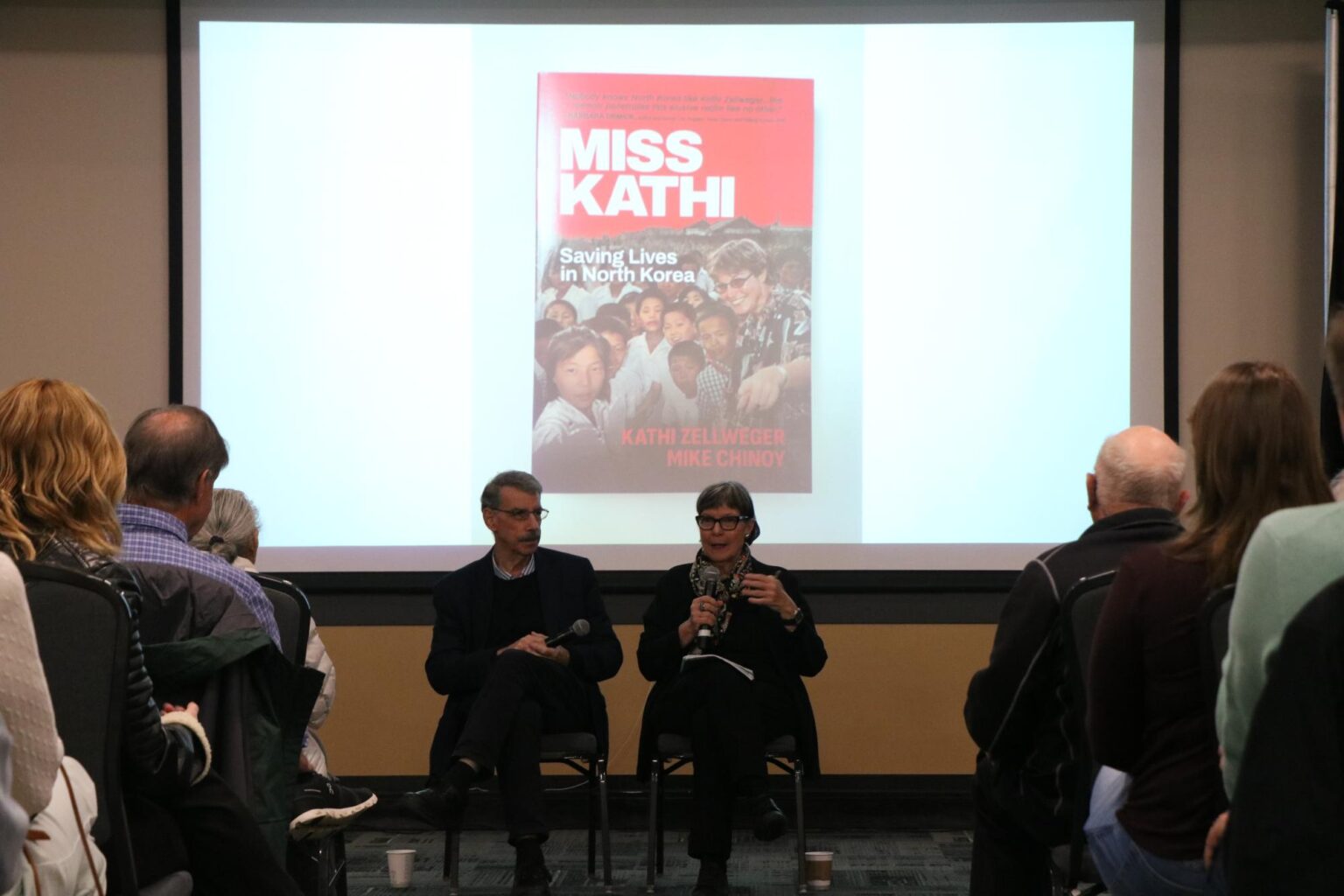
The Barry M. Klein Center for Culture and Globalization hosted the discussion on Zellweger and Chinoy’s book,”Miss Kathi: Saving Lives in North Korea,” in the Oakland Center’s Gold Rooms.
Chinoy, a former CNN Beijing bureau chief, began by explaining the two types of stories most often told about North Korea.
“There are really two genres of books about North Korea,” Chinoy said. “One of them focuses on the diplomacy surrounding the efforts to end the country’s nuclear program and its missile program.”
His first book, “Meltdown”, examined that diplomatic side. Other accounts come from defectors and center on their experiences leaving the country.
Chinoy’s work with Zellweger offers another perspective. Her story follows the people who remained in North Korea and the humanitarian work that reached them during some of the country’s most difficult years.
That work took Zellweger to North Korea 75 times over nearly 25 years. She also lived in Pyongyang for five years.
A CNN video shown during the presentation showed rural communities during the country’s devastating famine of the 1990s, providing context for Zellweger’s account of delivering aid there.
Before North Korea, Zellweger worked in Hong Kong for Caritas, a Catholic humanitarian organization serving vulnerable communities in Hong Kong and China. She said North Korea eventually landed on her desk unexpectedly.
In 1995, she returned to the country as widespread flooding deepened an already severe crisis.
“In July and August, it rained, and rained and rained,” Zellweger said.
Villages were destroyed, while food, fuel and electricity were already scarce. International aid began with emergency food assistance before expanding into rehabilitation efforts on farms and in hospitals.
The work required more than delivering supplies. Aid workers had to build trust with local officials and communities while navigating suspicion and different expectations.
One memory stayed with Zellweger from a trip with an international aid delegation.
As she introduced a colleague from New York, a North Korean official reacted with disbelief.
“Never, ever did I think that in my lifetime I would shake hands with an American,” the official told her.
The moment showed how unusual direct contact between North Koreans and Americans could be. It also reflected the personal encounters that can get lost when the country is discussed only through politics and military conflict.
Zellweger later served as North Korea country director for the Swiss Agency for Development and Cooperation from 2006 to 2011. Her work included agricultural development, training programs and efforts to help communities improve crop production.
She also found moments that challenged what she expected from life in North Korea. One orchestra conductor asked to speak German after explaining that he had studied music in Vienna for eight years.
“Life in North Korea is full of surprises,” Zellweger said.
Her work later turned toward people with disabilities. Through KorAid, the Hong Kong-based organization she established, Zellweger said projects supported 30,000 cataract operations over four years, along with locally produced prosthetic devices and sign-language education for children with hearing impairments.
She recalled meeting a woman who believed losing her eyesight was simply an unavoidable part of aging. Zellweger said she would never forget the woman’s smile after surgery restored her sight.
The book also reflects Chinoy’s own career experiences in Asia and fascination with the Chinese language.
“My interest in journalism was an outgrowth of my interest in China,” Chinoy said.
In 1973, he traveled to China with a student delegation, a year after President Richard Nixon’s visit. After graduate school, Chinoy moved to Hong Kong and began the journalism career that later brought him to CNN.
When asked what advice he had for students pursuing journalism or international relations, Chinoy encouraged them to pair practical skills with knowledge of a subject they care about.
“Master the new technology,” Chinoy said. “Audio, video, the internet, coding, online. And then specialize in a topic — law, economics, international relations, defense — something that gives you some in-depth knowledge that you can bring to the subject.”
For students considering careers in communication, the advice connected the night’s international focus to their own futures. Chinoy’s reporting background helped shape the book, while Zellweger’s experiences supplied the firsthand stories behind it.
Chiaoning Su, director of the Klein Center and an associate professor of communication, journalism and public relations, said the event was selected to create conversations about international affairs while asking students to consider the people affected by global conflict.
“To bring this event to campus is not only to encourage that conversation, but also to encourage the student to think about human factors behind geopolitical tensions and authoritarianism,” Su said.
“North Korea is often discussed through its leaders, military tensions and weapons programs,” Su said.
Zellweger’s experiences shifted attention to another side of the country.
“When you think about North Korea, I think most people will think about their authoritarian leaders, the geopolitical tensions, the weaponization of the situation, but this is about everyday life, ordinary people and the impact of humanitarian work,” Su said.
Humanitarian access to North Korea remains uncertain, Zellweger said. She described a sobering future, with tighter government control and limited access for international organizations, though she still sees reasons for hope.
For decades, Zellweger said, her work in North Korea has depended on three things: “Pragmatism, patience and perseverance.”
The discussion did not make North Korea seem simple or erase its political realities. It gave the OU community a closer look at the people whose lives exist behind them.