
Open as PDF
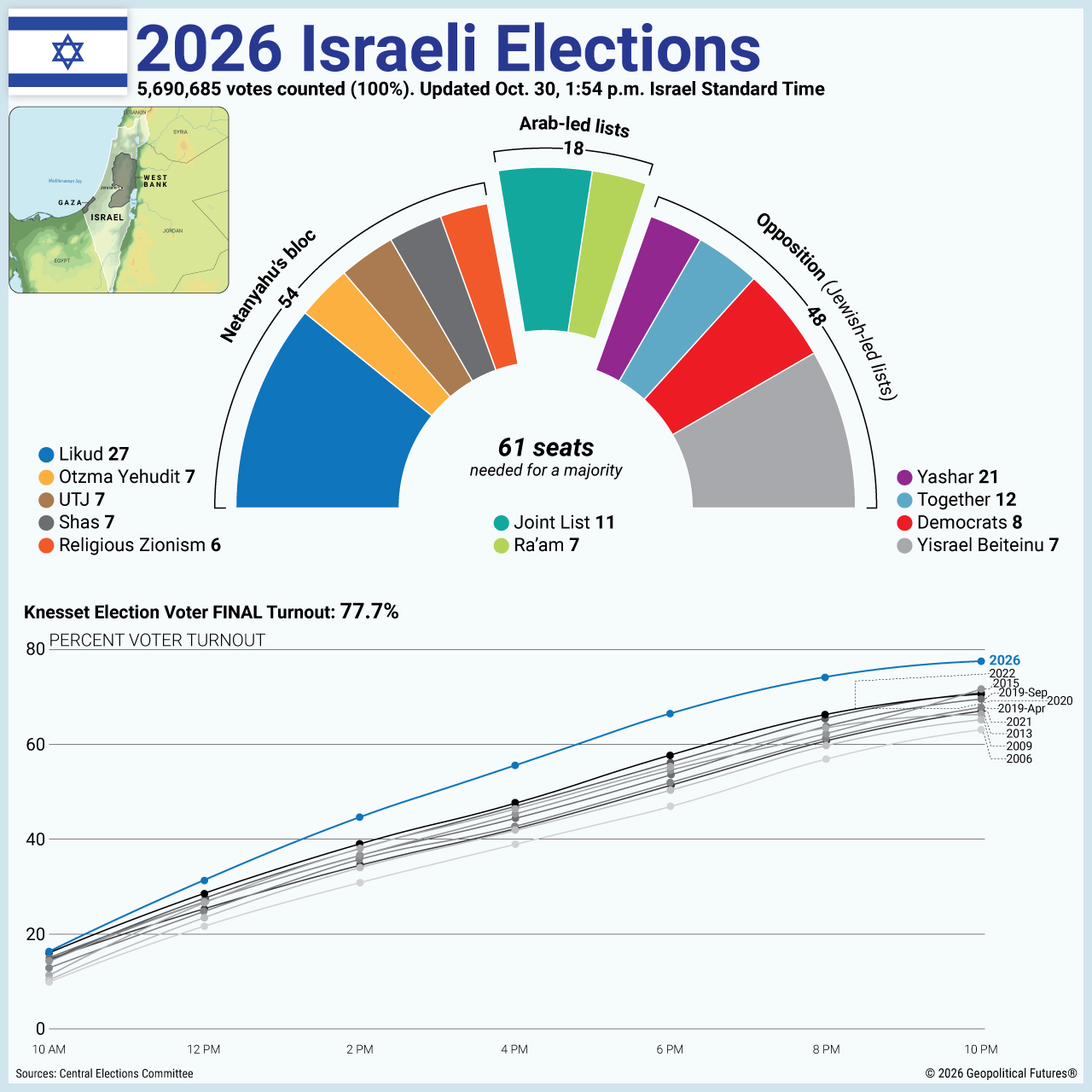
Israel’s Oct. 27 election produced a hung Knesset, with Prime Minister Benjamin Netanyahu’s bloc securing 54 seats, seven short of a governing majority, while the Jewish-led opposition won 48 seats and the Arab-led parties emerged as potential kingmakers with 18. The outcome represents a significant setback for Netanyahu’s outgoing coalition, which previously controlled 68 seats. Voter turnout reached 77.7 percent, its highest level in two decades, and participation exceeded that of every election since 2006 at each hourly checkpoint.
Although Netanyahu’s Likud remains the largest party with 27 seats, his coalition prospects are constrained by his partners’ opposition to cooperating with Arab parties and the refusal of opposition leaders Gadi Eisenkot, Naftali Bennett, Avigdor Liberman and Yair Golan to serve under him. Eisenkot faces similar obstacles, as his opposition bloc’s 48 seats could theoretically yield a 66-seat majority with Arab-party support, but key opposition leaders have rejected such cooperation. Liberman’s refusal to engage with Eisenkot or Bennett further complicates negotiations.
President Isaac Herzog is expected to begin consultations after the results are certified on Nov. 4, with Eisenkot potentially receiving the first mandate to form a government, although Netanyahu can remain caretaker prime minister and may receive a subsequent opportunity if Eisenkot fails. The remaining options are limited to a minority government dependent on Arab-party support, a realignment involving Haredi parties (despite persistent disputes over military conscription exemptions), or a unity arrangement that Eisenkot has previously rejected, including a rotating premiership. Prolonged political deadlock is therefore the likeliest near-term outcome, with another election in early 2027 emerging as the leading scenario unless one of the principal blocs changes its red lines on Arab-party participation, military conscription or cooperation with Netanyahu.

Geopolitical Futures (GPF) was founded in 2015 by George Friedman, international strategist and author of The Storm Before the Calm and The Next 100 Years. GPF is non-ideological, analyzes the world and forecasts the future using geopolitics: political, economic, military and geographic dimensions at the foundation of a nation.