
From urban forests and solar microgrids to women-led green enterprises, Shakti Foundation outlines how accessible finance, local partnerships and community-driven investment can strengthen Bangladesh’s climate resilience.
As Bangladesh prepares for the 31st UN Climate Change Conference (COP31) in Antalya, Türkiye, questions over climate finance accessibility, rising debt burdens and the slow delivery of international commitments are becoming increasingly urgent. For a climate-vulnerable country like Bangladesh, the challenge extends beyond securing funding to ensuring that it reaches frontline communities, particularly women and other marginalised groups. Shakti Foundation, which works on women’s economic empowerment, climate resilience, and community-based green initiatives, advocates grant-based adaptation finance, simplified funding procedures, and greater direct access for local organisations. In an exclusive pre-COP31 interview with Md Ibrahim Khalilullah, Executive Editor of The Climate Watch, Labiba Rahman, Strategic Advisor, Climate Change Program at Shakti Foundation, discusses reforms to international climate funds, financing solutions for urban resilience, women-led green businesses, renewable energy investments and the role of community-driven initiatives in addressing Bangladesh’s climate challenges. The interview is part of the “Shakti–The Climate Watch COP31 Dialogue Series,” which aims to bring critical perspectives on climate action and justice into the global climate conversation.
The Climate Watch: What specific reforms to international climate funds, including simplified applications, direct access and faster disbursement, should Bangladesh advocate at COP31 to ensure that adaptation finance reaches local communities, particularly women-led organisations?
This is meant to be the implementation COP. After ten years of pledges, the question is whether money reaches people. How can this process be made easier and more accessible, especially for a country like Bangladesh that already carries a significant debt burden? If we rely on loans, it will further cripple our country. Therefore, grants should really be the way to go.
Bangladesh should first demand the elimination of lengthy, complex and bureaucratic appraisal templates that shut grassroots groups out. A women’s group in a village can’t write a 100-page proposal. Second, direct access, so national and local organisations can receive funds without going through layers of international middlemen. Third, faster disbursement, with clear deadlines. Women’s labour force participation has fallen from 43 per cent in 2022 to 38 per cent in 2025 [source: World Bank], and climate shocks are part of that. So, for women specifically, we want ring-fenced windows and small grants for women-led organisations.
The Climate Watch: What concrete commitments should Bangladesh seek at COP31 to ensure that the Fund for Responding to Loss and Damage provides timely, grant-based support to climate-affected households? How can transparency and direct community access be ensured?
Our first problem is that we don’t speak with one voice. Look at Nepal. The fund approved $20 million for their floods just recently, in October. It’s still not disbursed, and it took about two months from the flood. That’s a first step, but it shows both the opportunity and the speed problem. So, Bangladesh needs a coordinated national position, and I’d ask for three things. It must be grants only. Since loss and damage results from historical emissions by developed countries, this funding is a matter of climate justice under the polluter-pays principle, not a debt-inducing assistance package. Bangladesh should also push for pre-agreed triggers, so money moves automatically after a disaster, like the parametric cyclone insurance Shakti launched in partnership with Sena Insurance PLC and K.M. Dastur & Company Limited. And it needs direct channels to trusted local organisations, with localised tracking so everyone can see whether the cash reached households.
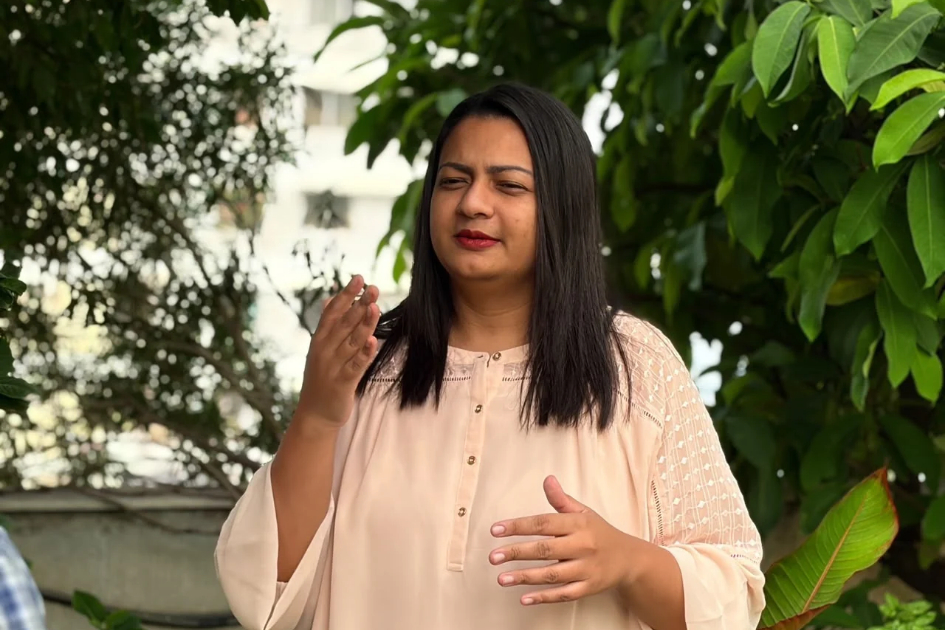 Labiba Rahman, Strategic Advisor, Climate Change Program at Shakti Foundation, speaks during an exclusive pre-COP31 interview with The Climate Watch.
The Climate Watch: Which financing instruments, such as green bonds, blended finance or public-private partnerships, offer the greatest potential for climate investment in Bangladesh? What safeguards would ensure that private capital also benefits low-income and climate-vulnerable communities?
If I had to pick one, it’s public-private partnerships, because we’ve seen them work. Lautola Forest, Dhaka’s first human-made urban forest, happened because the city, private funders and Shakti each did their part. Green bonds and big blended-finance structures are still early for our financial system, so I’d start smaller, with blended models run through local lenders. Alongside that, there’s Zakat, which is large and underused in Bangladesh. Directed towards climate-vulnerable families, it could be debt-free support. Whatever we use, private capital needs safeguards: impact targets for jobs, clean energy access and housing for low-income people, and checks against greenwashing.
The Climate Watch: Drawing on Shakti Foundation’s experience, which financing models could most effectively support women-led green businesses and household adaptation? What practical barriers must be addressed to expand women’s access to affordable climate finance?
Every Shakti programme is built around women, and 98 per cent of our borrowers are women. Our model isn’t just loans. It’s collateral-free credit combined with practical support, such as microfinance-linked green assets (like solar units) and mobile health clinics that bring healthcare directly to women in remote areas.
The practical barriers are huge. There’s a gender gap in digital financial inclusion, and many women lack formal documents. Disaster training and awareness data shows women are often left behind because they have to stay home caring for children and elderly family members. They can’t just walk out of the house easily. And when women do step up, the mindset of men in the community doesn’t always change. That’s why training has to be intergenerational and family-based, involving mothers, fathers and brothers, so everyone understands why women’s access to climate finance and green jobs matters. If we don’t address these social and structural barriers, funding and advanced projects won’t reach the women who need them most.
The Climate Watch: What three priority interventions should Dhaka and Chattogram implement over the next two to three years to protect low-income communities from extreme heat, flooding and waterlogging? How should their effectiveness be measured?
Our study with the Center for Urban Studies found Dhaka lost 60.7 per cent of its vegetation between 2000 and 2025, while built-up area grew 59 per cent. This rapid urban development has intensified urban heat, while air pollution reduces life expectancy by 5.5 years across Bangladesh and 6.6 years in Dhaka [source: University of Chicago’s air quality index]. The people bearing the brunt of this are day labourers, rickshaw pullers and those in informal settlements.
To protect those most affected, first we must significantly scale up urban greening by expanding urban forests, pocket parks and Miyawaki-style forests, building on initiatives like Shakti Foundation’s Lautola Forest, which has helped bring local temperatures down by 2 to 3 degrees. Second, we need to restore canals and drainage systems and clear blocked waterways to prevent severe waterlogging from disrupting low-income neighbourhoods every time it rains. Third, heat-resilient housing, with cool roofs and shaded community spaces, to protect urban families during extreme heatwaves.
Of course, taking action is only half the battle. The real challenge is ensuring that these interventions deliver results. To measure their impact, we need to track clear, practical outcomes on the ground. This means measuring reductions in ambient temperatures using thermal monitoring tools, monitoring improvements in local Air Quality Index (AQI) levels, tracking how quickly water drains after heavy monsoon rains and assessing whether heat-related illnesses among vulnerable urban workers are declining.
The Climate Watch: What measurable outcomes has Shakti Foundation observed from its Lautola urban forest initiative in Dhaka, particularly regarding tree survival, temperature reduction, biodiversity and community benefits? What would be required to replicate this model in other cities?
Our Lautola urban forest initiative in Mohammadpur, Dhaka, demonstrates how urban blight can be transformed into a thriving ecosystem. Before our intervention, the site was an illegal truck terminal. Through a strategic public-private partnership (PPP), the canal was retrieved and we converted the area into Dhaka’s first dense, man-made urban forest.
We planted over 9,000 fruit-bearing, medicinal and native trees across multiple vegetation layers, using carefully prepared, organic-rich soil. This resulted in an exceptional survival rate of over 95 per cent, far exceeding what is typically achieved through conventional urban plantation drives. The dense canopy has helped reduce local temperatures by a verified 2 to 3 degrees Celsius, while the forest’s natural air-filtering capacity has contributed to a 10 to 20-point improvement in the localised Air Quality Index (AQI) compared to nearby areas. Home to over 73 native species of trees, plants and shrubs, the forest has also attracted pollinators, insects and bird species that had largely disappeared from the area. It also absorbs rainwater, which helps with local waterlogging.
The community benefits matter just as much. Residents now have a safe, green public space. And Lautola employs transgender gardeners from the hijra community, so it creates work for people who are often shut out of jobs.
Replicating this model in other major cities across Bangladesh requires strong public-private partnerships. City corporations provide land and help restore canals. Private companies provide capital, often through CSR funding. And organisations like Shakti provide technical expertise and oversee the work. Beyond that, you need proper soil restoration, native species and early engagement with local people so they feel ownership and protect the forest for the long term.
 Labiba Rahman, Strategic Advisor, Climate Change Program at Shakti Foundation, speaks during an exclusive pre-COP31 interview with The Climate Watch.
The Climate Watch: Which financing mechanisms could realistically help Bangladeshi cities invest in affordable cooling, heat-resilient housing and green infrastructure? What changes are needed to allow local governments to access international adaptation funds more directly?
We have to face the reality that waiting around for traditional international climate grants just won’t cut it. First, as I mentioned earlier when talking about the Lautola Forest, public-private partnerships are a completely realistic and proven way forward.
Second, we can scale up green microfinance. A powerful model we are actively leveraging here is the ICCAP (Inclusive Climate Finance for Vulnerable Communities in the Asia-Pacific) project. Funded by Germany’s International Climate Initiative and led by the Stockholm Environment Institute alongside ADA and APRACA, this five-year regional programme channels public and private adaptation finance through local financial service providers like Shakti. Through this financing model, Shakti is developing client-centric green financial products that directly target 3,000 beneficiaries, with at least 50 per cent being low-income women, farmers and climate-vulnerable individuals who pay off these resilient upgrades through flexible instalments.
Third, as I touched on when discussing domestic climate finance, Zakat is a massive, untapped resource in Bangladesh that carries zero debt burdens, no foreign exchange risk and none of the heavy bureaucratic delays tied to international climate funds.
Now, as for getting international adaptation funds directly into the hands of local city governments, we need a few crucial shifts. City corporations need more financial autonomy, even to issue green bonds. At the same time, we have to build direct capacity within city corporations so they can meet the strict fiduciary and reporting standards required by global funders like the Green Climate Fund. And finally, international donors themselves need to establish dedicated sub-national funding windows that channel adaptation capital directly to local financial institutions and urban bodies where the heat and flooding are actually happening.
The Climate Watch: What three policy reforms or investment priorities are most critical to achieving Bangladesh’s NDC 3.0 renewable energy ambitions by 2035? What specific financial commitments, technologies and international partnerships should Bangladesh seek at COP31?
Bangladesh can’t scale up renewables if our grid can’t handle solar and wind variability. So, the first priority should be to invest in smart grid infrastructure, battery storage and high-voltage transmission lines that ensure off-grid microgrids can feed back into our energy mix instead of staying isolated. This brings me to my second point: we need a comprehensive, streamlined net-metering framework that allows rooftop solar and microgrids to easily sell surplus electricity back to the grid. Lastly, we need to de-risk clean energy investments using blended finance. Standard commercial loans are far too expensive for green startups and low-income households. By pairing soft grants and concessional capital with microcredit, we can lower borrowing costs and make solar home systems, electric vehicle hubs and clean cooking affordable for marginalised communities.
As for COP31, we must demand grants for adaptation and concessional finance for mitigation. Alongside financial commitments, Bangladesh needs direct technology transfer and local manufacturing support. Finally, we must push for strategic international partnerships that establish direct funding windows for sub-national entities, local financial providers, civil society and municipal governments to ensure climate adaptation capital reaches frontline communities.
The Climate Watch: Based on Shakti Foundation’s solar energy and community-level experience, which clean-energy business models offer the greatest opportunities for women entrepreneurs and small businesses? How can these models become commercially sustainable while remaining affordable for low-income households?
Alongside the environmental benefits, our motivation for deploying solar energy has always been about reaching the most remote communities while directly safeguarding women’s safety, supporting children’s education and protecting women and girls from gender-based violence. So far, we have deployed around 60,000 solar panels for households, schools and streetlights across Bangladesh.
When you look at which clean-energy business models offer the greatest opportunities for women entrepreneurs and small businesses, decentralised solar microgrids and productive-use energy models stand out the most. A prime example of what’s possible at the community level is our FCDO-funded project in Dhobaura, Mymensingh. Under a regulatory sandbox, 20 shop owners in a local market were equipped with interconnected solar panels as a microgrid, enabling them to trade excess power among themselves and even sell surplus electricity back to the national grid. Women and small business owners have leveraged this clean electricity to run solar irrigation pumps and three-wheeler charging stations, creating new green jobs and reliable, community-based revenue streams right within their communities.
To keep it affordable and sustainable, you have to connect clean technology directly with income generation and flexible financing. Offering collateral-free, flexible microcredit lets marginalised households and women-led enterprises acquire high-efficiency green technology over time without high upfront costs. They can then comfortably fund their loan repayments directly out of the savings made by displacing expensive fossil fuels, avoiding costly grid downtime and earning extra income through their solar-powered microenterprises.
The Climate Watch: Which green industries and skills should Bangladesh prioritise to create employment for women and young people? How can investments in renewable energy and energy-efficient cooling simultaneously generate jobs, reduce electricity costs and protect low-income households from extreme heat?
I would prioritise industries close to where people already live and earn, and I’d make sure the jobs reach the people who are usually left out. First, decentralised solar, specifically solar installation, maintenance and microgrid operations. Having deployed around 60,000 solar panels, we’ve seen this impact firsthand. In Dhobaura, Mymensingh, our solar microgrid enables microenterprises to create reliable, home-based work.
Second, urban greening and reuse. Our Lautola Forest employs transgender gardeners from the hijra community, so it’s already creating work for people who are often shut out of jobs. Expanding on this, our Circle of Care project, supported by the Australian High Commission, is training 100 individuals from marginalised communities in urban forestry, tailoring and making bags from reused materials, while providing integrated health services and counselling. That combination of practical skills and holistic support is what empowers people to secure and maintain long-term employment.
Third is heat-resilient housing and green infrastructure, such as cool roofs and shaded community spaces, which offer practical, hands-on employment for trained local youth. Sustainable finance is what ties all of this together. Through collateral-free microcredit, families can invest in solar technology and pay in flexible instalments, funding their repayments directly out of fuel savings and extra income. Furthermore, under our ICCAP initiative, we are developing tailored green financial products for 3,000 beneficiaries, at least half of whom are low-income women, farmers and climate-vulnerable individuals. Ultimately, the exact same investment that lowers energy bills, makes cooling affordable and protects families from extreme heat is what gives women, youth and marginalised groups a dignified living.