At least 20 Penn State students and faculty took their seats in 108 Chambers Building Friday to listen to a lecture by an award-winning Iowa State University professor on the importance of finding new ways to protect power grids and other energy infrastructure in the face of increasing artificial intelligence (AI) usage for cyberattacks.
Despite technical difficulties delaying the lecture’s start time by several minutes, Manimaran Govindarasu, an Iowa State University Anson Marston Distinguished Professor in Engineering and Murray J. and the Ruth M. Harpole Professor in Electrical and Computer Engineering, surged past these obstacles to give an hourlong talk on AI’s impact on cybersecurity and its in empowering or perpetrating cyber threats, ranging from committing cybercrimes to espionage.
Govindarasu said AI’s use by cybersecurity professionals in helping to find vulnerabilities in even the foundations of the internet such as in the PHP coding language used by the servers of up to 70% of all websites.
He argued during his lecture that it was because of this proliferation of artificial intelligence capabilities by both cybersecurity professionals as well as cyberthreats that there needed to be more investigations made into how AI can help to prevent attacks on power grids, including those improved on or created by artificial intelligence, as well as how to direct the response and recovery efforts following these incidents.
Govindarasu also said the protection of energy infrastructure in the face of increasing AI-based cyberthreats could also potentially be achieved by enacting stricter security measures such as enacting a “zero-trust” architecture, which would install stricter authorization and access controls within a system to make it harder for a cyberattack to succeed.

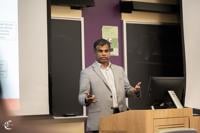
Iowa State University professor Manimaran Govindarasu gives a lecture on how cybersecurity can tackle AI-based threats to power grids in the Chambers Building in University Park, Pa., on Friday, Oct. 30, 2026.
Jonathon Chiu
Having conducted years of research into improving the cybersecurity capabilities of power grids, often with funding from several academic organizations and federal agencies such as the U.S. Department of Energy and Department of Defense, Govindarasu said in an interview there needs to be a more “adversarial” way of thinking among cybersecurity professionals to fully leverage the benefits of AI as well as other emerging technologies, such as quantum computing, to better protect from threats to energy infrastructure.
“The whole national security and economic security is centered around the security and resiliency of the grid infrastructure. If AI-based adversarial models are going to be leveraged by adversaries, could be hackers or terrorist groups, they can target our critical infrastructure,” Govindasaru said. “The first thing for a defender to understand is what adversaries can do so that we can stay ahead of the game in terms of using those same solutions for developing the most advanced security solutions.”
Nilanjan Chaudhuri, a professor in the College of Engineering whose research and interest areas include artificial intelligence and energy systems, said he shares similar views to Govindarasu on how AI is currently being used constructively as well as destructively, which can threaten the security of power grids.
He said harnessing the potential cybersecurity applications of artificial intelligence will require the cooperation of multiple disciplines and backgrounds, such as engineering and computer science.
“One of the challenges in today’s world, so far as the cybersecurity risks are concerned to our critical infrastructure, is power systems,” Chaudhuri said. “You look at the opportunities as to how you mitigate those challenges, it’s not just electrical engineering. It’s a cross-disciplinary sweet spot where you can apply your talents and you can grow and be part of the workforce in future.”
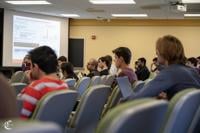
Attendees listen to Iowa State University professor Manimaran Govindarasu give a lecture on how cybersecurity can tackle AI-based threats to power grids in the Chambers Building in University Park, Pa., on Friday, Oct. 30, 2026.
Jonathon Chiu
Steve Zukley said despite being required to attend lectures such as Govindarasu’s as part of studying for his master’s degree in electrical engineering, he found the intersection of AI and cybersecurity in this talk to be of particular interest since it was something he “really hadn’t considered.”
He said since much of the U.S. power grid, including its computer systems, is several decades old there is an increasing need to find ways to keep pace with modern threats. For him, Govindarasu’s lecture highlighted how artificial intelligence could potentially be leveraged to provide up-to-date protection of the country’s energy infrastructure.
“If the power grid goes down during a blizzard or during a heat wave, people will pass away,” Zukley said. “Quantum computing is still kind of on the horizon but everyone has access to AI, the good guys and the bad guys, so I think that’s the main reason that this is such an important talk to have.”
MORE SCIENCE & TECHNOLOGY COVERAGE