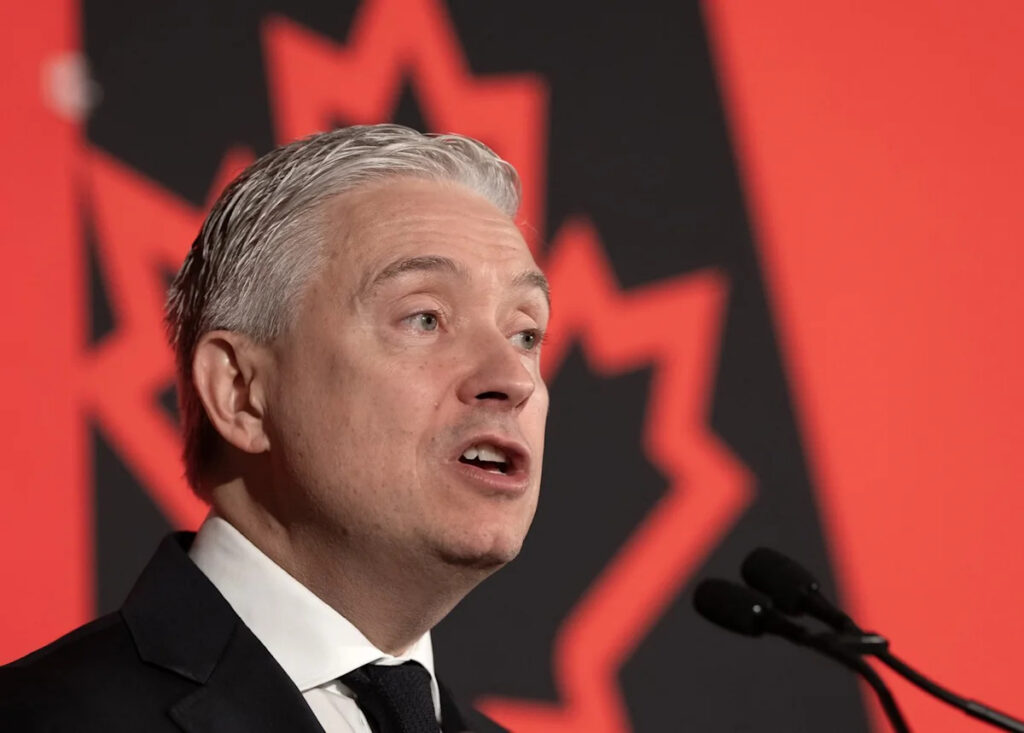
Federal Finance Minister François-Philippe Champagne speaks at a Canadian Club breakfast in Toronto on Monday, Nov. 2, 2026. THE CANADIAN PRESS/Frank Gunn – The Canadian Press
TORONTO — Thursday’s federal budget will look to make life easier for Canada’s small- and medium-sized businesses, says Finance Minister Francois-Philippe Champagne.
Champagne provided business leaders a preview of the government’s fiscal plan in a breakfast speech at the Canadian Club Toronto on Monday.
The budget — the second to be delivered under Prime Minister Mark Carney — is expected to support the Liberal government’s push to reduce Canada’s reliance on the United States by building up the domestic economy.
In a brief fireside chat after Monday’s speech, Champagne told the crowd Ottawa’s ambitions to stoke private investment and improve productivity are not limited to Canada’s largest companies.
Federal Finance Minister François-Philippe Champagne speaks at a Canadian Club breakfast in Toronto on Monday Nov. 2, 2026. THE CANADIAN PRESS/Frank Gunn
He acknowledged that one of the barriers to investment, particularly among Canada’s small businesses, is the complexity of the tax code.
“We had a number of boutique things and things which might be difficult if you’re small and medium-sized businesses, unless you have a tax adviser to figure out what’s the best way forward,” Champagne told CBC News journalist Peter Armstrong during a fireside chat after his speech.
“I think you will see in this budget a journey to fixing a number of things, to make things more simple, to simplify the life of small and medium-sized businesses. And I think that on Thursday, those who represent small businesses will see themselves in that budget.”
The Canadian Federation of Independent Business has called on Ottawa to use the Nov. 5 budget to lower the small business tax rate and fix gaps in the federal tariff relief regime that box out smaller firms.
“Small businesses tell us they don’t want handouts. They want broad policies that would help them reinvest in their businesses and plan for the future,” said Corinne Pohlmann, CFIB executive vice-president of advocacy, in a statement on Oct. 29.
“While major project investments usually get the spotlight, we also need to be building the foundation of our economy by making it more attractive to start and grow a small business.”
Champagne would not offer specific examples of what the federal government is proposing in Thursday’s budget. He did suggest Ottawa is considering more changes to the Scientific Research and Experimental Development program, which encourages firms to invest in themselves to develop innovative technologies.
One of the big-ticket measures accounted for in this upcoming budget is the productivity mega-deduction, which the government announced in September and has continued to highlight as a cornerstone of its investment policy. It’s estimated to cost $36 billion over five years.
The mega-deduction allows businesses to immediately write off the full value of an eligible capital investment in its first year, rather than over the lifetime of its use. The government argues deferring tax payments in this way will encourage firms to invest more in technology and tools that can make their workers more productive.
Champagne said the productivity mega-deduction isn’t just for large firms that want to break ground on pipelines and other nation-building projects. He said it could also help a local café buy a new coffee machine, for example.
“It’s our government’s signal to Canadians to use their capital right here in Canada, to invest in new machinery and technology, to expand their enterprises and to support a Canadian economy that nurtures and develops more workers and innovators,” he said.
The minister did not answer directly when asked whether the budget will offer further details about a planned sovereign wealth fund or a proposal to open Canada’s airports up to private investment.
The Liberal government has set an ambitious goal of attracting $1 trillion in private investment over the next five years. Since Carney took office, the federal budget framework has pivoted sharply away from day-to-day government spending and toward a capital-focused agenda that prioritizes infrastructure and other nation-building projects.
“At its core, our plan is about changing Canada’s growth model. We are building one Canadian economy, unlocking private investment, raising productivity, expanding our productive capacity, and diversifying our trade,” Champagne said in his speech.
Armstrong asked Champagne how renewed momentum in U.S. trade talks could affect Ottawa’s spending plans. The finance minister brushed off the question.
“It’s not about them,” he said. “This is about us, regaining our ability to build.”
At a Canadian Club Ottawa event on Monday evening, Champagne would not directly answer whether the budget would include information on immigration levels. He also dodged a question about whether the budget would include information on Canada’s federal ban on foreign home buyers.
“It’s something you have to look at,” he said. “We’re going to reflect carefully as to what is the best course of action.”
Champagne said Canada has the fiscal capacity and discipline to support Canadians at a time of need while also investing in the country’s future.
“We have had the discipline to reduce our expenses so that we can invest in the kind of things that are going to make a real difference in the lives of Canadians,” he told the Canadian Club of Ottawa.
Asked how high energy prices affected the upcoming budget and the Canadian economy, Champagne acknowledged the level of volatility is “quite unprecedented.” However, he also said Canada is working to build a more resilient and more independent country.
“There is no quick answer to that, because the kind of volatility you’ve seen there and the nature of war today certainly is going to make any straits, particularly the Strait of Hormuz, complex for years to come,” he said. “You need to make sure that you can develop your resources responsibly and sustainably.”
This report by The Canadian Press was first published Nov. 2, 2026.
— Written by Craig Lord in Ottawa
The Canadian Press
Federal Finance Minister François-Philippe Champagne speaks at a Canadian Club breakfast in Toronto on Monday Nov. 2, 2026. THE CANADIAN PRESS/Frank Gunn – The Canadian Press